Site içinde arama yapın
  • What Will 2026 Really Bring for Nigeria and the World? Azu Ishiekwene Predicts Power Shifts, Economic Strain, AI Disruption, 2027 Politics and Who Wins the World Cup

    Is 2026 a year of quiet recovery—or the beginning of deeper political, economic and global turbulence? And is Nigeria already slipping into the politics of 2027?

    In what he describes as possibly his final annual forecast, journalist and columnist Azu Ishiekwene delivers a sweeping, high-stakes outlook on Nigeria and the world, blending political prediction, economic analysis, technology trends and global power shifts. Known for earlier forecasts that accurately anticipated election outcomes and cabinet shake-ups, Ishiekwene argues that 2026 will be a year where politics collides head-on with harsh economic realities, leaving citizens caught between daily hardship and recycled political promises.

    He warns that Nigeria’s economy will remain under pressure, with tensions growing between tight monetary policy and rising demands for fiscal expansion in a pre-election year. Could divisions inside the Ministry of Finance undermine investor confidence? And will petrol prices remain stable around ₦850 per litre, as he suggests, only if oil output rises and NNPC escapes its heavy crude obligations?

    While cheaper fuel from the Dangote Refinery may offer temporary consumer relief, Ishiekwene predicts continued instability in electricity supply, pointing to a fragile transmission system that still requires massive investment. He also foresees President Bola Tinubu possibly unveiling private-sector-led reforms in power transmission involving major business players.

    But is Nigeria already entering the politics of 2027 in 2026?

    Ishiekwene argues that although early elections are unlikely, political realignments are accelerating. With multiple opposition governors defecting to the ruling APC, claims of a creeping one-party state are growing. Yet, he suggests the reality is more complex: a weakened opposition plagued by internal fractures, financial constraints and a lack of coherent alternatives.

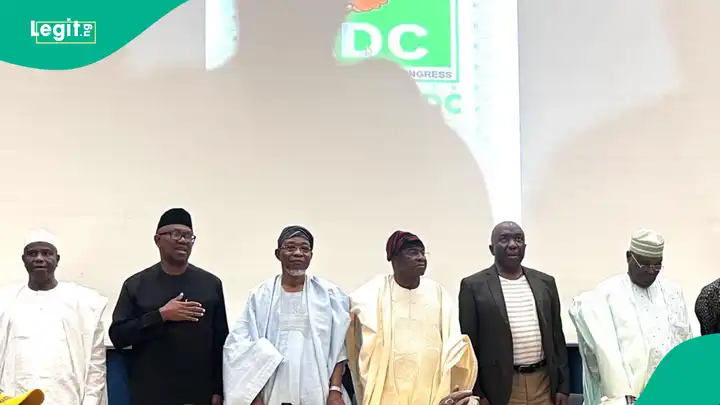
    Turning to the emerging African Democratic Congress (ADC) coalition—uniting figures such as Atiku Abubakar, Peter Obi, Nasir El-Rufai, Rotimi Amaechi and Rabiu Kwankwaso—he raises a critical question: is ADC truly built to win in 2027, or merely to survive until 2031? He predicts Atiku will clinch the party’s ticket over Obi, with Obi likely offered the vice-presidential slot—potentially triggering backlash among “Obidients.” With limited grassroots reach and the enormous financial demands of a presidential campaign, Ishiekwene concludes that ADC may struggle to pose a serious challenge to the ruling party in the next election cycle.

    Beyond Nigeria, he paints 2026 as a year shaped by geopolitical rivalry, especially between Donald Trump’s America and Xi Jinping’s China, and by growing global unease over U.S. trade policies, immigration enforcement and economic nationalism. Could gold and non-dollar assets accelerate as the world quietly prepares for a less dollar-centric future?

    He also highlights the rapid evolution of artificial intelligence, warning that 2026 will mark a shift from basic generative AI to agentic, autonomous systems capable of independent action. As AI blurs the line between reality and fabrication, he predicts rising confusion, misinformation, and ethical challenges—ushering in what he calls the “Year of the Humanoid.”

    Even football is not spared his forecasting. With the 2026 FIFA World Cup approaching, Ishiekwene tips Spain to win, citing tactical depth and cohesion, while acknowledging Morocco as Africa’s strongest hope.

    Ultimately, the essay asks uncomfortable but urgent questions:
    Is Nigeria drifting toward political dominance by one party?
    Will economic reforms truly ease citizens’ burdens—or merely reshuffle the pressure?
    Can a fractured opposition reorganise in time?
    And in a world increasingly shaped by AI and geopolitical rivalry, where does Nigeria truly stand?

    For Ishiekwene, 2026 is not just another year—it is a crossroads where technology, politics, power and survival intersect, setting the tone for Nigeria’s future well beyond the next election.

    What Will 2026 Really Bring for Nigeria and the World? Azu Ishiekwene Predicts Power Shifts, Economic Strain, AI Disruption, 2027 Politics and Who Wins the World Cup Is 2026 a year of quiet recovery—or the beginning of deeper political, economic and global turbulence? And is Nigeria already slipping into the politics of 2027? In what he describes as possibly his final annual forecast, journalist and columnist Azu Ishiekwene delivers a sweeping, high-stakes outlook on Nigeria and the world, blending political prediction, economic analysis, technology trends and global power shifts. Known for earlier forecasts that accurately anticipated election outcomes and cabinet shake-ups, Ishiekwene argues that 2026 will be a year where politics collides head-on with harsh economic realities, leaving citizens caught between daily hardship and recycled political promises. He warns that Nigeria’s economy will remain under pressure, with tensions growing between tight monetary policy and rising demands for fiscal expansion in a pre-election year. Could divisions inside the Ministry of Finance undermine investor confidence? And will petrol prices remain stable around ₦850 per litre, as he suggests, only if oil output rises and NNPC escapes its heavy crude obligations? While cheaper fuel from the Dangote Refinery may offer temporary consumer relief, Ishiekwene predicts continued instability in electricity supply, pointing to a fragile transmission system that still requires massive investment. He also foresees President Bola Tinubu possibly unveiling private-sector-led reforms in power transmission involving major business players. But is Nigeria already entering the politics of 2027 in 2026? Ishiekwene argues that although early elections are unlikely, political realignments are accelerating. With multiple opposition governors defecting to the ruling APC, claims of a creeping one-party state are growing. Yet, he suggests the reality is more complex: a weakened opposition plagued by internal fractures, financial constraints and a lack of coherent alternatives. Turning to the emerging African Democratic Congress (ADC) coalition—uniting figures such as Atiku Abubakar, Peter Obi, Nasir El-Rufai, Rotimi Amaechi and Rabiu Kwankwaso—he raises a critical question: is ADC truly built to win in 2027, or merely to survive until 2031? He predicts Atiku will clinch the party’s ticket over Obi, with Obi likely offered the vice-presidential slot—potentially triggering backlash among “Obidients.” With limited grassroots reach and the enormous financial demands of a presidential campaign, Ishiekwene concludes that ADC may struggle to pose a serious challenge to the ruling party in the next election cycle. Beyond Nigeria, he paints 2026 as a year shaped by geopolitical rivalry, especially between Donald Trump’s America and Xi Jinping’s China, and by growing global unease over U.S. trade policies, immigration enforcement and economic nationalism. Could gold and non-dollar assets accelerate as the world quietly prepares for a less dollar-centric future? He also highlights the rapid evolution of artificial intelligence, warning that 2026 will mark a shift from basic generative AI to agentic, autonomous systems capable of independent action. As AI blurs the line between reality and fabrication, he predicts rising confusion, misinformation, and ethical challenges—ushering in what he calls the “Year of the Humanoid.” Even football is not spared his forecasting. With the 2026 FIFA World Cup approaching, Ishiekwene tips Spain to win, citing tactical depth and cohesion, while acknowledging Morocco as Africa’s strongest hope. Ultimately, the essay asks uncomfortable but urgent questions: Is Nigeria drifting toward political dominance by one party? Will economic reforms truly ease citizens’ burdens—or merely reshuffle the pressure? Can a fractured opposition reorganise in time? And in a world increasingly shaped by AI and geopolitical rivalry, where does Nigeria truly stand? For Ishiekwene, 2026 is not just another year—it is a crossroads where technology, politics, power and survival intersect, setting the tone for Nigeria’s future well beyond the next election.
    love
    1
    · 0 Yorumlar ·0 hisse senetleri ·5K Views
  • ADC Presidential Ticket: No one is stepping down- Atiku

    Amid the call by Obidients that presidential aspirants in the African Democratic Congress (ADC) should step down for Peter Obi, the former Vice President, Atiku Abubakar, has dismissed the notion, saying no aspirant will withdraw for another in the coalition.

    Atiku’s position was made known in a statement issued by his media aide, Paul Ibe, on Tuesday, January 6. Ibe issued the statement following recent comments by Obi’s allies, including Prof Pat Utomi and Aisha Yesufu, who have rejected the idea of Obi emerging as a Vice Presidential candidate in the coalition.

    Rejecting any suggestion that he should step aside, Atiku described such calls as dangerous to Nigeria’s democracy.

    “Any call — overt or covert — for Atiku to ‘step aside’ is a gift to authoritarian ambition and a betrayal of the Nigerian people,” the statement said.

    The former vice president also accused the Bola Tinubu-led administration of shrinking democratic space and deliberately weakening opposition parties in a bid to impose what he described as a “creeping, de facto one-party state.”

    “For nearly three years, Nigerians have endured one of the harshest periods in recent history — an era defined by punishing economic policies and shrinking democratic space,” the statement read, adding that the ruling All Progressives Congress (APC) had sought to eliminate political alternatives through systematic pressure on opposition forces.
    ADC Presidential Ticket: No one is stepping down- Atiku Amid the call by Obidients that presidential aspirants in the African Democratic Congress (ADC) should step down for Peter Obi, the former Vice President, Atiku Abubakar, has dismissed the notion, saying no aspirant will withdraw for another in the coalition. Atiku’s position was made known in a statement issued by his media aide, Paul Ibe, on Tuesday, January 6. Ibe issued the statement following recent comments by Obi’s allies, including Prof Pat Utomi and Aisha Yesufu, who have rejected the idea of Obi emerging as a Vice Presidential candidate in the coalition. Rejecting any suggestion that he should step aside, Atiku described such calls as dangerous to Nigeria’s democracy. “Any call — overt or covert — for Atiku to ‘step aside’ is a gift to authoritarian ambition and a betrayal of the Nigerian people,” the statement said. The former vice president also accused the Bola Tinubu-led administration of shrinking democratic space and deliberately weakening opposition parties in a bid to impose what he described as a “creeping, de facto one-party state.” “For nearly three years, Nigerians have endured one of the harshest periods in recent history — an era defined by punishing economic policies and shrinking democratic space,” the statement read, adding that the ruling All Progressives Congress (APC) had sought to eliminate political alternatives through systematic pressure on opposition forces.
    0 Yorumlar ·0 hisse senetleri ·2K Views
  • How will ADC and Atiku manage Obidients?

    Handling them is somehow bigger than handling Nigeria issues.
    How will ADC and Atiku manage Obidients? Handling them is somehow bigger than handling Nigeria issues.
    0 Yorumlar ·0 hisse senetleri ·485 Views
  • 2027 Election: Five Major Advantages of Peter Obi’s Defection From Labour Party to ADC as Opposition Coalition Gathers Momentum

    Peter Obi, the Labour Party’s presidential candidate in the 2023 election, has officially defected to the African Democratic Congress (ADC) ahead of the 2027 general election, a move widely seen as a major boost for the opposition coalition challenging the ruling APC. Obi announced his decision on December 31, 2025, at a political rally held at the Nike Lake Resort in Enugu State, alongside many of his loyal supporters popularly known as “Obidients.”

    Analysts say Obi’s entry into the ADC offers several advantages. First, it strengthens the emerging national coalition against the APC by uniting two of the strongest opposition figures from the 2023 polls under one platform. Second, the move expands Obi’s political reach beyond the Labour Party’s base, especially into northern Nigeria where the ADC is gaining traction, while consolidating support in the Southeast.

    Third, Obi’s defection helps present a unified opposition front, as the ADC has been adopted as the coalition platform for major opposition leaders ahead of 2027. Fourth, the decision is viewed as a sign of political maturity and flexibility, preserving the momentum Obi built among young voters while positioning him strategically within a broader alliance.

    Finally, Obi’s move strengthens his bargaining power within the coalition, opening the door for negotiations around power-sharing arrangements, including the possibility of a vice-presidential slot on a joint ticket. Overall, the defection marks a significant realignment in Nigeria’s political landscape as opposition forces intensify preparations for the 2027 election.

    :
    #2027Election #PeterObi #ADC #NigerianPolitics #OppositionCoalition #LabourParty #AtikuAbubakar #Enugu
    2027 Election: Five Major Advantages of Peter Obi’s Defection From Labour Party to ADC as Opposition Coalition Gathers Momentum Peter Obi, the Labour Party’s presidential candidate in the 2023 election, has officially defected to the African Democratic Congress (ADC) ahead of the 2027 general election, a move widely seen as a major boost for the opposition coalition challenging the ruling APC. Obi announced his decision on December 31, 2025, at a political rally held at the Nike Lake Resort in Enugu State, alongside many of his loyal supporters popularly known as “Obidients.” Analysts say Obi’s entry into the ADC offers several advantages. First, it strengthens the emerging national coalition against the APC by uniting two of the strongest opposition figures from the 2023 polls under one platform. Second, the move expands Obi’s political reach beyond the Labour Party’s base, especially into northern Nigeria where the ADC is gaining traction, while consolidating support in the Southeast. Third, Obi’s defection helps present a unified opposition front, as the ADC has been adopted as the coalition platform for major opposition leaders ahead of 2027. Fourth, the decision is viewed as a sign of political maturity and flexibility, preserving the momentum Obi built among young voters while positioning him strategically within a broader alliance. Finally, Obi’s move strengthens his bargaining power within the coalition, opening the door for negotiations around power-sharing arrangements, including the possibility of a vice-presidential slot on a joint ticket. Overall, the defection marks a significant realignment in Nigeria’s political landscape as opposition forces intensify preparations for the 2027 election. : #2027Election #PeterObi #ADC #NigerianPolitics #OppositionCoalition #LabourParty #AtikuAbubakar #Enugu
    0 Yorumlar ·0 hisse senetleri ·3K Views
  • S𝐞𝐲𝐢 𝐓𝐢𝐧𝐮𝐛𝐮 𝐜𝐚𝐧 𝐜𝐡𝐚𝐥𝐥𝐞𝐧𝐠𝐞 𝐡𝐢𝐬 𝐟𝐚𝐭𝐡𝐞𝐫 𝐟𝐨𝐫 𝐩𝐫𝐞𝐬𝐢𝐝𝐞𝐧𝐭 – 𝐁𝐰𝐚𝐥𝐚

    Bwala: Seyi Tinubu Qualified To Contest Lagos Governorship

    The Special Adviser to President Bola Tinubu on Policy Communication, Daniel Bwala, has said that the president’s son, Seyi Tinubu, is constitutionally qualified to contest for any political office in Nigeria, including the governorship of Lagos State.

    Speaking on The Clarity Zone podcast posted on YouTube on Wednesday, Bwala dismissed criticisms suggesting Seyi’s political relevance is tied solely to his father’s influence. He described him instead as a bridge-builder among Nigerian youth.

    “If Seyi Tinubu’s father is the president, what stops him from running for Lagos State governor? Seyi Tinubu can even challenge his father in the next election,” Bwala said.

    He praised Seyi’s character, describing him as humble and unassuming despite his privileged background as the son of a former Lagos governor and now president of Nigeria.

    According to him, Seyi has cultivated long-standing friendships, supported young people in securing government opportunities, and even attracted criticism for bringing in individuals across party lines, including Obidients.

    Bwala further noted that Seyi has maintained maturity by avoiding scandals or social media attacks, even though his father is one of the most heavily criticised Nigerian leaders in recent memory.

    The presidential aide also revealed that his own criticisms of the Tinubu administration have never affected his relationship with Seyi, describing him as someone capable of separating politics from personal relationships.

    He urged Nigerians to judge Seyi Tinubu based on personal experience rather than inherited opinions.

    “Until you experience somebody, don’t have an opinion of them. Too many people inherit other people’s problems without any personal encounter,” Bwala added.
    S𝐞𝐲𝐢 𝐓𝐢𝐧𝐮𝐛𝐮 𝐜𝐚𝐧 𝐜𝐡𝐚𝐥𝐥𝐞𝐧𝐠𝐞 𝐡𝐢𝐬 𝐟𝐚𝐭𝐡𝐞𝐫 𝐟𝐨𝐫 𝐩𝐫𝐞𝐬𝐢𝐝𝐞𝐧𝐭 – 𝐁𝐰𝐚𝐥𝐚 Bwala: Seyi Tinubu Qualified To Contest Lagos Governorship The Special Adviser to President Bola Tinubu on Policy Communication, Daniel Bwala, has said that the president’s son, Seyi Tinubu, is constitutionally qualified to contest for any political office in Nigeria, including the governorship of Lagos State. Speaking on The Clarity Zone podcast posted on YouTube on Wednesday, Bwala dismissed criticisms suggesting Seyi’s political relevance is tied solely to his father’s influence. He described him instead as a bridge-builder among Nigerian youth. “If Seyi Tinubu’s father is the president, what stops him from running for Lagos State governor? Seyi Tinubu can even challenge his father in the next election,” Bwala said. He praised Seyi’s character, describing him as humble and unassuming despite his privileged background as the son of a former Lagos governor and now president of Nigeria. According to him, Seyi has cultivated long-standing friendships, supported young people in securing government opportunities, and even attracted criticism for bringing in individuals across party lines, including Obidients. Bwala further noted that Seyi has maintained maturity by avoiding scandals or social media attacks, even though his father is one of the most heavily criticised Nigerian leaders in recent memory. The presidential aide also revealed that his own criticisms of the Tinubu administration have never affected his relationship with Seyi, describing him as someone capable of separating politics from personal relationships. He urged Nigerians to judge Seyi Tinubu based on personal experience rather than inherited opinions. “Until you experience somebody, don’t have an opinion of them. Too many people inherit other people’s problems without any personal encounter,” Bwala added.
    0 Yorumlar ·0 hisse senetleri ·1K Views
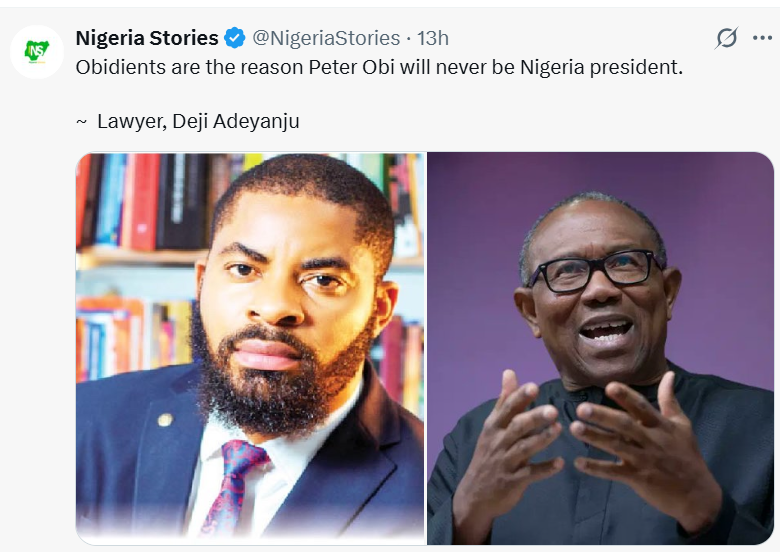
  • Obidients are the reason Peter Obi will never be Nigeria president.

    ~ Lawyer, Deji Adeyanju
    Obidients are the reason Peter Obi will never be Nigeria president. ~ Lawyer, Deji Adeyanju
    0 Yorumlar ·0 hisse senetleri ·616 Views
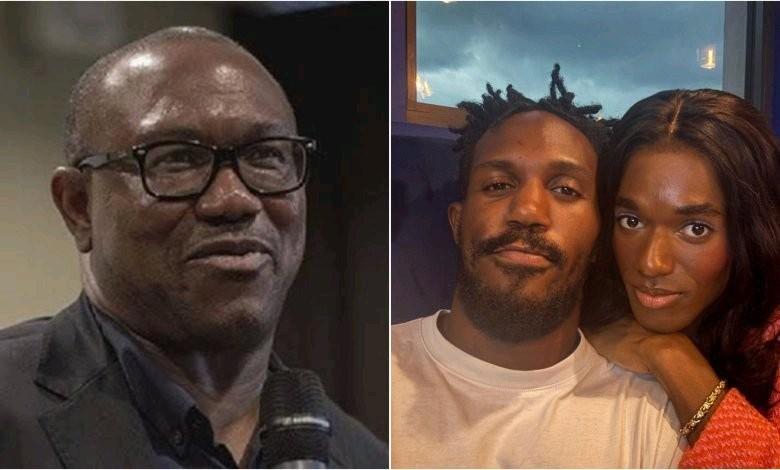
  • Obi Opens Up as Alleged Photos of His Son with Gay Partner Go Viral.

    Former presidential candidate Peter Obi has dismissed trending photos circulating online that allegedly depict his son, Oseloka Obi, with a gay partner.

    The images, which trended on social media, depicted a man celebrating with another man believed to be his partner on the partner’s birthday.

    A northern influencer on X, with the handle @Waspapping_, shared the photos with the caption:

    “Peter Obi’s son and his partner are out there enjoying life, but Obidients will turn a blind eye. Well, congratulations to the soon-to-be couple.”

    The post and many others have gained traction on social media.

    Reacting to the controversy, Obi’s media aide, Valentine Obienyem, in a statement debunked the claims, stressing that the photos do not feature Obi’s son.

    The statement, titled “Fake Picture, False Claim: Obi’s Integrity Remains Untouched,” read:

    “The picture currently being circulated is not that of Mr. Peter Obi’s son. Having searched every corner of his life and found nothing incriminating, mischief-makers resorted to posting this false image, claiming it to be his son. Let it be clear: this is not his son. They should look elsewhere for the scandal they have fruitlessly hunted for years.”
    Obi Opens Up as Alleged Photos of His Son with Gay Partner Go Viral. Former presidential candidate Peter Obi has dismissed trending photos circulating online that allegedly depict his son, Oseloka Obi, with a gay partner. The images, which trended on social media, depicted a man celebrating with another man believed to be his partner on the partner’s birthday. A northern influencer on X, with the handle @Waspapping_, shared the photos with the caption: “Peter Obi’s son and his partner are out there enjoying life, but Obidients will turn a blind eye. Well, congratulations to the soon-to-be couple.” The post and many others have gained traction on social media. Reacting to the controversy, Obi’s media aide, Valentine Obienyem, in a statement debunked the claims, stressing that the photos do not feature Obi’s son. The statement, titled “Fake Picture, False Claim: Obi’s Integrity Remains Untouched,” read: “The picture currently being circulated is not that of Mr. Peter Obi’s son. Having searched every corner of his life and found nothing incriminating, mischief-makers resorted to posting this false image, claiming it to be his son. Let it be clear: this is not his son. They should look elsewhere for the scandal they have fruitlessly hunted for years.”
    0 Yorumlar ·0 hisse senetleri ·555 Views
  • News Brief: APC Will Continue Defeating Opposition, Obidients with Digital Strategy — Tinubu’s Aide.

    Olusegun Dada, Special Adviser to President Bola Tinubu on New Media, has asserted that the All Progressives Congress (APC) will continue to defeat opposition groups, including members of the Obidient movement, through strategic digital media campaigns.

    Speaking on Channels Television’s The Morning Brief on Monday, Dada credited the APC’s success in the 2023 presidential election to its focused digital strategy. “We elected a president that people said was unelectable,” he said. “We have beaten them [Obidients] three times, and we will continue to beat them.”

    He claimed that opposition supporters often avoid criticism and target those who challenge them, while the APC listens to feedback to inform governance. “Our strategy has been to clarify, not be distracted by noise,” Dada said, adding that he has participated in over 40 governorship races across Nigeria, most of which APC won.

    Dada dismissed the opposition’s tactics as aggressive and repetitive, insisting the ruling party remains focused on promoting its candidates and policies through data-backed narratives and digital communication.

    #APC #TinubuAide #DigitalStrategy #Obidients #2023Elections #OlusegunDada #NewMedia
    News Brief: APC Will Continue Defeating Opposition, Obidients with Digital Strategy — Tinubu’s Aide. Olusegun Dada, Special Adviser to President Bola Tinubu on New Media, has asserted that the All Progressives Congress (APC) will continue to defeat opposition groups, including members of the Obidient movement, through strategic digital media campaigns. Speaking on Channels Television’s The Morning Brief on Monday, Dada credited the APC’s success in the 2023 presidential election to its focused digital strategy. “We elected a president that people said was unelectable,” he said. “We have beaten them [Obidients] three times, and we will continue to beat them.” He claimed that opposition supporters often avoid criticism and target those who challenge them, while the APC listens to feedback to inform governance. “Our strategy has been to clarify, not be distracted by noise,” Dada said, adding that he has participated in over 40 governorship races across Nigeria, most of which APC won. Dada dismissed the opposition’s tactics as aggressive and repetitive, insisting the ruling party remains focused on promoting its candidates and policies through data-backed narratives and digital communication. #APC #TinubuAide #DigitalStrategy #Obidients #2023Elections #OlusegunDada #NewMedia
    0 Yorumlar ·0 hisse senetleri ·3K Views
Fintter https://fintter.com