The Night Oloolu Walked Among Men
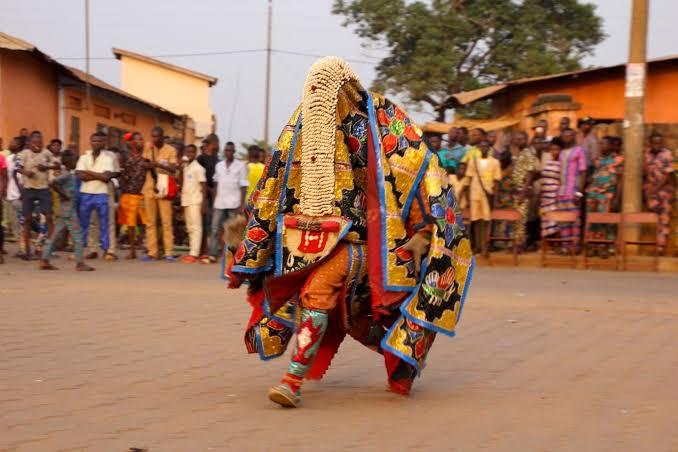
Oloolu
Long before the noise of modern cities, before streetlights replaced moonlight, and before people forgot how deeply the living were tied to the dead, there lived a presence in Ibadan that no one dared to ignore. His name was Oloolu.
To outsiders, he was just a masquerade. A figure covered in layers of cloth, beads, charms, and mystery. But to the people who knew, to those who had grown up hearing the whispers and warnings, Oloolu was not just a masquerade. He was an ancestor. A force. A living embodiment of judgment and power.
And above all, he was feared.
It was said that Oloolu was not born like ordinary masquerades. His origin was wrapped in stories told only at night, when the wind moved slowly and elders spoke in low voices. They said he came from a powerful lineage of warriors, a spirit tied to justice, one that refused to tolerate disrespect, disobedience, or moral decay.
In those days, the masquerade tradition was not entertainment. It was sacred. The Egungun represented the spirits of the ancestors returning to the world of the living, watching, correcting, protecting, and sometimes punishing.
Oloolu was among the strongest of them.
Every year, when the time came, the city would prepare. Not with excitement alone, but with caution. Markets would close early. Mothers would warn their children. Even the bravest young men would speak in softer tones.
Because when Oloolu appeared, it was not a performance.
It was an encounter.
No one could predict his movements. No one could control him. He moved through the streets with authority that felt ancient. His attendants followed him, trying to guide the path, but even they knew that Oloolu was not something you could command.
He chose where to go.
He chose who to face.
And sometimes, he chose who to punish.
This was where the stories of cruelty began.
There were tales of people who crossed his path carelessly. A young man who mocked the tradition, laughing loudly as Oloolu approached. They said he did not laugh for long. By the time Oloolu was done, the boy had learned a lesson he would never forget.
Another story spoke of a trader who refused to respect the sacred rules. She stood her ground, stubborn and proud. But when Oloolu came near, something changed. The atmosphere grew heavy. The air itself felt like it was watching.
She ran.
But not fast enough.
People said Oloolu did not chase like a man. He moved like something beyond flesh, something driven by purpose, not emotion. And when he caught up, it was not anger that people saw. It was judgment.
This is why many called him cruel.
But those who understood the deeper meaning would shake their heads.
Cruel?
No. Strict.
Unforgiving.
Ancient.
Oloolu did not harm without reason. At least, that is what the elders said. His actions were seen as correction, a reminder that the living must never forget the laws of the ancestors.
Still, fear does not always listen to wisdom.
Fear grows in stories.
Fear grows in memory.
Fear grows in the unknown.
And Oloolu carried all three.
There was something about his presence that unsettled even the strongest hearts. It was not just the way he moved, or the suddenness of his actions. It was the feeling that came with him.
A silence.
A weight.
A knowing.
As if the boundary between the living and the dead had been torn open, even if only for a moment.
Children would hide behind their mothers, peeking through wrappers with wide eyes. Some would cry. Others would freeze, unable to move, as Oloolu passed by.
Men who claimed bravery would step aside quietly, pretending they had somewhere else to be.
Because deep down, everyone knew.
This was not something to test.
There were also stories of protection. Stories that were not told as loudly as the ones about fear, but were just as important.
They spoke of how Oloolu guarded the land. How his presence drove away negative forces. How communities that respected him experienced peace and order.
In times of conflict, his appearance was believed to restore balance. In moments of chaos, he brought control.
But humans remember pain more than protection.
And so, the stories of cruelty spread faster.
Some said Oloolu’s power came from deep spiritual preparation. The person inside the masquerade was no longer just a human once the costume was worn. Rituals were performed. Words were spoken. Spirits were invoked.
At that point, the man disappeared.
Only Oloolu remained.
This belief made people even more cautious. Because if Oloolu was truly an ancestor, then his actions were not guided by human emotions. No mercy. No hesitation.
Only purpose.
There was a particular night that remained in the memory of many, a night that would be spoken about for years.
It was during one of the festivals, when the crowd was larger than usual. Music filled the air. Drums spoke in rhythms that felt alive. People gathered to witness what they both feared and respected.
Oloolu appeared suddenly.
Not from the center of the crowd, but from the edge, like a shadow stepping into light.
At first, everything seemed normal. He moved with power, his costume flowing like waves, his presence commanding attention. The attendants shouted warnings, telling people to keep their distance.
But then something changed.
A group of young men, filled with boldness and laughter, decided to challenge what they did not understand. They moved closer, ignoring the warnings. One of them even reached out, as if to test whether Oloolu was real.
That moment changed everything.
The drums stopped.
Not slowly.
Instantly.
The air grew thick.
And Oloolu turned.
What happened next became a story that parents would tell their children as a warning. Not out of cruelty, but out of respect for something greater.
Oloolu moved with speed that shocked everyone. The young men scattered, but fear had already taken over their legs. One fell. Another froze.
And Oloolu did what Oloolu does.
He corrected.
He reminded.
He enforced.
When it was over, there was silence.
Not the silence of fear alone, but the silence of understanding.
From that day, fewer people questioned.
Fewer people tested.
Because the line had been made clear.
Respect is not optional.
It is necessary.
Even today, in a world that has changed so much, where traditions struggle to survive in the face of modern life, the name Oloolu still carries weight.
You will hear it in conversations.
In warnings.
In stories told late at night.
Some will still call him cruel.
Others will call him powerful.
But those who truly understand will say something different.
They will say Oloolu is a reminder.
A reminder that there are forces older than us.
That not everything is meant to be questioned.
That some traditions carry truths we may never fully understand.
And that sometimes, fear is not the enemy.
Sometimes, fear is the lesson.
Because in the end, Oloolu is not just a masquerade walking through the streets.
He is history.
He is judgment.
He is the voice of ancestors echoing through time.
And when he walks, the world remembers.

الأقسام
إقرأ المزيد
Introduction The history of Zambia is a powerful story of migration, trade, colonial struggle, and national independence. Located in Southern Africa and named after the Zambezi River, Zambia is a landlocked country rich in natural resources and cultural diversity. Though modern Zambia gained independence in 1964, its history stretches back thousands of years through ancient communities,...
Dr Julius Mubiru Dr Julius Mubiru’s story is the kind that begins in a hospital ward, not in a boardroom. It begins where fear often arrives before treatment does. In many hospitals across Uganda and much of Africa, one of the most ordinary procedures in medicine can become one of the most stressful: finding a vein. For many adults, a blood draw or intravenous line is unpleasant...

Robben Island Far out in the cold waters of Table Bay, just a few kilometers from the city of Cape Town, lies a small rocky island that once held the dreams of a nation behind iron bars. This island is Robben Island, a place whose prison walls witnessed some of the most powerful scenes in the history of the struggle for freedom in South Africa. Today the island is quiet....
Kenneth Okolie Kenneth Okolie is a Nigerian actor, model, and former beauty pageant titleholder best known for winning Mr Nigeria and later building a successful career in Nollywood. With his tall frame, charming personality, and confident delivery, he has become one of the notable male faces in contemporary Nigerian cinema. Early Life and Background Kenneth Okolie was born on...

Barcelona coach Hansi Flick believes Lamine Yamal will be even more motivated after narrowly missing out on the Ballon d’Or to former teammate Ousmane Dembélé. The 18-year-old winger finished second in the 2025 Ballon d’Or voting behind Paris Saint-Germain's Dembélé at the prestigious awards ceremony in Paris on Monday. However, Yamal was honored with...