Site içinde arama yapın
  • “Strip Yourself Naked and Pray by Midnight” — Raye Sparks Debate on X Over Controversial Faith Advice

    Internet personality Raye has ignited widespread debate on X after sharing a controversial opinion on prayer and spirituality.

    In a post that quickly drew attention, Raye advised people to strip themselves naked and pray by midnight, claiming that with enough faith, there is nothing one could ask for that heaven would ignore.

    The statement triggered mixed reactions online, with many users questioning the approach and criticizing the message, while others defended her right to express her personal spiritual beliefs.

    Amid the backlash, Raye issued a follow-up post clarifying that no one is obligated to pray or believe the way she does. She noted that religion can sound “crazy” rather than logical when broken down and over-analysed.

    According to her, faith should not always be approached from a purely logical standpoint, adding that people should simply practice what works for them spiritually and move on if they disagree.
    “Strip Yourself Naked and Pray by Midnight” — Raye Sparks Debate on X Over Controversial Faith Advice Internet personality Raye has ignited widespread debate on X after sharing a controversial opinion on prayer and spirituality. In a post that quickly drew attention, Raye advised people to strip themselves naked and pray by midnight, claiming that with enough faith, there is nothing one could ask for that heaven would ignore. The statement triggered mixed reactions online, with many users questioning the approach and criticizing the message, while others defended her right to express her personal spiritual beliefs. Amid the backlash, Raye issued a follow-up post clarifying that no one is obligated to pray or believe the way she does. She noted that religion can sound “crazy” rather than logical when broken down and over-analysed. According to her, faith should not always be approached from a purely logical standpoint, adding that people should simply practice what works for them spiritually and move on if they disagree.

    love
    1
    · 0 Yorumlar ·0 hisse senetleri ·1K Views
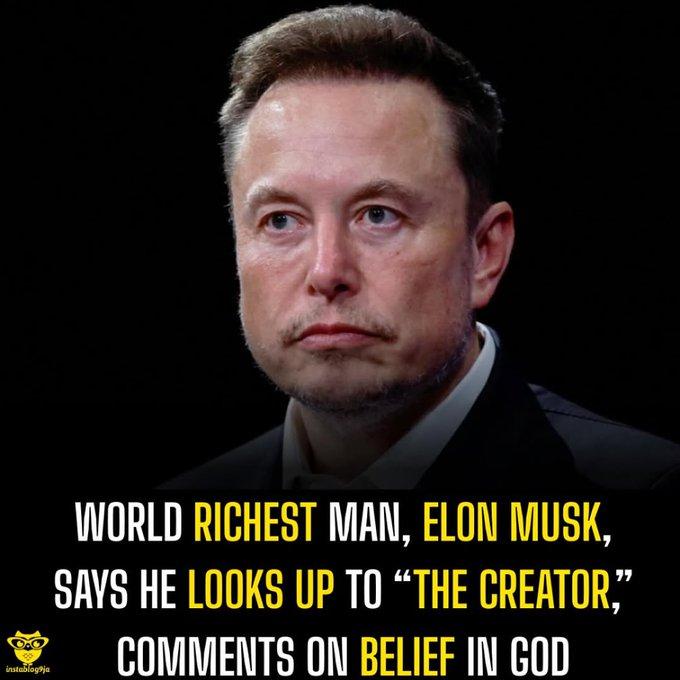
  • World richest man, Elon Musk, Says He Looks Up To “The Creator,” Comments On Belief In God

    Elon Musk, the billionaire entrepreneur and CEO of Tesla and SpaceX, recently opened up about his views on faith and spirituality during an interview with Katie Miller. When asked “Who do you look up to the most,” Musk answered: “The Creator.”

    He was further asked if he believed in God, to which he replied: “Well i believe this universe came from something,” adding that “people have different labels.” His response reflects a philosophical perspective, acknowledging a creative force behind the universe while avoiding alignment with any specific religious doctrine.

    Musk has previously described himself as a “cultural Christian,” noting he was baptized and raised Anglican. However, he has often emphasized curiosity over traditional religious beliefs, stating that his guiding principle is exploration and expanding human consciousness. He has also highlighted the importance of moral teachings from religion, such as wisdom in compassion and restraint, without fully committing to organized faith.

    In this interview, Musk’s choice of words underscores his view that the origin of the universe is a mystery open to interpretation. By referring to “the Creator” instead of “God,” and noting that “people have different labels,” he signals openness to different philosophical or spiritual understandings rather than strictly religious ones. Musk’s remarks continue to fuel discussions on the intersection of science, technology, and spirituality, highlighting how leading figures grapple with questions about existence, purpose, and belief in the modern era.
    More at fintter.com
    #fintter
    World richest man, Elon Musk, Says He Looks Up To “The Creator,” Comments On Belief In God Elon Musk, the billionaire entrepreneur and CEO of Tesla and SpaceX, recently opened up about his views on faith and spirituality during an interview with Katie Miller. When asked “Who do you look up to the most,” Musk answered: “The Creator.” He was further asked if he believed in God, to which he replied: “Well i believe this universe came from something,” adding that “people have different labels.” His response reflects a philosophical perspective, acknowledging a creative force behind the universe while avoiding alignment with any specific religious doctrine. Musk has previously described himself as a “cultural Christian,” noting he was baptized and raised Anglican. However, he has often emphasized curiosity over traditional religious beliefs, stating that his guiding principle is exploration and expanding human consciousness. He has also highlighted the importance of moral teachings from religion, such as wisdom in compassion and restraint, without fully committing to organized faith. In this interview, Musk’s choice of words underscores his view that the origin of the universe is a mystery open to interpretation. By referring to “the Creator” instead of “God,” and noting that “people have different labels,” he signals openness to different philosophical or spiritual understandings rather than strictly religious ones. Musk’s remarks continue to fuel discussions on the intersection of science, technology, and spirituality, highlighting how leading figures grapple with questions about existence, purpose, and belief in the modern era. More at fintter.com #fintter
    0 Yorumlar ·0 hisse senetleri ·2K Views
  • Dunsin Oyekan Reacts as Nigerians’ Spotify Wrapped 2025 Mixes Gospel and Secular Music

    Spotify Wrapped 2025 has sparked major conversations in Nigeria as many users shared surprising combinations of gospel and secular music in their yearly listening recap. While some listeners stayed loyal to their favourite artistes, others posted unexpected blends featuring gospel stars like Dunsin Oyekan, Nathaniel Bassey, and Moses Bliss alongside secular acts such as Odumodu Blvck, Olamide, and Wizkid.
    The mix caught the attention of gospel singer Dunsin Oyekan, who reacted with an eye emoji, suggesting surprise at the unusual pairings. His reaction stirred debates online, with some Nigerians expressing embarrassment over their mixed playlists, while others argued that music taste can be diverse. The trend also reignited discussions on spirituality, entertainment, and listening habits among young Christians.
    Dunsin Oyekan Reacts as Nigerians’ Spotify Wrapped 2025 Mixes Gospel and Secular Music Spotify Wrapped 2025 has sparked major conversations in Nigeria as many users shared surprising combinations of gospel and secular music in their yearly listening recap. While some listeners stayed loyal to their favourite artistes, others posted unexpected blends featuring gospel stars like Dunsin Oyekan, Nathaniel Bassey, and Moses Bliss alongside secular acts such as Odumodu Blvck, Olamide, and Wizkid. The mix caught the attention of gospel singer Dunsin Oyekan, who reacted with an eye emoji, suggesting surprise at the unusual pairings. His reaction stirred debates online, with some Nigerians expressing embarrassment over their mixed playlists, while others argued that music taste can be diverse. The trend also reignited discussions on spirituality, entertainment, and listening habits among young Christians.
    like
    1
    · 0 Yorumlar ·0 hisse senetleri ·2K Views
  • Bovi Sparks Reactions as he declares Monogamy a social construct.

    During a recent episode of Mentality, Nigerian entertainer Bovi, TV host Ebuka, and singer Banky W engaged in a candid discussion on the evolving concept of monogamy in contemporary society.

    Bovi sparked the conversation by suggesting that “monogamy is a social construct,” hinting at the shifting dynamics of relationships in modern times. Ebuka then posed a provocative question, asking whether monogamy could become extinct in the next decade, referencing perceptions that many Lagos women engage in extramarital affairs and the increasing normalization of polyamory.

    Banky W, however, took a measured stance, pushing back against sweeping generalizations. “I think I push back when we make generalistic statements… Lagos women are like this, Nigerian men are like that.

    You’re casting a blanket of assumption on everybody,” he said. He emphasized the potential harm of such stereotypes, particularly for shaping the expectations of younger generations.

    Speaking from his personal experience, Banky W highlighted the role of spirituality in maintaining a committed relationship. “I don’t believe that monogamy is impossible, but my experience is that it is possible with God. When there’s God in the picture, you answer to a higher authority, and that helps you say there are some lines I’m not going to cross,” he noted.

    The episode provided a nuanced perspective on monogamy, challenging assumptions while also addressing the influence of faith and personal values in sustaining committed relationships.
    Bovi Sparks Reactions as he declares Monogamy a social construct. During a recent episode of Mentality, Nigerian entertainer Bovi, TV host Ebuka, and singer Banky W engaged in a candid discussion on the evolving concept of monogamy in contemporary society. Bovi sparked the conversation by suggesting that “monogamy is a social construct,” hinting at the shifting dynamics of relationships in modern times. Ebuka then posed a provocative question, asking whether monogamy could become extinct in the next decade, referencing perceptions that many Lagos women engage in extramarital affairs and the increasing normalization of polyamory. Banky W, however, took a measured stance, pushing back against sweeping generalizations. “I think I push back when we make generalistic statements… Lagos women are like this, Nigerian men are like that. You’re casting a blanket of assumption on everybody,” he said. He emphasized the potential harm of such stereotypes, particularly for shaping the expectations of younger generations. Speaking from his personal experience, Banky W highlighted the role of spirituality in maintaining a committed relationship. “I don’t believe that monogamy is impossible, but my experience is that it is possible with God. When there’s God in the picture, you answer to a higher authority, and that helps you say there are some lines I’m not going to cross,” he noted. The episode provided a nuanced perspective on monogamy, challenging assumptions while also addressing the influence of faith and personal values in sustaining committed relationships.
    0 Yorumlar ·0 hisse senetleri ·1K Views
  • Bigger Than Africa: The Yoruba Story That Conquered Continents and Captivated Netflix Audiences

    The Yoruba people — one of Africa’s most influential tribes with over 40 million members worldwide — take center stage in the breathtaking documentary Bigger Than Africa, directed by Toyin Ibrahim Adekeye.

    Premiered on February 12, 2018, this cinematic masterpiece takes viewers across six countries — Nigeria, the Republic of Benin, Brazil, Trinidad & Tobago, Cuba, and the United States — to explore the global influence, spirituality, and resilience of Yoruba culture.

    A Story That Transcends Borders
    Bigger Than Africa focuses not on what divides Africans, but on what unites them. Through powerful storytelling and insightful interviews, it reveals how Yoruba traditions survived slavery, crossed oceans, and became embedded in cultures across the Americas.

    The documentary features some of Africa’s most respected figures — former President Olusegun Obasanjo, Nobel Laureate Prof. Wole Soyinka, the King of Port Novo, and Fame Elebuibon, among others.

    Global Recognition and Awards
    Produced by Motherland Productions, the documentary has earned several international accolades, including:

    Best Documentary, International Houston Black Film Festival (2019)

    Best Documentary, Charlotte Black Film Festival

    Jury Special Award, Festival International du Film Panafricain de Cannes


    It has also been screened at prestigious venues such as the Schomburg Center for Research on Black Culture and even at the United Nations.

    The Inspiration Behind the Masterpiece
    Toyin Ibrahim Adekeye’s inspiration came during a visit to Oyotunji African Village in South Carolina — a Yoruba cultural haven in the U.S. What began as a short school project soon evolved into a global film celebrating African heritage.

    Raised in Kwara State, Nigeria, Toyin moved to the U.S. in 2001, later enrolling at the Los Angeles Film School to pursue his passion for filmmaking. His journey, fueled by creativity and cultural pride, birthed Bigger Than Africa — a documentary that redefines how the world sees Yoruba culture.

    Now Streaming on Netflix
    Since May 13, Bigger Than Africa has been available for global streaming on Netflix, distributed by KAP Film and EGMNY (New York). This gives millions worldwide a chance to experience the beauty, depth, and unity of Yoruba heritage.
    Bigger Than Africa: The Yoruba Story That Conquered Continents and Captivated Netflix Audiences The Yoruba people — one of Africa’s most influential tribes with over 40 million members worldwide — take center stage in the breathtaking documentary Bigger Than Africa, directed by Toyin Ibrahim Adekeye. Premiered on February 12, 2018, this cinematic masterpiece takes viewers across six countries — Nigeria, the Republic of Benin, Brazil, Trinidad & Tobago, Cuba, and the United States — to explore the global influence, spirituality, and resilience of Yoruba culture. A Story That Transcends Borders Bigger Than Africa focuses not on what divides Africans, but on what unites them. Through powerful storytelling and insightful interviews, it reveals how Yoruba traditions survived slavery, crossed oceans, and became embedded in cultures across the Americas. The documentary features some of Africa’s most respected figures — former President Olusegun Obasanjo, Nobel Laureate Prof. Wole Soyinka, the King of Port Novo, and Fame Elebuibon, among others. Global Recognition and Awards Produced by Motherland Productions, the documentary has earned several international accolades, including: Best Documentary, International Houston Black Film Festival (2019) Best Documentary, Charlotte Black Film Festival Jury Special Award, Festival International du Film Panafricain de Cannes It has also been screened at prestigious venues such as the Schomburg Center for Research on Black Culture and even at the United Nations. The Inspiration Behind the Masterpiece Toyin Ibrahim Adekeye’s inspiration came during a visit to Oyotunji African Village in South Carolina — a Yoruba cultural haven in the U.S. What began as a short school project soon evolved into a global film celebrating African heritage. Raised in Kwara State, Nigeria, Toyin moved to the U.S. in 2001, later enrolling at the Los Angeles Film School to pursue his passion for filmmaking. His journey, fueled by creativity and cultural pride, birthed Bigger Than Africa — a documentary that redefines how the world sees Yoruba culture. Now Streaming on Netflix Since May 13, Bigger Than Africa has been available for global streaming on Netflix, distributed by KAP Film and EGMNY (New York). This gives millions worldwide a chance to experience the beauty, depth, and unity of Yoruba heritage.
    0 Yorumlar ·0 hisse senetleri ·3K Views
  • "Igbo Traditional Religion is Superior to Christianity" — Filmmaker Tobe Osigwe.

    Nigerian filmmaker and practitioner of Igbo traditional spirituality, Tobe Osigwe, has claimed that Odinala the indigenous Igbo religion is superior to Christianity and other organised faiths.

    Speaking during an interview on 90MinutesAfrica with Rudolf Okonkwo, the Theatre Arts graduate described Christianity as “a secondary school,” while comparing Odinala to “a university.”

    Osigwe, who is also a practising dibia, argued that any Igbo person who seeks deeper spiritual knowledge after practising Christianity would eventually find themselves in traditional religion.

    “Anyone who has gone through Christianity and still wants to advance spiritually will discover that the next step is traditional religion. Igbo traditional religion is higher than Christianity and other organised faiths,” he asserted.

    He added that many Igbo people remain in Christianity out of fear.
    “They are afraid of hellfire. But some of us know that hell doesn’t exist, it’s a myth created to sustain Christianity and keep people from questioning it,” he said.

    While urging the Igbo to reconnect with Odinala, Osigwe stressed that such a return must not ignore the importance of education. According to him, meaningful technological progress can only follow when education and tradition go hand in hand.

    “The ways of our ancestors are about ethics and values, but science is another matter entirely. Tradition cannot replace science,” he said. “Igbo elites should pursue education that drives technological growth, and then integrate the moral systems of Odinala. The Chinese learned technology from the West but kept their own values. I don’t want to go back to an analogue lifestyle, but to use our traditional ethics to protect and guide modern society.”
    "Igbo Traditional Religion is Superior to Christianity" — Filmmaker Tobe Osigwe. Nigerian filmmaker and practitioner of Igbo traditional spirituality, Tobe Osigwe, has claimed that Odinala the indigenous Igbo religion is superior to Christianity and other organised faiths. Speaking during an interview on 90MinutesAfrica with Rudolf Okonkwo, the Theatre Arts graduate described Christianity as “a secondary school,” while comparing Odinala to “a university.” Osigwe, who is also a practising dibia, argued that any Igbo person who seeks deeper spiritual knowledge after practising Christianity would eventually find themselves in traditional religion. “Anyone who has gone through Christianity and still wants to advance spiritually will discover that the next step is traditional religion. Igbo traditional religion is higher than Christianity and other organised faiths,” he asserted. He added that many Igbo people remain in Christianity out of fear. “They are afraid of hellfire. But some of us know that hell doesn’t exist, it’s a myth created to sustain Christianity and keep people from questioning it,” he said. While urging the Igbo to reconnect with Odinala, Osigwe stressed that such a return must not ignore the importance of education. According to him, meaningful technological progress can only follow when education and tradition go hand in hand. “The ways of our ancestors are about ethics and values, but science is another matter entirely. Tradition cannot replace science,” he said. “Igbo elites should pursue education that drives technological growth, and then integrate the moral systems of Odinala. The Chinese learned technology from the West but kept their own values. I don’t want to go back to an analogue lifestyle, but to use our traditional ethics to protect and guide modern society.”
    0 Yorumlar ·0 hisse senetleri ·1K Views
  • Nigeria deserves better than this.
    The Federal Ministry of Agriculture has failed in its basic duty—ensuring food security through effective planning, policy, and support for farmers. Now, instead of rolling out sustainable solutions, they’re organizing a solemn assembly to pray for divine intervention.

    Let’s be clear: prayer is powerful, but it is not a substitute for governance.

    This is not leadership—it’s negligence disguised as spirituality. What the people need is action, not ceremonies. Mechanize agriculture, support local farmers, tackle insecurity, fix storage systems—do your job.

    Stop hiding behind religion to cover up incompetence. Nigerians are hungry, and it’s not prayers they’re asking for. It’s food.
    Nigeria deserves better than this. The Federal Ministry of Agriculture has failed in its basic duty—ensuring food security through effective planning, policy, and support for farmers. Now, instead of rolling out sustainable solutions, they’re organizing a solemn assembly to pray for divine intervention. Let’s be clear: prayer is powerful, but it is not a substitute for governance. This is not leadership—it’s negligence disguised as spirituality. What the people need is action, not ceremonies. Mechanize agriculture, support local farmers, tackle insecurity, fix storage systems—do your job. Stop hiding behind religion to cover up incompetence. Nigerians are hungry, and it’s not prayers they’re asking for. It’s food.
    0 Yorumlar ·0 hisse senetleri ·442 Views
Fintter https://fintter.com