• Is the U.S. Turning Its Back on the United Nations? Why UN Chief Guterres Regrets Trump’s Withdrawal From Dozens of Global Bodies and What It Means for World Governance

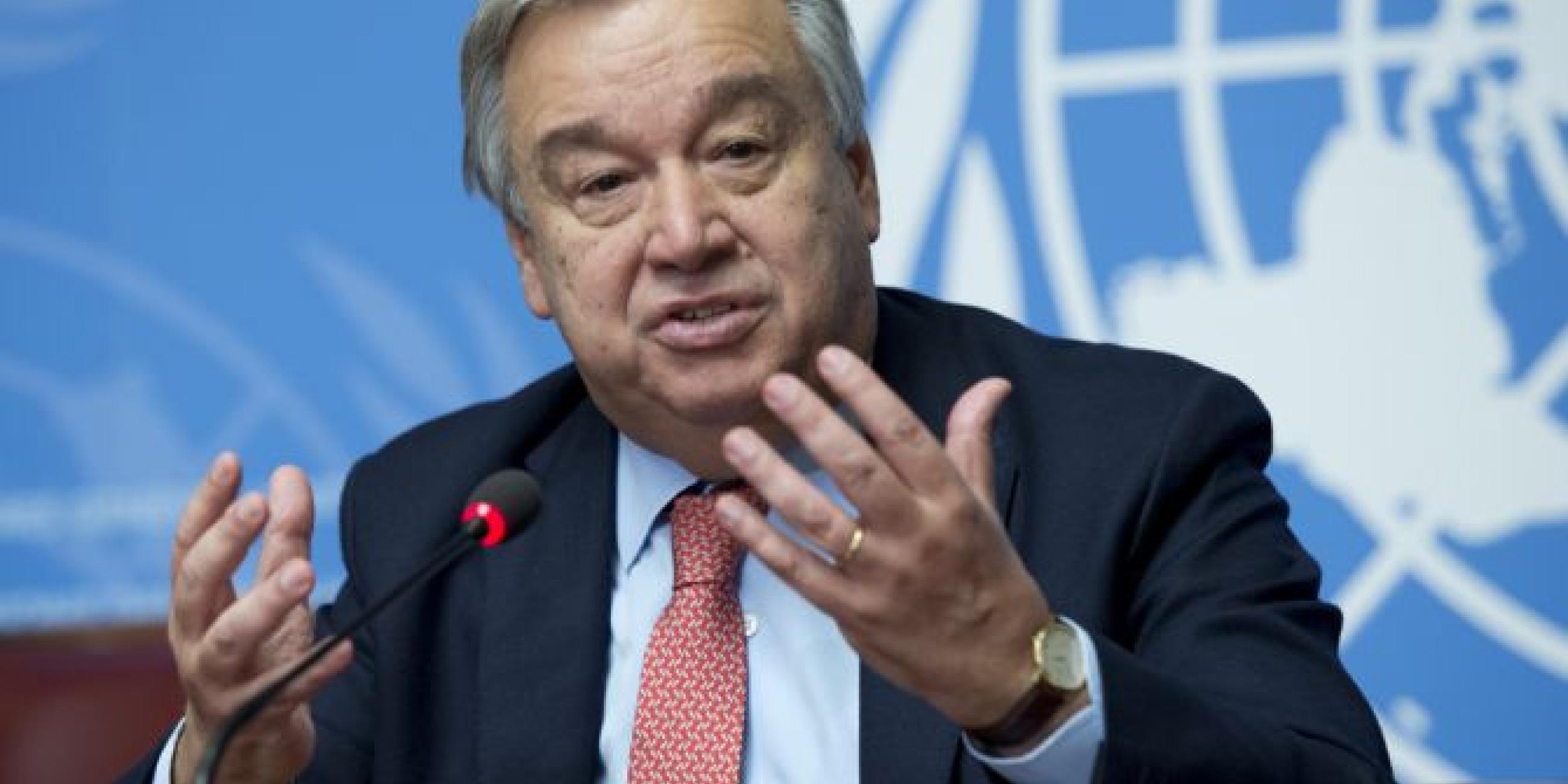
    United Nations Secretary-General Antonio Guterres has expressed strong regret over the United States’ decision to withdraw from multiple international organisations, warning that financial obligations to the UN remain legally binding under international law. The reaction follows a sweeping policy directive signed by U.S. President Donald Trump, ordering American withdrawal from 66 international bodies, including 31 United Nations entities and 35 non-UN organisations.

    In a statement delivered by UN Spokesman Stéphane Dujarric, the Secretary-General described the decision as “regrettable” and stressed that assessed contributions to the UN’s regular and peacekeeping budgets are mandatory under the UN Charter for all member states, including the United States. “Assessed contributions… are a legal obligation under the UN Charter,” Dujarric said, adding that all UN agencies would continue implementing their mandates despite political or financial challenges.

    While the UN statement did not specify which bodies would be affected or the immediate financial consequences, officials have long warned that funding shortfalls could undermine peacekeeping operations, humanitarian assistance, development programmes, and human-rights initiatives worldwide.

    The development stems from a Presidential Memorandum issued by Trump, declaring that continued U.S. participation in the listed organisations no longer serves American interests. The directive follows a comprehensive review ordered under Executive Order 14199 in February 2025, which assessed U.S. involvement in all international organisations, treaties, and conventions receiving American funding or support. After reviewing the findings with his Cabinet, Trump ordered federal agencies to take “immediate steps” to withdraw, where legally permissible.

    Among the non-UN organisations affected are bodies dealing with climate change, energy, environmental protection, democracy promotion, cybersecurity, and regional cooperation, including the Intergovernmental Panel on Climate Change (IPCC), the International Renewable Energy Agency (IRENA), the International Union for Conservation of Nature (IUCN), and the Freedom Online Coalition. The order also targets several security and justice-focused groups, such as the Global Counterterrorism Forum and the International Institute for Justice and the Rule of Law.

    On the UN side, the memorandum directs the United States to cease participation in or funding for multiple agencies and programmes, including UN Women, the UN Population Fund (UNFPA), UN Conference on Trade and Development (UNCTAD), the UN Framework Convention on Climate Change (UNFCCC), and offices focused on peacebuilding, development, oceans, water, international law, and human rights. It also affects entities such as the Peacebuilding Fund, UN Water, UN Oceans, and the UN University system.

    Despite the decision, the UN leadership insists its mission will continue. “All United Nations entities will go on with the implementation of their mandates as given by Member States,” the statement said, underscoring the organisation’s responsibility to people worldwide who rely on its work.

    The move has intensified global debate: Can the United States legally withdraw while still bound to financial obligations? Will UN programmes suffer operational setbacks? Does this signal a broader retreat from multilateralism—or a recalibration of U.S. foreign policy priorities? As the review process remains ongoing, with more organisations potentially targeted, the episode raises urgent questions about the future of international cooperation, global governance, and the stability of multilateral institutions.
    Is the U.S. Turning Its Back on the United Nations? Why UN Chief Guterres Regrets Trump’s Withdrawal From Dozens of Global Bodies and What It Means for World Governance United Nations Secretary-General Antonio Guterres has expressed strong regret over the United States’ decision to withdraw from multiple international organisations, warning that financial obligations to the UN remain legally binding under international law. The reaction follows a sweeping policy directive signed by U.S. President Donald Trump, ordering American withdrawal from 66 international bodies, including 31 United Nations entities and 35 non-UN organisations. In a statement delivered by UN Spokesman Stéphane Dujarric, the Secretary-General described the decision as “regrettable” and stressed that assessed contributions to the UN’s regular and peacekeeping budgets are mandatory under the UN Charter for all member states, including the United States. “Assessed contributions… are a legal obligation under the UN Charter,” Dujarric said, adding that all UN agencies would continue implementing their mandates despite political or financial challenges. While the UN statement did not specify which bodies would be affected or the immediate financial consequences, officials have long warned that funding shortfalls could undermine peacekeeping operations, humanitarian assistance, development programmes, and human-rights initiatives worldwide. The development stems from a Presidential Memorandum issued by Trump, declaring that continued U.S. participation in the listed organisations no longer serves American interests. The directive follows a comprehensive review ordered under Executive Order 14199 in February 2025, which assessed U.S. involvement in all international organisations, treaties, and conventions receiving American funding or support. After reviewing the findings with his Cabinet, Trump ordered federal agencies to take “immediate steps” to withdraw, where legally permissible. Among the non-UN organisations affected are bodies dealing with climate change, energy, environmental protection, democracy promotion, cybersecurity, and regional cooperation, including the Intergovernmental Panel on Climate Change (IPCC), the International Renewable Energy Agency (IRENA), the International Union for Conservation of Nature (IUCN), and the Freedom Online Coalition. The order also targets several security and justice-focused groups, such as the Global Counterterrorism Forum and the International Institute for Justice and the Rule of Law. On the UN side, the memorandum directs the United States to cease participation in or funding for multiple agencies and programmes, including UN Women, the UN Population Fund (UNFPA), UN Conference on Trade and Development (UNCTAD), the UN Framework Convention on Climate Change (UNFCCC), and offices focused on peacebuilding, development, oceans, water, international law, and human rights. It also affects entities such as the Peacebuilding Fund, UN Water, UN Oceans, and the UN University system. Despite the decision, the UN leadership insists its mission will continue. “All United Nations entities will go on with the implementation of their mandates as given by Member States,” the statement said, underscoring the organisation’s responsibility to people worldwide who rely on its work. The move has intensified global debate: Can the United States legally withdraw while still bound to financial obligations? Will UN programmes suffer operational setbacks? Does this signal a broader retreat from multilateralism—or a recalibration of U.S. foreign policy priorities? As the review process remains ongoing, with more organisations potentially targeted, the episode raises urgent questions about the future of international cooperation, global governance, and the stability of multilateral institutions.
    0 Commenti ·0 condivisioni ·788 Views
  • Trump Orders U.S. Withdrawal From 66 International Organizations, Including 31 UN Bodies

    U.S. President Donald J. Trump has signed a Presidential Memorandum directing the United States to withdraw from 66 international organizations, including 31 United Nations bodies and 35 non-UN entities. The decision, part of Trump’s “America First” foreign policy, follows a review mandated under Executive Order 14199 on February 4, 2025, which tasked the Secretary of State with evaluating U.S. participation in all international intergovernmental organizations, conventions, and treaties receiving American support.

    According to the memorandum, the Secretary of State submitted findings, which were reviewed by the president and Cabinet, leading to the determination that continued membership in these organizations no longer aligns with U.S. interests. The memorandum instructs all executive departments and agencies to take “immediate steps” to implement withdrawals where legally permissible, including ceasing participation or funding for affected UN bodies.

    The withdrawal list encompasses a wide array of policy areas, from climate change, energy, and environmental conservation to human rights, peacebuilding, democracy promotion, and cybersecurity. Notable non-UN organizations affected include the Intergovernmental Panel on Climate Change, International Renewable Energy Agency, International Union for Conservation of Nature, and the Global Counterterrorism Forum.

    UN entities affected include major offices and programs such as the UN Framework Convention on Climate Change, UN Women, UN Population Fund, UN Conference on Trade and Development, UN Peacebuilding Fund, UN Oceans, and the UN University system.

    Trump emphasized that the review is ongoing, and additional organizations or agreements may be targeted in the future. The memorandum clarifies that this directive does not override existing legal authorities or budgetary controls and does not create enforceable legal rights for any party.

    The announcement marks one of the largest U.S. withdrawals from international institutions in modern history, reflecting a strategic pivot toward national sovereignty, cost reduction, and reevaluation of multilateral commitments. The State Department will oversee implementation and provide additional guidance to federal agencies.
    Trump Orders U.S. Withdrawal From 66 International Organizations, Including 31 UN Bodies U.S. President Donald J. Trump has signed a Presidential Memorandum directing the United States to withdraw from 66 international organizations, including 31 United Nations bodies and 35 non-UN entities. The decision, part of Trump’s “America First” foreign policy, follows a review mandated under Executive Order 14199 on February 4, 2025, which tasked the Secretary of State with evaluating U.S. participation in all international intergovernmental organizations, conventions, and treaties receiving American support. According to the memorandum, the Secretary of State submitted findings, which were reviewed by the president and Cabinet, leading to the determination that continued membership in these organizations no longer aligns with U.S. interests. The memorandum instructs all executive departments and agencies to take “immediate steps” to implement withdrawals where legally permissible, including ceasing participation or funding for affected UN bodies. The withdrawal list encompasses a wide array of policy areas, from climate change, energy, and environmental conservation to human rights, peacebuilding, democracy promotion, and cybersecurity. Notable non-UN organizations affected include the Intergovernmental Panel on Climate Change, International Renewable Energy Agency, International Union for Conservation of Nature, and the Global Counterterrorism Forum. UN entities affected include major offices and programs such as the UN Framework Convention on Climate Change, UN Women, UN Population Fund, UN Conference on Trade and Development, UN Peacebuilding Fund, UN Oceans, and the UN University system. Trump emphasized that the review is ongoing, and additional organizations or agreements may be targeted in the future. The memorandum clarifies that this directive does not override existing legal authorities or budgetary controls and does not create enforceable legal rights for any party. The announcement marks one of the largest U.S. withdrawals from international institutions in modern history, reflecting a strategic pivot toward national sovereignty, cost reduction, and reevaluation of multilateral commitments. The State Department will oversee implementation and provide additional guidance to federal agencies.
    0 Commenti ·0 condivisioni ·645 Views
  • Chinese Hacking Group ‘Salt Typhoon’ Breaches U.S. House Committee Emails

    A Chinese-linked hacking group, nicknamed Salt Typhoon, has reportedly compromised email systems used by staff members of several U.S. House of Representatives committees, including the House China Committee and panels overseeing foreign affairs, intelligence, and the armed services. The breach, detected in December, targeted committee aides, though it remains unclear whether lawmakers’ emails were accessed.

    The cyberattack is part of ongoing allegations of espionage linked to Chinese intelligence, which has previously been accused of intercepting communications involving U.S. politicians and officials. In response, Beijing has denied involvement, while U.S. authorities have imposed sanctions on individuals and companies allegedly connected to Salt Typhoon’s operations.

    The Federal Bureau of Investigation has declined to comment, and the White House and the targeted committees have yet to issue official statements. Cybersecurity experts note that U.S. lawmakers and staffers have frequently been targeted for espionage, with prior incidents reported in the Senate and among senior officials.

    Salt Typhoon’s alleged operations highlight persistent vulnerabilities in U.S. government digital communications and underscore the ongoing geopolitical tensions between the United States and China.

    Chinese Hacking Group ‘Salt Typhoon’ Breaches U.S. House Committee Emails A Chinese-linked hacking group, nicknamed Salt Typhoon, has reportedly compromised email systems used by staff members of several U.S. House of Representatives committees, including the House China Committee and panels overseeing foreign affairs, intelligence, and the armed services. The breach, detected in December, targeted committee aides, though it remains unclear whether lawmakers’ emails were accessed. The cyberattack is part of ongoing allegations of espionage linked to Chinese intelligence, which has previously been accused of intercepting communications involving U.S. politicians and officials. In response, Beijing has denied involvement, while U.S. authorities have imposed sanctions on individuals and companies allegedly connected to Salt Typhoon’s operations. The Federal Bureau of Investigation has declined to comment, and the White House and the targeted committees have yet to issue official statements. Cybersecurity experts note that U.S. lawmakers and staffers have frequently been targeted for espionage, with prior incidents reported in the Senate and among senior officials. Salt Typhoon’s alleged operations highlight persistent vulnerabilities in U.S. government digital communications and underscore the ongoing geopolitical tensions between the United States and China.
    0 Commenti ·0 condivisioni ·461 Views
  • 10 Mobile Banking Threats Nigerians Must Watch Out for in 2026 to Protect Their Money

    As mobile banking becomes central to daily financial transactions in Nigeria, cybercriminals are innovating faster than ever. Journalist Pascal Oparada highlights the top 10 mobile banking threats in 2026, including AI-powered phishing scams, fake banking apps, SIM-swap fraud, social media investment scams, public Wi-Fi hacking, hidden malware in everyday apps, voice-cloning scams, weak passwords, account takeovers from data leaks, and low awareness of fraud reporting channels. Experts urge Nigerians to stay vigilant, update software regularly, and adopt secure banking practices to safeguard their money.

    #MobileBanking #CyberSecurity #Nigeria #FraudPrevention #DigitalSafety #AIPhishing #SIMSwap #Malware #BankingApps #TechNews
    10 Mobile Banking Threats Nigerians Must Watch Out for in 2026 to Protect Their Money As mobile banking becomes central to daily financial transactions in Nigeria, cybercriminals are innovating faster than ever. Journalist Pascal Oparada highlights the top 10 mobile banking threats in 2026, including AI-powered phishing scams, fake banking apps, SIM-swap fraud, social media investment scams, public Wi-Fi hacking, hidden malware in everyday apps, voice-cloning scams, weak passwords, account takeovers from data leaks, and low awareness of fraud reporting channels. Experts urge Nigerians to stay vigilant, update software regularly, and adopt secure banking practices to safeguard their money. #MobileBanking #CyberSecurity #Nigeria #FraudPrevention #DigitalSafety #AIPhishing #SIMSwap #Malware #BankingApps #TechNews
    0 Commenti ·0 condivisioni ·598 Views
  • Former Alpha-Beta Employee Accuses Tinubu-Linked Firm of Cybersecurity Policy Forgery, Workplace Harassment, EFCC and Police Investigate

    A former employee of Alpha-Beta Consulting Limited, Segun Oluwasanmi, has accused the Lagos State tax consultancy firm—reportedly linked to President Bola Tinubu—of serious corporate misconduct, including forgery of electronic documents, cybersecurity policy manipulation, and sustained workplace harassment. Oluwasanmi alleged that the company’s Chief Technical Officer forged his signature on the firm’s Cybersecurity Policy in September 2023 after deliberately excluding him from the finalisation process. Despite an internal panel reportedly confirming the act, no disciplinary action was taken, prompting the Committee for the Defence of Human Rights (CDHR) to escalate the matter to the Nigeria Police, ICPC, and EFCC. The petition cites violations of the Cybercrimes Act and Criminal Code, warning that failure to act could undermine corporate governance and cybersecurity integrity within the tax consultancy firm.
    Former Alpha-Beta Employee Accuses Tinubu-Linked Firm of Cybersecurity Policy Forgery, Workplace Harassment, EFCC and Police Investigate A former employee of Alpha-Beta Consulting Limited, Segun Oluwasanmi, has accused the Lagos State tax consultancy firm—reportedly linked to President Bola Tinubu—of serious corporate misconduct, including forgery of electronic documents, cybersecurity policy manipulation, and sustained workplace harassment. Oluwasanmi alleged that the company’s Chief Technical Officer forged his signature on the firm’s Cybersecurity Policy in September 2023 after deliberately excluding him from the finalisation process. Despite an internal panel reportedly confirming the act, no disciplinary action was taken, prompting the Committee for the Defence of Human Rights (CDHR) to escalate the matter to the Nigeria Police, ICPC, and EFCC. The petition cites violations of the Cybercrimes Act and Criminal Code, warning that failure to act could undermine corporate governance and cybersecurity integrity within the tax consultancy firm.
    0 Commenti ·0 condivisioni ·560 Views

  • Nigerians, Bola Ahmed Tinubu is about to hand our taxes and economic data to France.

    Yesterday, December 10, the FIRS signed a Memorandum of Understanding with France’s tax authority at the French Embassy in Abuja.

    France will provide AI audits, automated compliance, real-time analytics, and cybersecurity tools. In return, Nigeria will share insights from our digital economy and tax system, including international taxation issues like transfer pricing, profit shifting, and multinational compliance.

    The government claims no raw taxpayer files will leave the country, but sensitive aggregated data will.

    The truth is, this data can reveal key financial patterns and give France visibility into our economy. Once it leaves, we can’t get it back, putting our national economic sovereignty at risk.

    France has been losing influence across West Africa, with Mali, Burkina Faso, and Niger pushing back. Now, while those doors close, Nigeria appears ready to open a new one, putting our fiscal independence at risk.

    This MoU could compromise our control over our revenue system, expose sensitive economic data, and weaken Nigeria’s fiscal independence. We are big enough to manage our own tax system and employ our own experts.

    This deal should be paused or renegotiated to protect Nigerian taxpayers and safeguard the sovereignty of our economy.
    🇳🇬 Nigerians, Bola Ahmed Tinubu is about to hand our taxes and economic data to France. Yesterday, December 10, the FIRS signed a Memorandum of Understanding with France’s tax authority at the French Embassy in Abuja. France will provide AI audits, automated compliance, real-time analytics, and cybersecurity tools. In return, Nigeria will share insights from our digital economy and tax system, including international taxation issues like transfer pricing, profit shifting, and multinational compliance. The government claims no raw taxpayer files will leave the country, but sensitive aggregated data will. The truth is, this data can reveal key financial patterns and give France visibility into our economy. Once it leaves, we can’t get it back, putting our national economic sovereignty at risk. France has been losing influence across West Africa, with Mali, Burkina Faso, and Niger pushing back. Now, while those doors close, Nigeria appears ready to open a new one, putting our fiscal independence at risk. This MoU could compromise our control over our revenue system, expose sensitive economic data, and weaken Nigeria’s fiscal independence. We are big enough to manage our own tax system and employ our own experts. This deal should be paused or renegotiated to protect Nigerian taxpayers and safeguard the sovereignty of our economy.
    1 Commenti ·0 condivisioni ·473 Views
  • Ghana has taken firm diplomatic action after three of its citizens were deported from Israel under what officials described as unfair and unacceptable conditions.
    The Ghanaians — including members of a parliamentary delegation travelling for a cybersecurity conference — were detained upon arrival on 7 December, and three were later sent back without clear justification.

    In a reciprocal move, the Ghanaian government ordered the removal of three Israelis who had recently entered the country, signalling that it will not tolerate disrespect toward its nationals abroad.

    Ghana’s Foreign Affairs Minister confirmed that Israel’s chargé d’affaires in Accra was summoned for discussions, stressing that while Ghana values its relationship with Israel, mutual respect for travellers is non-negotiable.

    Both countries are now working diplomatically to calm rising tensions and restore normal relations.

    #Ghana #Israel #Diplomacy #ForeignAffairs
    Ghana has taken firm diplomatic action after three of its citizens were deported from Israel under what officials described as unfair and unacceptable conditions. The Ghanaians — including members of a parliamentary delegation travelling for a cybersecurity conference — were detained upon arrival on 7 December, and three were later sent back without clear justification. In a reciprocal move, the Ghanaian government ordered the removal of three Israelis who had recently entered the country, signalling that it will not tolerate disrespect toward its nationals abroad. Ghana’s Foreign Affairs Minister confirmed that Israel’s chargé d’affaires in Accra was summoned for discussions, stressing that while Ghana values its relationship with Israel, mutual respect for travellers is non-negotiable. Both countries are now working diplomatically to calm rising tensions and restore normal relations. #Ghana #Israel #Diplomacy #ForeignAffairs
    0 Commenti ·0 condivisioni ·497 Views
  • Ghana Summons Israeli Envoy, Condemns Detention of Officials and Threatens Diplomatic Retaliation

    Ghana has sharply criticised Israel after seven Ghanaian travellers — including four lawmakers attending an international cybersecurity conference — were detained at Ben Gurion Airport in Tel Aviv on December 7. The Ministry of Foreign Affairs described the treatment as discriminatory, inhumane, and a betrayal of over 60 years of diplomatic ties. While the lawmakers were released after more than five hours of interrogation, three other travellers were deported. Ghana dismissed Israel’s justification of “non-cooperation” from its embassy as false and has summoned the Israeli envoy in Accra to lodge a formal protest. The government warned that reciprocal measures affecting visas, travel, and bilateral programmes are now being considered.

    Ghana Summons Israeli Envoy, Condemns Detention of Officials and Threatens Diplomatic Retaliation Ghana has sharply criticised Israel after seven Ghanaian travellers — including four lawmakers attending an international cybersecurity conference — were detained at Ben Gurion Airport in Tel Aviv on December 7. The Ministry of Foreign Affairs described the treatment as discriminatory, inhumane, and a betrayal of over 60 years of diplomatic ties. While the lawmakers were released after more than five hours of interrogation, three other travellers were deported. Ghana dismissed Israel’s justification of “non-cooperation” from its embassy as false and has summoned the Israeli envoy in Accra to lodge a formal protest. The government warned that reciprocal measures affecting visas, travel, and bilateral programmes are now being considered.
    0 Commenti ·0 condivisioni ·401 Views
  • Russian Hacker Groups Gamaredon, Turla Collaborate To Target Ukraine — ESET | Fintter

    Cybersecurity researchers have found evidence of Russian hacking groups Gamaredon and Turla collaborating to target Ukrainian entities.

    According to Slovak cybersecurity company ESET, Gamaredon tools such as PteroGraphin and PteroOdd were used earlier this year to execute Turla’s Kazuar backdoor on Ukrainian systems. Researchers say this indicates active cooperation between the two groups, both linked to Russia’s FSB.

    ESET noted multiple attacks between February and June 2025, involving different variants of Kazuar malware deployed through Gamaredon’s toolset. The activity mainly targeted Ukraine’s defense sector.

    Source: The Hacker News
    Russian Hacker Groups Gamaredon, Turla Collaborate To Target Ukraine — ESET | Fintter Cybersecurity researchers have found evidence of Russian hacking groups Gamaredon and Turla collaborating to target Ukrainian entities. According to Slovak cybersecurity company ESET, Gamaredon tools such as PteroGraphin and PteroOdd were used earlier this year to execute Turla’s Kazuar backdoor on Ukrainian systems. Researchers say this indicates active cooperation between the two groups, both linked to Russia’s FSB. ESET noted multiple attacks between February and June 2025, involving different variants of Kazuar malware deployed through Gamaredon’s toolset. The activity mainly targeted Ukraine’s defense sector. Source: The Hacker News
    0 Commenti ·0 condivisioni ·793 Views
  • Break into Cybersecurity with the ultimate 4-step pathway:
    1️⃣ Google Cybersecurity Certificate – Industry-ready foundations.
    2️⃣ CompTIA Security+ – Globally recognized security skills.
    3️⃣ CEH – Professional ethical hacking knowledge.
    4️⃣ OSCP – Advanced penetration testing mastery.
    Employers want it. Professionals respect it. Your journey starts now!”
    https://learn.fintter.com/
    Break into Cybersecurity with the ultimate 4-step pathway: 1️⃣ Google Cybersecurity Certificate – Industry-ready foundations. 2️⃣ CompTIA Security+ – Globally recognized security skills. 3️⃣ CEH – Professional ethical hacking knowledge. 4️⃣ OSCP – Advanced penetration testing mastery. 🚀 Employers want it. Professionals respect it. Your journey starts now!” https://learn.fintter.com/
    0 Commenti ·0 condivisioni ·847 Views
  • Defend the future with the right skills — hack the right way, prevent attacks, and prevail. Your cybersecurity career starts here — join today!
    https://learn.fintter.com/
    Defend the future with the right skills — hack the right way, prevent attacks, and prevail. Your cybersecurity career starts here — join today! https://learn.fintter.com/
    like
    1
    · 0 Commenti ·1 condivisioni ·4K Views
  • • “Protect. Prevent. Prevail.”
    • “Hack the right way – learn Ethical Hacking.”
    • “Your Cybersecurity Career Starts Here.”
    • “Defend the future, join today.”


    • Enroll Now – Limited Slots!
    • “Protect. Prevent. Prevail.” • “Hack the right way – learn Ethical Hacking.” • “Your Cybersecurity Career Starts Here.” • “Defend the future, join today.” ⸻ 📌 • Enroll Now – Limited Slots!
    0 Commenti ·0 condivisioni ·615 Views
  • FG Unveils New Secondary School Curriculum with Journalism, Programming, AI Modules— Starting from September 2025.

    Nigeria has introduced a new secondary school curriculum that will, for the first time, feature modules in journalism, computer programming, artificial intelligence (AI), robotics, and fact-checking.

    Dada Olusegun, Senior Special Adviser to President Bola Ahmed Tinubu on Social Media, revealed excerpts from the yet-to-be-released curriculum document on Tuesday.

    According to the framework, journalism will now be taught under the English Language module at the senior secondary level, while programming will span both junior and senior classes. AI and robotics will be integrated into a new subject, Digital Literacy, for senior students.

    The reforms aim to equip learners with skills for a technology-driven world, while fostering critical thinking, creativity, and innovation.

    Subject Breakdown:
    • Junior Secondary (JSS 1–3): Mathematics, English, Integrated Science, Digital Literacy & Coding (including Python basics, Scratch, and robotics kits), Social Studies, Languages (mother tongue and French/Arabic), Creative Arts, and Physical & Health Education.
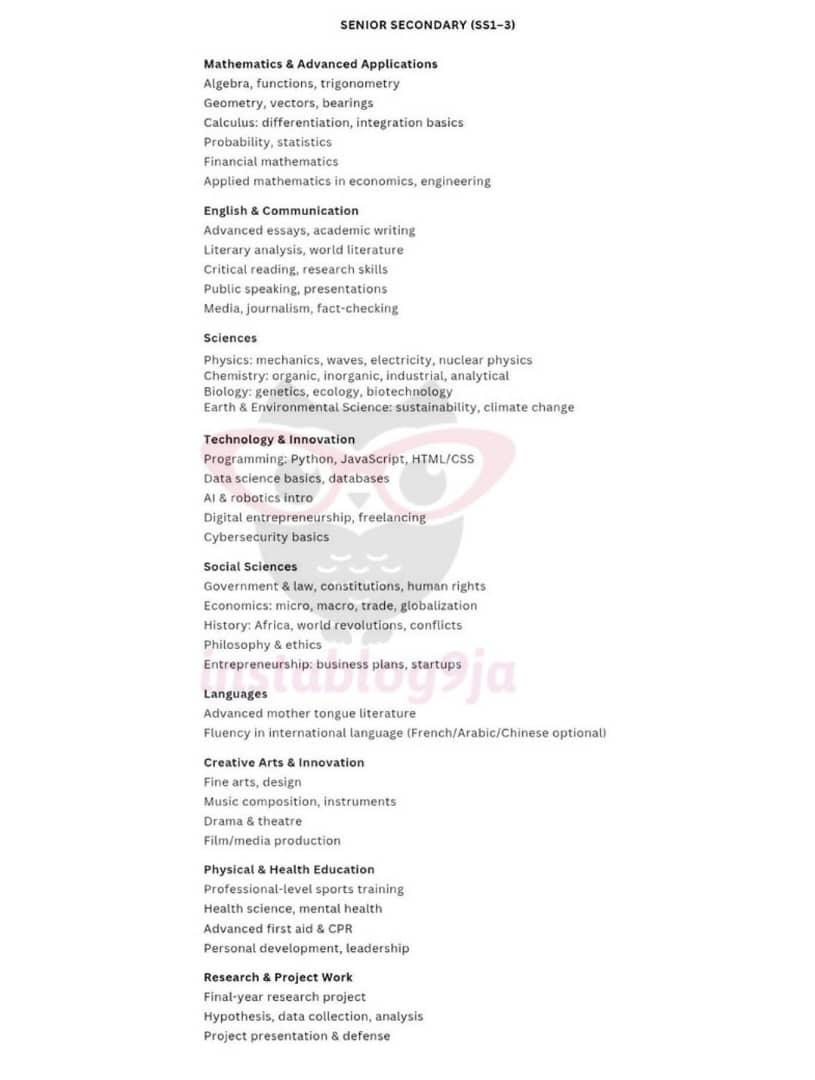
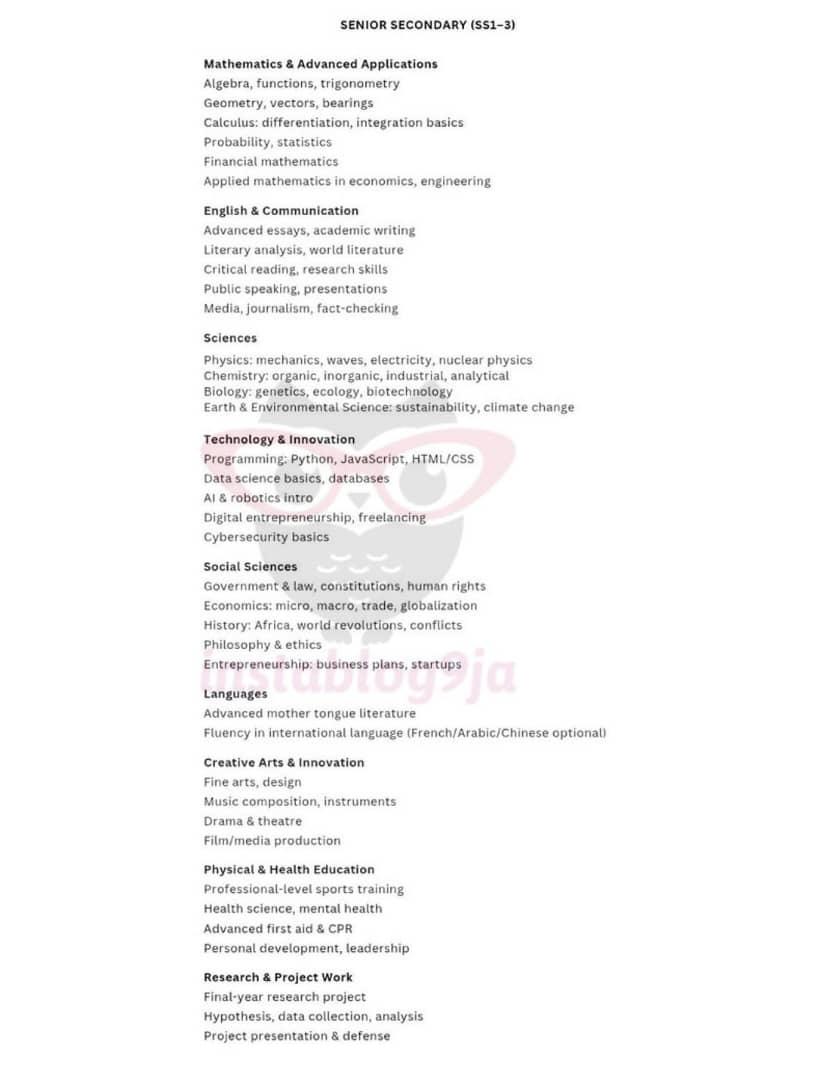
    • Senior Secondary (SS 1–3): Advanced Mathematics, English & Communication (including journalism and fact-checking), Sciences, Technology & Innovation (programming, AI, robotics, cybersecurity, data science), Social Sciences, Languages (with options for French/Arabic/Chinese), Creative Arts & Media, Physical & Health Education, and a final-year research project.

    Education experts have welcomed the overhaul, describing it as a step toward preparing Nigerian students for global competitiveness in the knowledge economy.
    FG Unveils New Secondary School Curriculum with Journalism, Programming, AI Modules— Starting from September 2025. Nigeria has introduced a new secondary school curriculum that will, for the first time, feature modules in journalism, computer programming, artificial intelligence (AI), robotics, and fact-checking. Dada Olusegun, Senior Special Adviser to President Bola Ahmed Tinubu on Social Media, revealed excerpts from the yet-to-be-released curriculum document on Tuesday. According to the framework, journalism will now be taught under the English Language module at the senior secondary level, while programming will span both junior and senior classes. AI and robotics will be integrated into a new subject, Digital Literacy, for senior students. The reforms aim to equip learners with skills for a technology-driven world, while fostering critical thinking, creativity, and innovation. Subject Breakdown: • Junior Secondary (JSS 1–3): Mathematics, English, Integrated Science, Digital Literacy & Coding (including Python basics, Scratch, and robotics kits), Social Studies, Languages (mother tongue and French/Arabic), Creative Arts, and Physical & Health Education. • Senior Secondary (SS 1–3): Advanced Mathematics, English & Communication (including journalism and fact-checking), Sciences, Technology & Innovation (programming, AI, robotics, cybersecurity, data science), Social Sciences, Languages (with options for French/Arabic/Chinese), Creative Arts & Media, Physical & Health Education, and a final-year research project. Education experts have welcomed the overhaul, describing it as a step toward preparing Nigerian students for global competitiveness in the knowledge economy.
    0 Commenti ·0 condivisioni ·926 Views
  • FG Unveils New Secondary School Curriculum with Journalism, Programming, AI Modules— Starting from September 2025.

    Nigeria has introduced a new secondary school curriculum that will, for the first time, feature modules in journalism, computer programming, artificial intelligence (AI), robotics, and fact-checking.

    Dada Olusegun, Senior Special Adviser to President Bola Ahmed Tinubu on Social Media, revealed excerpts from the yet-to-be-released curriculum document on Tuesday.

    According to the framework, journalism will now be taught under the English Language module at the senior secondary level, while programming will span both junior and senior classes. AI and robotics will be integrated into a new subject, Digital Literacy, for senior students.

    The reforms aim to equip learners with skills for a technology-driven world, while fostering critical thinking, creativity, and innovation.

    Subject Breakdown:
    • Junior Secondary (JSS 1–3): Mathematics, English, Integrated Science, Digital Literacy & Coding (including Python basics, Scratch, and robotics kits), Social Studies, Languages (mother tongue and French/Arabic), Creative Arts, and Physical & Health Education.
    • Senior Secondary (SS 1–3): Advanced Mathematics, English & Communication (including journalism and fact-checking), Sciences, Technology & Innovation (programming, AI, robotics, cybersecurity, data science), Social Sciences, Languages (with options for French/Arabic/Chinese), Creative Arts & Media, Physical & Health Education, and a final-year research project.

    Education experts have welcomed the overhaul, describing it as a step toward preparing Nigerian students for global competitiveness in the knowledge economy.
    FG Unveils New Secondary School Curriculum with Journalism, Programming, AI Modules— Starting from September 2025. Nigeria has introduced a new secondary school curriculum that will, for the first time, feature modules in journalism, computer programming, artificial intelligence (AI), robotics, and fact-checking. Dada Olusegun, Senior Special Adviser to President Bola Ahmed Tinubu on Social Media, revealed excerpts from the yet-to-be-released curriculum document on Tuesday. According to the framework, journalism will now be taught under the English Language module at the senior secondary level, while programming will span both junior and senior classes. AI and robotics will be integrated into a new subject, Digital Literacy, for senior students. The reforms aim to equip learners with skills for a technology-driven world, while fostering critical thinking, creativity, and innovation. Subject Breakdown: • Junior Secondary (JSS 1–3): Mathematics, English, Integrated Science, Digital Literacy & Coding (including Python basics, Scratch, and robotics kits), Social Studies, Languages (mother tongue and French/Arabic), Creative Arts, and Physical & Health Education. • Senior Secondary (SS 1–3): Advanced Mathematics, English & Communication (including journalism and fact-checking), Sciences, Technology & Innovation (programming, AI, robotics, cybersecurity, data science), Social Sciences, Languages (with options for French/Arabic/Chinese), Creative Arts & Media, Physical & Health Education, and a final-year research project. Education experts have welcomed the overhaul, describing it as a step toward preparing Nigerian students for global competitiveness in the knowledge economy.
    0 Commenti ·0 condivisioni ·1K Views
  • NITDA Alerts Nigerians To eSIM Security Flaw Exploited Globally

    The National Information Technology Development Agency (NITDA) has warned of a critical vulnerability in embedded SIM (eSIM) technology that could allow attackers to hijack devices, intercept communications, and clone eSIM profiles.

    The flaw, linked to outdated GSMA TS 48 test profiles, affects over 2 billion smartphones, tablets, wearables, and IoT devices worldwide.

    NITDA urged device makers and service providers to apply Kigen OS patches via OTA updates, adopt the updated GSMA TS 48 version 7.0 standard, and remove legacy profiles to block exploitation.

    The agency stressed that swift action is essential to avert large-scale cyberattacks and protect user data.

    #CyberSecurity #NITDA #eSIM #NigeriaTech
    NITDA Alerts Nigerians To eSIM Security Flaw Exploited Globally The National Information Technology Development Agency (NITDA) has warned of a critical vulnerability in embedded SIM (eSIM) technology that could allow attackers to hijack devices, intercept communications, and clone eSIM profiles. The flaw, linked to outdated GSMA TS 48 test profiles, affects over 2 billion smartphones, tablets, wearables, and IoT devices worldwide. NITDA urged device makers and service providers to apply Kigen OS patches via OTA updates, adopt the updated GSMA TS 48 version 7.0 standard, and remove legacy profiles to block exploitation. The agency stressed that swift action is essential to avert large-scale cyberattacks and protect user data. #CyberSecurity #NITDA #eSIM #NigeriaTech
    0 Commenti ·0 condivisioni ·1K Views
  • FG Launches Nationwide Tech Empowerment Program for Youths.

    The Federal Government has officially launched a nationwide skills empowerment programme aimed at equipping young Nigerians with practical digital and technical skills to boost employability and entrepreneurship.

    GoldenNewsNg reports that the initiative is being implemented under the National Poverty Reduction with Growth Strategy (NPRGS) and is led by the Office of the Senior Special Assistant to the President on Technical, Vocational and Entrepreneurship Education (OSSAP-TVEE).

    Designed to target high-demand sectors, the programme offers hands-on training in areas such as web development, cybersecurity, and solar installation—industries that continue to grow and play an important role in Nigeria’s future.

    Beyond training, participants will also receive essential tools, including laptops, tablets, and other digital devices. These resources are intended to support not just learning but also help beneficiaries immediately start work or launch their own businesses.

    According to officials, this programme is a key part of President Bola Ahmed Tinubu’s broader vision to lift 100 million Nigerians out of poverty by the year 2030. The focus, they said, is on empowerment over dependency and technical capacity over handouts.

    “This isn’t just about training people for jobs; it’s about preparing a new generation of Nigerians who can innovate, lead, and compete both locally and globally,” a representative from OSSAP-TVEE said during the launch.
    The programme will run across several states, particularly focusing on underserved areas where unemployment remains high. It aims to bridge the digital divide, open up new career paths for young people, and support inclusive economic growth.


    Implementation will be carried out in collaboration with training institutions, tech hubs, and private sector partners to ensure quality delivery and real-world impact. This move also supports Nigeria’s broader national priorities in education, job creation, and building a knowledge-based economy.

    In the coming months, as the programme unfolds, the government hopes to unlock the entrepreneurial and innovative potential of Nigerian youth, laying the groundwork for a stronger, more self-sufficient society.
    FG Launches Nationwide Tech Empowerment Program for Youths. The Federal Government has officially launched a nationwide skills empowerment programme aimed at equipping young Nigerians with practical digital and technical skills to boost employability and entrepreneurship. GoldenNewsNg reports that the initiative is being implemented under the National Poverty Reduction with Growth Strategy (NPRGS) and is led by the Office of the Senior Special Assistant to the President on Technical, Vocational and Entrepreneurship Education (OSSAP-TVEE). Designed to target high-demand sectors, the programme offers hands-on training in areas such as web development, cybersecurity, and solar installation—industries that continue to grow and play an important role in Nigeria’s future. Beyond training, participants will also receive essential tools, including laptops, tablets, and other digital devices. These resources are intended to support not just learning but also help beneficiaries immediately start work or launch their own businesses. According to officials, this programme is a key part of President Bola Ahmed Tinubu’s broader vision to lift 100 million Nigerians out of poverty by the year 2030. The focus, they said, is on empowerment over dependency and technical capacity over handouts. “This isn’t just about training people for jobs; it’s about preparing a new generation of Nigerians who can innovate, lead, and compete both locally and globally,” a representative from OSSAP-TVEE said during the launch. The programme will run across several states, particularly focusing on underserved areas where unemployment remains high. It aims to bridge the digital divide, open up new career paths for young people, and support inclusive economic growth. Implementation will be carried out in collaboration with training institutions, tech hubs, and private sector partners to ensure quality delivery and real-world impact. This move also supports Nigeria’s broader national priorities in education, job creation, and building a knowledge-based economy. In the coming months, as the programme unfolds, the government hopes to unlock the entrepreneurial and innovative potential of Nigerian youth, laying the groundwork for a stronger, more self-sufficient society.
    0 Commenti ·0 condivisioni ·915 Views
Fintter https://fintter.com