Sobre
Sobre
The Night the Dead Walk Among the Living The Untold Story of the Odo Masquerade
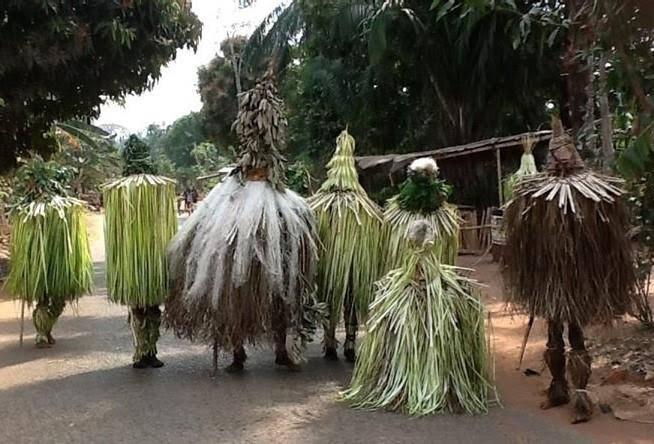
Odo Masquerade
In the quiet villages of southeastern Nigeria, where the wind moves gently through the tall palm trees and the earth holds the stories of generations, there exists a mystery older than memory itself. It is a mystery that is not spoken of lightly, a presence that is both revered and feared. They call it Odo.
To outsiders, it may appear as just another masquerade, colorful and dramatic like many others across Igbo land. But to those who understand its depth, Odo is not merely a performance. It is believed to be the return of the dead.
The story of Odo begins long before modern times, in an age when the line between the living and the spirit world was thinner, when people believed that death was not an end but a journey. The ancestors were never truly gone. They watched. They listened. And sometimes, they returned.
In certain communities, especially around Nsukka and parts of Enugu, the Odo festival is one of the most sacred traditions. It does not happen every year. Sometimes it comes after two years, sometimes longer. But when it comes, the entire community prepares as if welcoming kings.
Because that is what they believe they are doing.
Welcoming the dead back home.
As the season approaches, there is a shift in the atmosphere. Elders begin to speak in low tones. Sacred groves are cleared. Rituals are performed in secrecy. Women and children are warned. Not everything is meant for everyone to see.
Then one night, without warning, the silence breaks.
A sound rises from the forest.
It is not music.
It is not a human voice.
It is something deeper, something that vibrates through the bones. A haunting call that sends chills through even the bravest hearts. That is the voice of Odo.
The first appearance is never casual. It is dramatic, powerful, and overwhelming. Figures emerge from the darkness, dressed in heavy raffia and cloth, their faces hidden behind masks that do not resemble men but something older, something otherworldly.
They move differently.
They do not walk like humans.
Their presence alone is enough to make grown men step back.
Because at that moment, they are no longer seen as people in costume.
They are spirits.
The belief is simple but powerful. When a man wears the Odo mask during the sacred period, he ceases to be himself. He becomes a vessel. The spirit of an ancestor enters him. He speaks not with his own voice but with the authority of the dead.
And when the dead speak, the living listen.
This is where the fear begins.
Odo is not gentle.
Odo does not joke.
Odo does not tolerate disrespect.
It is said that during the Odo season, the masquerades enforce discipline in the community. They can enter compounds uninvited. They can question people. They can punish wrongdoing. And no one dares to challenge them.
Because to challenge Odo is to challenge the ancestors.
There are stories, whispered across generations, of those who forgot this.
One such story tells of a young man who mocked the masquerade, laughing openly as Odo passed through the village square. He called it a trick, a performance, nothing more.
That night, Odo came to his compound.
No one knows exactly what happened, because no one was allowed to witness it. But the next morning, the young man was found trembling, unable to speak. Some say he never recovered.
Others say he had seen something no human should ever see.
This is why many call Odo cruel.
Not because it seeks cruelty, but because it does not show mercy the way humans do.
Odo represents a different kind of justice.
A justice that is ancient, uncompromising, and absolute.
During the festival period, there are rules. Strict ones.
Women are not allowed to come too close to certain rituals. Children must stay indoors at specific times. Outsiders are warned not to wander at night.
Because when Odo moves, it owns the night.
Its presence can turn celebration into silence within seconds. Its voice can command attention without a single gesture. And its actions, though sometimes harsh, are seen as necessary to maintain order and tradition.
Yet, beyond the fear, there is also deep respect.
The people do not only fear Odo.
They honor it.
They prepare food, offer sacrifices, and sing songs that welcome the spirits. They believe that Odo brings blessings, protection, and guidance from the ancestors.
It is a reunion.
A sacred meeting between worlds.
Elders often say that without Odo, the connection between the living and the dead would weaken. And when that connection breaks, a community loses more than tradition. It loses its identity.
But the mystery remains.
Who is behind the mask?
Everyone knows that physically, it is a man from the community. But once he wears the mask, that knowledge becomes irrelevant. Even his closest family members treat him as something else.
They lower their eyes.
They speak with caution.
Because in that moment, he is no longer their son, brother, or husband.
He is Odo.
This transformation is what makes it one of the most powerful and feared masquerades in Igbo culture. It is not just about appearance. It is about belief.
A belief so strong that it changes reality.
There are moments during the festival when Odo sits among elders, listening to disputes and giving judgments. People bring their problems, their conflicts, their questions.
And Odo responds.
Not as a man.
But as a voice from beyond.
This is why its authority is rarely questioned.
Because how do you argue with the dead?
Still, as times change and modern life begins to touch even the most remote villages, the perception of Odo is slowly evolving. Some see it now as cultural heritage rather than spiritual truth. Others continue to hold on to the old beliefs with unwavering faith.
But even among the skeptics, one thing remains constant.
Respect.
Because whether one believes or not, the power of Odo is not something to take lightly.
It lives in stories.
It lives in memory.
It lives in the collective consciousness of the people.
And perhaps that is its greatest strength.
On the final night of the festival, there is a sense of sadness in the air. The spirits must return. The masquerades move once more through the village, their voices echoing through the darkness.
This time, it is not a call of arrival.
It is a farewell.
The people gather, watching in silence as Odo disappears back into the forest, back into the world of the unseen.
And just like that, the village returns to normal.
But something has changed.
It always does.
Because for a brief moment, the line between life and death was crossed.
And those who witnessed it will carry that memory forever.
That is the story of Odo.
Not just a masquerade.
But a bridge between worlds.
A symbol of fear and respect.
A reminder that in some places, the dead are never truly gone.

Categorias
Leia mais
Sani Abacha Sani Abacha was a Nigerian military officer who served as the Head of State of Nigeria from 1993 until his death in 1998. His rule is one of the most controversial periods in Nigeria’s political history because it combined strong military control with economic reforms and widespread criticism over human rights issues. Born on September 20, 1943, in Kano,...

Donald Trump will on Sunday showcase his unexpected attachment to a sport in which “America First” remains a dream, for now. The US president is attending the final of the newly expanded FIFA Club World Cup in his latest use of the beautiful game as a soft power political weapon. His appearance at the MetLife stadium in New Jersey, where Paris Saint-Germain face Chelsea,...

Finland’s Immigration Service (Migri) has opened the 2025 application portal for its Seasonal Work Permit, giving Nigerians and other foreign workers access to well-paying opportunities in agriculture, forestry, and tourism. The programme, created to tackle Finland’s rising demand for seasonal labour, offers legal employment for up to nine months with a reported minimum monthly...
Ewuare There are rulers who inherit a throne, and there are rulers who seem to rise out of fire. Ewuare the Great belonged to the second kind. Long before modern Nigeria took shape, long before colonial maps cut across ancient kingdoms, there stood Benin, proud, disciplined, artistic, and feared. At the center of its glory was a king whose name still travels across history like a...

Adebimpe’s POV My hands trembled as I followed the palace guard down the long corridor. Every step felt heavier than the last. The King and Queen… I had served in this palace for years, yet I had never stood before them like this not as a worker, but as the woman their son wished to marry. When the great doors opened, my heart nearly jumped out of my chest. I dropped...