Environ
When Hope Met Reality in Nigeria
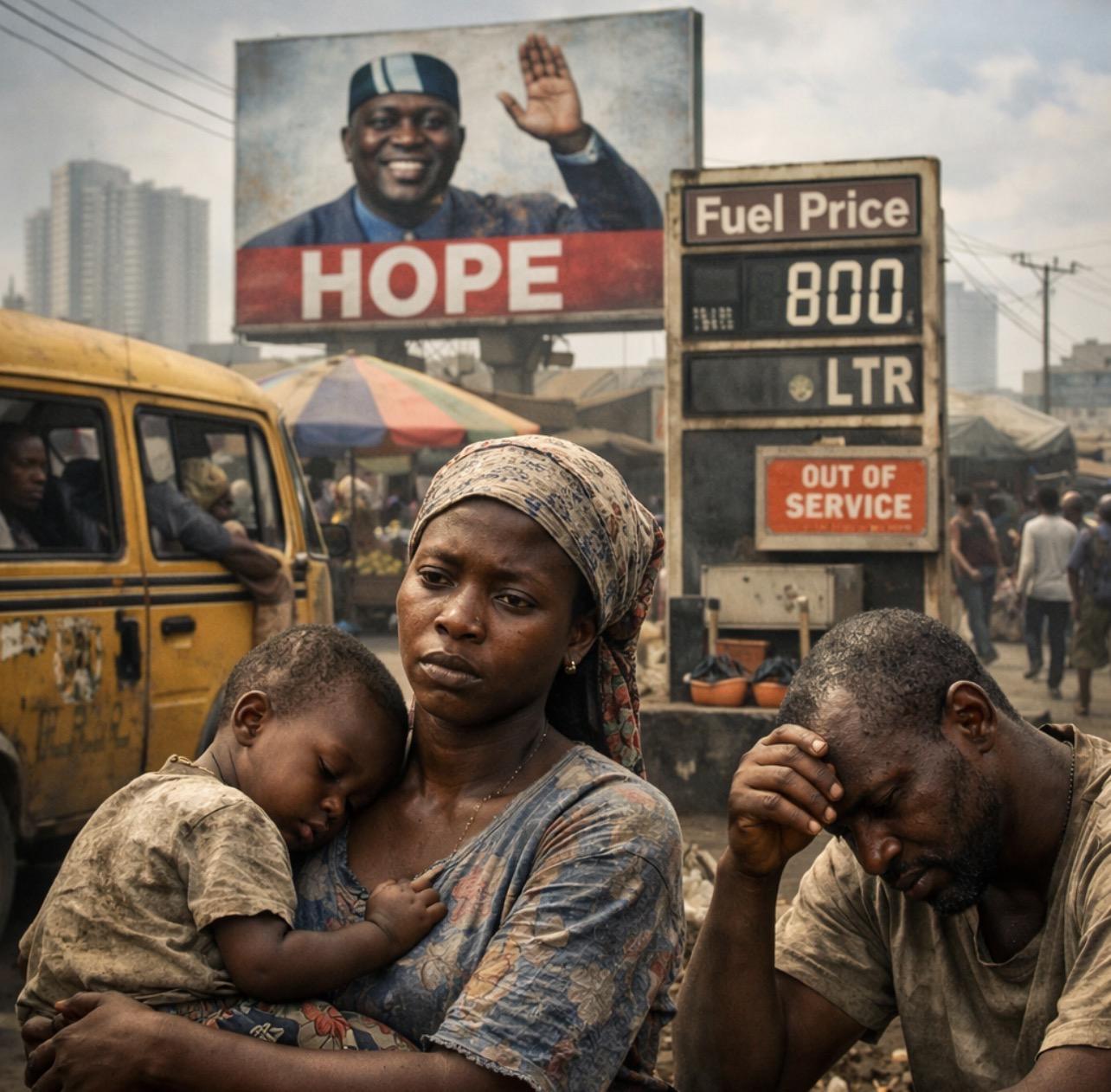
Hope
There was a time not too long ago when many Nigerians looked ahead with the kind of hope that only a tired people can truly understand. It was not a loud hope. It was not the kind that danced in the streets every day. It was a quiet hope, carried in buses, whispered in market stalls, discussed in barbershops, argued over in offices, and prayed over in churches and mosques.
People wanted something simple. They wanted relief.
They wanted a Nigeria where hard work could breathe again. A Nigeria where a worker could earn a salary and still feed a family. A Nigeria where a parent would not stand in the market calculating which child should eat meat and which one should manage soup alone. A Nigeria where the price of transport would not change before morning ended. A Nigeria where small businesses could plan, not just survive.
That was the dream many held.
Some expected bold reforms that would fix long broken systems. Some expected a government that would tell the truth and still protect the weak. Some expected pain at first, yes, but they also expected that the pain would feel meaningful, measured, and shared fairly. They hoped that sacrifice would lead somewhere visible.
Instead, what many ordinary Nigerians feel today is a deep emotional mix of patience, confusion, pride, exhaustion, and disappointment.
Because the truth is this: while some of the country’s economic indicators have shown signs of stabilization and growth, daily life for many citizens still feels brutally hard. Nigeria’s headline inflation was reported at 15.06 percent in the latest rebased March 2026 data from the National Bureau of Statistics, after easing from much higher levels through 2025. The World Bank has also said growth improved, with Nigeria’s economy expanding 3.9 percent year on year in the first half of 2025, while the IMF said reforms helped improve macroeconomic stability and resilience. But those same institutions also stressed that gains have not yet translated into broad relief for ordinary people, with poverty and food insecurity still pressing hard on households.
And that is where the emotional tension lives.
On paper, there are signs that some things are moving in a better direction. In real life, many Nigerians still wake up each day asking a painful question: if things are improving, why does survival still feel this expensive?
That question is not rebellion. It is not disrespect. It is not even always anger. Sometimes it is simply the cry of a mother standing before a food seller with less money than she had last week. Sometimes it is the silence of a father who now thinks twice before turning on the generator. Sometimes it is the frustration of a young graduate who studied hard, believed in tomorrow, and now finds that even transport to a job interview has become a burden.
The average citizen does not live inside policy documents. They live inside prices.
They do not eat GDP growth. They do not cook with fiscal reforms. They do not board a bus with foreign reserve numbers. What they understand is the difference between what they could afford before and what they can afford now.
This is why the Nigerian story today is so emotional. It is not just about whether reforms are right or wrong. It is about how reforms feel when they arrive in homes already stretched thin.
Many Nigerians understood that the country needed serious change. They knew the old ways were broken. They knew subsidy systems were wasteful and vulnerable to abuse. They knew currency distortions and structural weaknesses could not continue forever. They did not reject reform simply because it was hard. What many wanted was a path where reform would be matched by visible protection for ordinary people.
They wanted the government to move fast on relief, not just policy.
They wanted cheaper food, better transport support, stronger wages, more jobs, and credible signs that the burden of adjustment was not falling mostly on those who had the least cushion. They wanted leadership that did not only speak the language of correction but also the language of compassion.
And that is where the emotional divide has grown.
Because people can endure hardship when they believe they are seen.
They can manage pain when they feel it is temporary, honest, and fairly shared. But when hardship stays too long, when relief feels too slow, and when everyday life keeps getting more uncertain, even patient citizens begin to feel abandoned by the very future they were asked to believe in.
Still, this is not a story that should be told only in bitterness.
That would be unfair.
Nigeria is not a simple country, and its problems did not begin yesterday. The cracks in the economy were built over many years. Waste, weak institutions, corruption, policy inconsistency, insecurity, and overdependence on fragile systems all helped create this moment. No single government inherited an easy house. And no serious observer should pretend that deep national problems can be solved like magic.
That is why many Nigerians remain emotionally torn.
Part of them still wants to believe.
Part of them still says maybe this difficult season will lead to something better. Maybe the sacrifice will not be wasted. Maybe the country is going through a rough but necessary correction. Maybe the pain of today will prevent a bigger collapse tomorrow.
That hope is still alive, but it is now more cautious than before.
It no longer sings as loudly.
It watches. It waits. It measures.
It listens to speeches, then looks at the market. It hears promises, then checks transport fare. It reads headlines about reforms, then asks what happened to rent, school fees, medicine, and electricity bills.
This is the new Nigerian emotional condition: hope that now demands proof.
In many homes, people have adjusted in quiet ways that statistics may never fully capture. Families buy less. They postpone plans. They reduce portions. They cut down on travel. They move children from one school to another. They abandon business dreams. They borrow in silence. They smile in public and calculate in private.
This is not just economic pressure. It is emotional pressure.
It changes how people think. It changes how they love. It changes how they argue, save, dream, and even pray.
And yet Nigerians remain Nigerians.
They still laugh. They still hustle. They still help one another. They still find ways to survive systems that should have broken many nations completely. There is something deeply powerful in that resilience, but resilience should never become an excuse for leaders to expect endless suffering from the people.
A strong people still deserve soft landings.
A resilient nation still deserves relief.
A patient citizen still deserves results.
So what did Nigerians expect?
They expected honesty, courage, relief, and visible improvement.
What are many seeing today?
They are seeing reform, yes, but also prolonged hardship. They are seeing signs of macroeconomic repair, but not enough everyday comfort. They are seeing a country trying to rebalance itself, while millions of its citizens are still carrying an unbearable personal cost. The World Bank noted that even with easing inflation, poverty is expected to remain high, and the institution’s October 2025 Nigeria Development Update said improved growth and stronger external balances had still not significantly improved living standards.
That is why this moment must be handled with wisdom.
The Nigerian people do not only need reforms that impress economists. They need outcomes that restore dignity. They need social protection that works. They need food to become more affordable. They need public transport and energy costs that do not crush daily life. They need jobs that are real, not theoretical. They need proof that this season of pressure is leading somewhere better than survival.
Most of all, they need to feel that the nation is not asking the poor to carry the heaviest part of the future alone.
Because a country can survive tough policies.
But no country should become comfortable with normalizing the quiet suffering of its own people.
Nigeria is standing in a fragile emotional space today. Between hope and fatigue. Between belief and doubt. Between patience and frustration. The story is not finished. That is the good news. The pain is real, but so is the possibility of a better chapter.
What happens next will matter more than what was promised before.
If reforms begin to produce visible relief, many Nigerians will endure this chapter and say the pain had purpose.
But if hardship continues without enough human-centered results, then hope itself may become the next national crisis.
And that would be the saddest story of all.

Catégories
Lire la suite
Alibaba Akporobome Alibaba is a Nigerian comedian, actor, master of ceremonies, entrepreneur, and motivational speaker. He is widely regarded as the father of modern Nigerian stand up comedy. Early Life and Background Alibaba whose real name is Atunyota Alleluya Akpobome was born on June 24, 1965, in Warri, Delta State, Nigeria. He grew up in a disciplined family and from a young...

President Bola Tinubu has allegedly continued his smoking habit despite repeated interventions from close aides and allies urging him to quit, SaharaReporters has gathered. Sources familiar with the matter revealed that concerns about the President’s health have been raised several times, but Tinubu has shown no sign of giving up the practice. “Tinubu’s smoking addiction is...

Dagrin: Biography Early Life and Background Dagrin was born Olaitan Olanipekun Oladapo on October 21, 1984, in Ogun State, Nigeria. He grew up in a Yoruba speaking household and was deeply connected to his cultural roots from a young age. Raised in a modest environment, he experienced firsthand the struggles of everyday Nigerian life. These early experiences later became the foundation of his...
Sophie chisom Sophie Chisom Ikemba also known as you Sophie Ososo is a beautiful Nigerian model, actress, social media influencer, chef, skit maker, brand ambassador and content creator born 12th May 1999. She's currently 25 years old and hails from Inewi, Anambra state Nigeria. She is of Igbo descent and Christian by religion.Chisom Ikemba Biography Chisom Ikemba is a Nigerian...

Got a few minutes to kill? Looking for a deceptively simple game that will keep you glued to your screen? Then look no further than Slope. This addictive arcade game is all about guiding a ball down an increasingly treacherous, randomly generated slope. Sounds easy? Think again! What is Slope? An Introduction to Endless Rolling Slope is a free, browser-based game that’s been...