About
About
The Fire That Shaped a Civilization The Forgotten African Iron Smelting Technology of the Nok People
NokCivilization
The Land Before the Fire
Long before the rise of many kingdoms that would later define the history of West Africa, there existed a mysterious and remarkable civilization in what is today central Nigeria. This ancient society is known today as the Nok Civilization. It flourished roughly between 1000 BCE and 300 CE across parts of present day Kaduna, Plateau, and Niger States.
The Nok people lived in a landscape of rolling hills, forests, and fertile valleys. The land was generous, offering water, clay, wood, and rich soil for farming. Small communities formed around these resources. Families built homes of mud and thatch. Farmers cultivated crops like millet and sorghum. Hunters moved through forests tracking antelope and other animals.
Yet beneath the calm rhythm of village life, something extraordinary was happening.
Deep within the earth lay iron ore. To most ancient societies, this reddish stone meant nothing. But to the Nok people, it held the promise of transformation. They would learn how to unlock the metal hidden inside stone and in doing so, change the course of African technological history.
At a time when many parts of the world were still relying heavily on stone tools, the Nok people were mastering the art of iron.
The Secret of the Stone
Iron ore looks ordinary. It resembles a rough reddish rock scattered among the soil and hills. But inside it lies iron, one of the strongest and most useful metals known to humanity.
Extracting iron from stone, however, is not simple.
The Nok people discovered that iron ore could be transformed through fire. Not just ordinary fire, but extremely hot fire sustained for long hours in specially designed furnaces.
This knowledge required experimentation, patience, and deep observation of nature.
Somewhere in the Nok lands, generations ago, a group of curious minds began testing the power of fire. They built clay furnaces, stacked charcoal, and added pieces of iron rich stone. When the furnace burned hot enough, something remarkable happened.
The stone began to release metal.
When the furnace cooled, inside the ashes remained a glowing mass of iron called a bloom. This bloom could be hammered repeatedly to remove impurities and shaped into tools.
What began as experimentation slowly became one of the most sophisticated iron technologies of the ancient world.
The Builders of the Furnace
Iron smelting was not a simple household activity. It was a specialized craft practiced by skilled individuals within Nok communities.
The furnaces themselves were impressive structures.
Made from clay and hardened by heat, many Nok furnaces were tall cylindrical towers built above ground. Some were nearly two meters high. These furnaces had small openings near the base where air could enter and where molten slag could flow out.
Charcoal was the primary fuel. Wood from nearby forests was burned slowly to create charcoal, which produced the intense heat required for smelting.
Inside the furnace, alternating layers of charcoal and crushed iron ore were stacked carefully.
Bellows made from animal skin or wood helped pump air into the furnace, increasing the temperature. The fire burned for hours, sometimes an entire day.
As the temperature rose above 1200 degrees Celsius, the iron ore began to separate from its impurities. Slag, the waste material, melted and drained away while iron collected inside the furnace.
When the process was complete, the furnace would be broken open to reveal the iron bloom.
This moment must have felt magical.
From stone came metal.
From earth came strength.
Fire, Skill, and Community
Iron smelting was not only a technological achievement. It was also a social event.
The entire community often took part in the preparation. Men collected iron ore from hillsides. Others cut wood and burned charcoal. Skilled smelters supervised the furnace construction and the smelting process.
In many African societies, iron smelting was surrounded by rituals and spiritual beliefs. Fire was powerful and mysterious. Transforming stone into metal felt almost supernatural.
Some researchers believe Nok smelters may also have performed ceremonies before lighting the furnace. The success of the smelt depended on many delicate factors including temperature, airflow, and timing.
Too little heat and the iron would not separate.
Too much air and the furnace could collapse.
Only experience and skill ensured success.
Because of this, iron smelters were highly respected members of society.
The Rise of Iron Tools
Once iron was produced, blacksmiths took over.
Using stone anvils and hammering tools, they reheated the iron blooms and shaped them into useful objects.
Iron tools transformed daily life.
Farmers gained stronger hoes and digging tools, allowing them to clear fields faster and cultivate more land. Hunting weapons such as spearheads and arrowheads became sharper and more durable.
Woodworkers gained axes capable of cutting large trees more efficiently.
Iron knives helped with food preparation, leather work, and crafts.
With stronger tools, villages could grow larger, farms more productive, and communities more stable.
Iron technology helped the Nok Civilization thrive for centuries.
The Artists of Nok
The Nok people were not only masters of iron. They were also extraordinary artists.
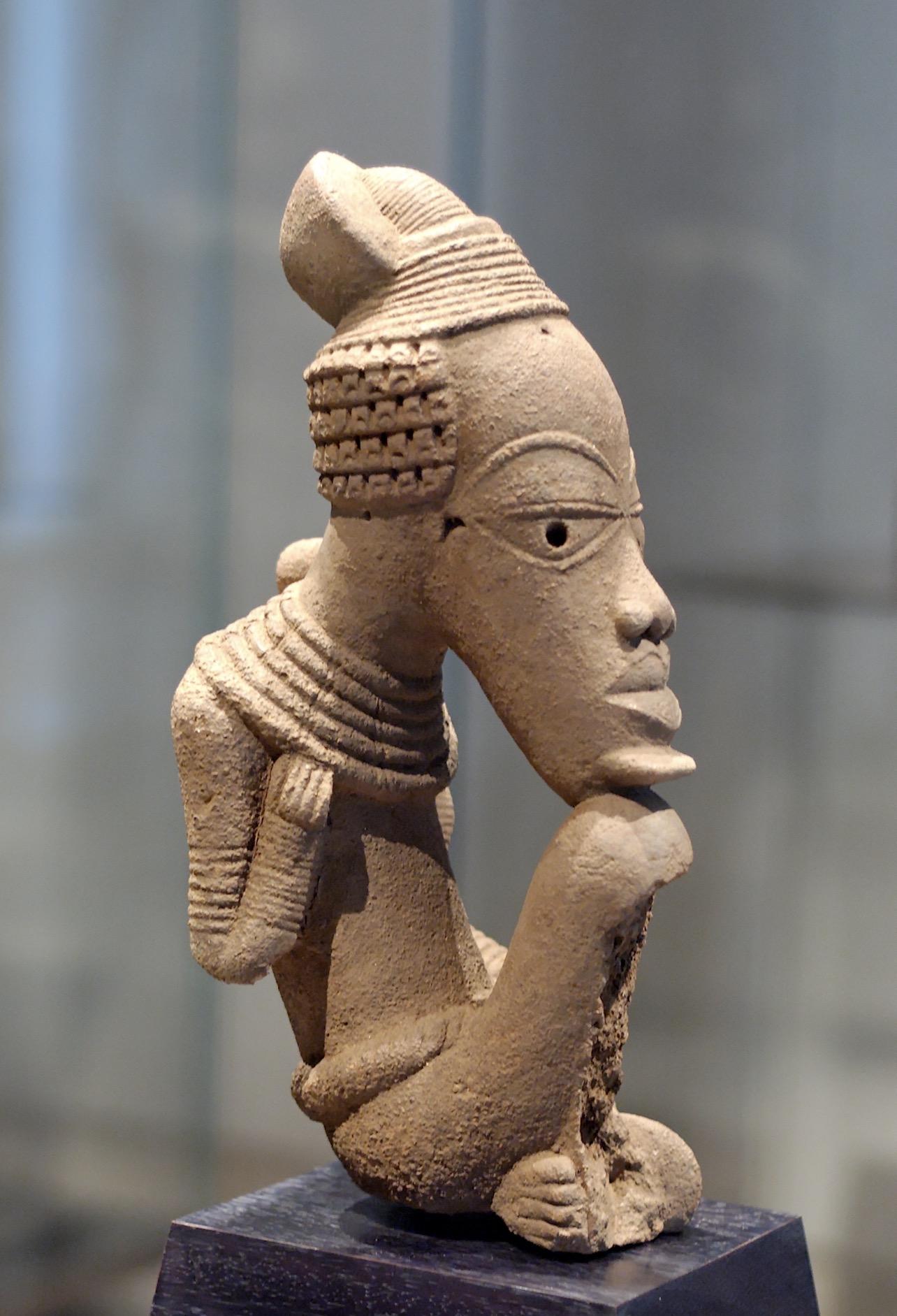
Archaeologists discovered hundreds of Nok terracotta sculptures buried across central Nigeria. These clay figures often depict human heads, animals, and mysterious symbolic forms.
The sculptures are known for their detailed expressions, elaborate hairstyles, and triangular eyes.
Many scholars believe these sculptures had spiritual or ceremonial significance. Some may have represented ancestors, leaders, or protective spirits.
What makes Nok art even more fascinating is its connection to technology.
The same people who built iron furnaces also mastered high temperature clay firing used for terracotta sculptures. Both crafts required deep knowledge of fire, temperature, and materials.
This suggests the Nok civilization possessed a complex technological culture combining art, metallurgy, and engineering.
A Civilization Hidden for Centuries
For thousands of years, the Nok civilization remained hidden beneath the soil.
Then in 1928, something unexpected happened.
A tin miner in the village of Nok in Kaduna State uncovered a strange clay head while digging. The sculpture looked ancient and unlike anything seen before.
Archaeologists soon began studying the area. More sculptures appeared. Then pieces of ancient furnaces. Slag from iron smelting. Tools. Pottery.
Gradually the picture of an advanced ancient African civilization emerged.
Radiocarbon dating showed that Nok iron smelting may have begun as early as 900 BCE.
This discovery shocked historians.
For many years, outdated theories had suggested iron technology in Africa came only from outside influences. The Nok findings proved something very different.
Africans had developed iron smelting independently and very early.
The Mystery of Their Disappearance
Around 300 CE, the Nok civilization began to decline.
Villages were abandoned. Iron furnaces stopped burning. Terracotta sculptures disappeared from the archaeological record.
Why this happened remains a mystery.
Some scholars believe environmental changes may have played a role. Extensive use of wood for charcoal could have led to deforestation. Soil erosion may have reduced farmland productivity.
Others suggest climate shifts, migration, or the emergence of new societies.
Whatever the reason, the Nok people gradually faded from history.
Yet their technological legacy remained.
Later West African societies continued iron production, building on knowledge that may have roots in Nok experimentation.
Rediscovering Africa’s Ancient Technology
Today, the Nok civilization stands as one of Africa’s most important archaeological discoveries.
It tells a powerful story.
Long before colonial contact and long before written records, African societies were experimenting, inventing, and mastering complex technologies.
Iron smelting required chemistry, engineering, resource management, and skilled craftsmanship.
The Nok people possessed all of these.
Their furnaces transformed stone into tools that shaped agriculture, hunting, and community life.
Their terracotta sculptures reveal artistic brilliance.
Their technological achievements challenge outdated narratives about African history.
The Fire That Still Burns in Memory
Although the Nok civilization disappeared centuries ago, its legacy still glows like embers beneath the surface of African history.
Every piece of iron slag found in the soil tells a story of ancient innovation.
Every terracotta head reminds us of the creativity and intelligence of a people who lived thousands of years ago.
The Nok were pioneers of fire and metal.
They transformed earth into tools.
They built furnaces that roared with heat under African skies.
And though their cities may have vanished, the story of their iron remains one of the most remarkable chapters in the history of technology.
Their forgotten furnaces once lit the darkness of ancient nights.
Today, archaeology is slowly bringing that fire back into the light.

Categories
Read More
Bamike Olawunmi BamBam, whose real name is Bamike Olawunmi Adenibuyan, is a Nigerian actress, singer, and reality television personality who rose to fame after participating in Big Brother Naija. Since her time on the show, she has built a successful career in entertainment and brand influencing. Early Life and Background BamBam was born on April 23, 1989, in Ogun State,...

Guinea’s former coup leader, Mamady Doumbouya, has been declared the winner of the country’s presidential election, according to provisional results released on Tuesday. The results show Doumbouya secured 86.72% of votes cast in the December 28 election, giving him an outright majority and eliminating the need for a runoff. Turnout was officially put at 80.95%, though participation...

Dele Giwa: There are journalists who report the news, and there are journalists who become the news. The life of Dele Giwa belongs to the second category. His story is not only about headlines and deadlines. It is about courage in a time of fear, about a man who believed that the truth must be told even when power trembles at its sound. His life burned bright and ended violently, but...
Oba Lamidi Adeyemi III In the ancient town of Oyo, where echoes of cavalry once shook the earth and the memory of empire still breathes in palace walls, a king rose whose presence commanded attention far beyond his kingdom. He was regal, bold, eloquent, and deeply conscious of history. He was Lamidi Adeyemi III, the Alaafin of Oyo. His life was not just a reign. It was a performance...
Ilorin Before the Fulani Kings: The City of Rivers, Horses, and Hidden Prayers Long before Ilorin became known for emirate councils, turbans, palace courtyards, and the strong influence of Fulani rule, it was first simply a frontier town. A place where forest met savannah. Where Yoruba farmers watched the grasslands like a doorway. Where traders from the north arrived with salt,...