About
About
Ilorin Before the Fulani Kings: The City of Rivers, Horses, and Hidden Prayers
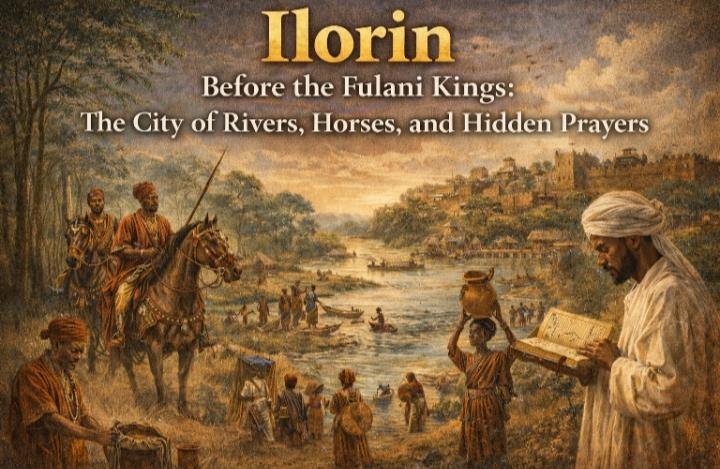
Ilorin Before the Fulani Kings: The City of Rivers, Horses, and Hidden Prayers
Long before Ilorin became known for emirate councils, turbans, palace courtyards, and the strong influence of Fulani rule, it was first simply a frontier town.
A place where forest met savannah.
Where Yoruba farmers watched the grasslands like a doorway.
Where traders from the north arrived with salt, leather, and stories.
Where the Oyo Empire’s shadow stretched far, but did not cover everything.
In those early days, Ilorin was not one thing. It was many things at once.
It was the sound of pestles at dawn.
It was the smoke of ironworks.
It was the smell of shea butter and roasted yam.
It was the shout of hunters returning from the bush.
It was the quiet murmur of men praying in corners new prayers spoken in Arabic words while the town still beat its drum for old deities.
This is the full story of Ilorin before the Fulani became kings, told as a long tale of how a frontier settlement grew into a powerful city ripe for the storm that would later change its leadership forever.
1) The Land That Calls People In
Ilorin sits where the land changes its mind.
To the south, the earth is darker, thicker, more forested good for farming, hidden paths, sacred groves.
To the north, the grass spreads wide—open, windy, full of long-distance routes and horsemen.
It’s a meeting point. And meeting points never stay quiet for long.
Old people used to say the land had two mouths:
One mouth spoke in the language of yam and palm oil
The other spoke in the language of horses and trade
When you live in a place like that, you learn early that strangers will come. Some will come to buy. Some will come to settle. Some will come to fight. Some will come to pray.
And some will come with ambitions too big to hide.
2) The First Ilorin: Water, Iron, and Work
The earliest Ilorin was not yet a city. It was a growing settlement of Yoruba-speaking people families who farmed and hunted and worked iron. The name “Ilorin” is often linked to stone sharpening a place associated with sharpening metal tools and weapons, a town shaped by craft and practicality.
In the beginning, life was simple and serious:
Men cleared farmland and built compounds with mud walls.
Women processed food, wove cloth, and traded in small markets.
Hunters protected the community and supplied meat.
Blacksmiths turned iron into cutlasses, hoes, arrowheads, and later, swords.
Ilorin people were tough not because they loved hardship, but because the frontier demanded toughness. The bush could swallow a careless traveler. Bandits could test a weak settlement. A town that could not defend itself could not last.
So Ilorin learned to work and learned to guard its work.
3) Oyo’s Long Reach
To understand pre-emirate Ilorin, you must understand Oyo.
The Oyo Empire was once one of the most powerful forces in Yorubaland, famous for its cavalry, administration, and influence over many towns. Ilorin, being on the northern edge, became part of the empire’s frontier network important as a defensive point and a gateway for trade.
But Ilorin was not the heart of Oyo.
Ilorin was the edge.
And edges behave differently from centers.
In the center, the king’s rules are firm.
On the edge, the king’s rules arrive like distant thunder: you hear them, you respect them, but you still make your own decisions when the clouds are not directly above you.
Ilorin existed in that in between space:
Close enough to belong to Oyo’s influence
Far enough to develop a bold identity of its own
4) A City of Many Peoples
Even before Fulani kingship, Ilorin was already mixed its strength and its tension both came from this.
Because Ilorin sat on routes that connected Yoruba lands to northern trade corridors, people arrived from different directions:
Yoruba groups, including Igbomina and others
Traders from Hausa speaking areas
Nupe connections moving along river routes
Bariba/Baruba influences from the north-west
Muslim scholars and travelers passing through
Some came to trade and left.
But others stayed.
They married. They built houses. They formed small communities inside the town.
So Ilorin began to speak with more than one accent while still keeping a Yoruba core.
Markets grew bigger.
Goods became more diverse: leather, kola nuts, cloth, horses, grains, iron tools, beads.
And when a town becomes rich, it becomes important.
When it becomes important, it becomes contested.
5) The Drums and the Prayers
Ilorin’s spiritual life was layered like a woven mat.
Many families followed Yoruba traditional religion: honoring oriṣa (deities)
keeping family shrines
celebrating festivals tied to seasons and protection
But Islam also existed in Ilorin early carried by traders and scholars. At first, it did not come with power. It came with discipline.
The new faith offered:
literacy in Arabic
wider connections to scholars and networks a structured moral code a feeling of belonging to something bigger than the town In those days, you could see it:
A man might pour libation at dawn in his father’s compound, then later sit quietly to learn Arabic letters from a teacher who had traveled far.
Some elders disliked it.
Some tolerated it.
Some embraced it.
But almost everyone respected knowledge, and Islam brought knowledge.
So Ilorin became a town where drums could sound at night and prayers could rise before sunrise without the town tearing itself apart.
Not yet.
6) The Frontier’s Constant Fear
Ilorin’s beauty came with danger.
The frontier meant: raids could happen small wars could flare up alliances could shift quickly people could disappear on the road and never return
So Ilorin developed a habit: always keep watch.
Young men trained with weapons.
Hunters doubled as scouts.
Walls and gates began to matter more.
The town’s leaders learned the politics of survival:
Sometimes you fight. Sometimes you negotiate. Sometimes you pay tribute. Sometimes you pretend to be weaker than you are until the right time.
Ilorin was becoming wise.
And in a world like that, wisdom is often sharpened by tragedy.
7) The Rise of Warrior-Leadership
As the town grew, it needed stronger organization. Households and lineages still mattered, but now leadership expanded into military and administrative roles.
Ilorin began to produce or attract warriors men who could command others and defend territory.
In frontier towns, warrior-leaders are admired because people want to sleep at night without fear.
But warrior leaders also bring risk:
A man who can protect the town can also challenge the town.
A man who commands soldiers can also command politics.
So Ilorin’s leadership became a balancing act between elders, chiefs, and military men.
This balance held until the bigger Yoruba world began to shake.
8) When Oyo Began to Crack
Oyo’s decline did not happen in one day. Empires rarely fall neatly. They weaken slowly, like a roof whose wood is rotting inside.
There were many pressures:
internal political conflict economic shifts external threats rebellions and rival powers On the frontier, people felt the change first.
Because when a center weakens, the edge becomes exposed.
Ilorin began to realize that the great empire that once felt permanent was now struggling to control its own space.
And when power begins to slip from the center, local commanders start to ask dangerous questions:
“If the center cannot protect us… why should we obey the center?”
That question is the beginning of many new kingdoms and many disasters.
9) Afonja: The Fire of Ambition
In the history of Ilorin, one name burns brighter than most: Afonja.
Before Fulani kingship, Ilorin became deeply linked to Afonja a powerful Yoruba military figure associated with Oyo’s structures. He is often remembered as a strong warrior whose choices helped reshape Ilorin’s future.
In the stories, Afonja was not a small man in personality. He carried authority like a weapon.
People described him as:
fearless in battle
proud in speech
impatient with weakness
skilled at gathering fighters around him
But ambition is a double edged cutlass.
Afonja’s influence in Ilorin rose during the time when Oyo’s control was weakening. He was a frontier power with real soldiers, real supporters, real resources.
And when you hold that much power at the edge of a weakening empire, you start to believe you can become the center yourself.
So the tension grew:
The old Oyo order demanded loyalty
Frontier leaders wanted autonomy
Ilorin’s mixed population created new alliances and new fears
The town was becoming a dry field.
All it needed was a spark.
10) The City Splits Quietly
Ilorin, even before Fulani kingship, was already a city with two conversations happening at the same time.
Conversation One, spoken loudly in public:
loyalty to Yoruba kingship traditions
the pride of being part of Yorubaland
The importance of lineage, chiefs, and customary authority
Conversation Two, spoken more quietly in private: rising influence of Islamic teachers
new networks of solidarity across ethnic lines
the idea that faith could unite people beyond ancestry
the growth of “learned men” whose power came from knowledge, not lineage
These conversations did not always fight. Sometimes they coexisted.
But as political pressure increased, people began choosing sides not only by tribe, but by what kind of future they wanted.
And once people begin choosing futures, peace becomes fragile.
11) The Scholar’s Shadow
Around this period, Ilorin became increasingly connected to Muslim clerics and teachers. One of the most famous in later history is often remembered as Shehu Alimi (also known as Alimi), a scholar whose presence would later shape Ilorin’s direction.
But in this part of the story before Fulani kingship what matters most is not the later outcomes, but the early atmosphere:
Ilorin was attracting scholars because:
it was a crossroads
it had trade wealth
it had people interested in learning
it had military leaders who wanted spiritual legitimacy
In many West African societies, power and religion often dance together:
Warriors seek blessings.
Kings seek legitimacy.
Communities seek protection from the unseen.
So scholars gained respect. Their words began to matter. Their gatherings became larger. Their influence spread quietly, like dye soaking into cloth.
12) A Town That Could No Longer Stay Neutral
Ilorin used to be able to play many roles:
Yoruba town
frontier fortress
trade hub
mixed settlement
place where old religion and Islam coexisted
But the coming storms of the region made neutrality harder.
As Oyo weakened, nearby conflicts increased.
As armies moved, refugees arrived.
As raids happened, fear became normal.
And fear changes people.
Fear makes people accept stronger leaders.
Fear makes people cling to faith.
Fear makes people tolerate harsh decisions if those decisions promise safety.
Ilorin began to harden not only in walls and weapons, but in mindset.
13) The Market That Heard Everything
If you want to know what Ilorin felt like then, imagine its market.
The market was the city’s ear.
At dawn, women arranged produce.
Grain sellers argued about measures.
Leather traders displayed saddles and straps.
Northern merchants offered salt and cloth.
Horses stood restless in the heat.
And beneath the normal noise, the market carried rumors:
“Oyo is weaker now.”
“Afonja is angry.”
“Another town was raided.”
“A new teacher arrived his prayers are powerful.”
“Some warriors have sworn new oaths.”
“Someone is planning something.”
In African cities, markets don’t only sell goods.
They sell knowledge.
And knowledge, once shared, cannot be put back into silence.
14) The Young Man Named Aderemi
To bring the old Ilorin to life, imagine a young man let us call him Aderemi born into a Yoruba family of farmers and hunters.
Aderemi grew up with two teachers:
his father, who taught him farming and the drum rhythms of old festivals
a traveling mallam, who taught him letters and the discipline of prayer
Aderemi could recite praise poetry and also recognize Arabic script on a wooden slate.
His best friend, Bako, came from a northern trader family that had settled in Ilorin. Bako spoke Yoruba with a different rhythm and knew caravan routes like a map in his head.
They were young men in a town that had not yet decided what it wanted to be.
One day, as they sat near the market watching horsemen pass, Aderemi asked:
“Do you think Ilorin belongs to the forest or to the savannah?”
Bako smiled. “It belongs to whoever can hold it.”
That answer did not sound like a joke.
It sounded like prophecy.
15) The Night the Drums Stopped Early
One evening, a festival began as usual drums, songs, laughter. But before midnight, the drummers slowed. People started going home earlier than normal.
Because scouts had brought news:
strangers had been seen near the northern paths.
Not traders. Not farmers.
Men moving carefully.
Men watching.
No raid happened that night, but the mood changed.
Aderemi noticed something:
Older men who used to laugh loudly now spoke in careful tones.
Women who used to dance freely now watched their children more closely.
Even the dogs barked differently like they were hearing something the people could not.
That was Ilorin then: a city learning to listen harder.
16) Power Wants a Crown
When Oyo was strong, Ilorin could rely on the empire’s authority.
But when the empire weakened, Ilorin’s leaders began to behave like independent rulers. And among leaders, the most dangerous desire is not money it is permanence.
Money can be stolen.
Fame can fade.
But a crown once accepted can rewrite history.
In Ilorin, power was beginning to reorganize itself:
military influence expanded
scholars gained authority
old chiefs tried to keep control
traders funded whichever side protected commerce
The town was becoming a pot of soup with too many cooks.
And when too many cooks argue, the soup spills.
17) The Gathering of Warriors
Afonja’s men were not only Yoruba fighters from Ilorin. He drew in warriors from many places especially those who disliked Oyo’s weakening center or wanted the opportunities that conflict brings.
Afonja promised strength. He promised protection. He promised a future where Ilorin would not bow to distant authority.
Many young men found that promise irresistible.
Even Aderemi’s cousin joined them, saying:
“Better to follow a strong commander than a dying empire.”
But Aderemi was not fully convinced. He watched the warriors train and noticed something troubling:
Their unity was not built only on love for Ilorin.
It was also built on anger.
Anger is powerful fuel.
But it burns the hands that carry it.
18) The Quiet Growth of the Learned Men
While warriors trained in the open, the scholars grew influence quietly.
They gathered students.
They settled disputes.
They provided spiritual comfort.
They created networks of loyalty that were not based on lineage alone.
Some Yoruba families sent their children to learn because literacy was valuable. Some traders supported the scholars because scholars strengthened trade connections northward. Some warriors sought blessings because no soldier wants to die without feeling protected.
So, without a battle, a new kind of power was taking root: moral authority.
And moral authority, when combined with politics, can become a throne.
19) Ilorin as a Doorway
By now, Ilorin was not just a town. It was a doorway:
a doorway between Yoruba lands and the north a doorway between old religion and Islam
a doorway between empire loyalty and local ambition
a doorway between mixed identities and political unity
Doorways are important, but they are also vulnerable.
Because everyone wants control of the doorway.
20) The Final Calm Before the Shift
The period “before Fulani became kings” in Ilorin is best described as a final calm filled with hidden tension.
On the surface, daily life continued:
farming seasons still came
markets still opened
marriages still happened
children still played
But underneath, people sensed a turning.
Aderemi felt it when:
his father began storing more food “just in case”
chiefs held longer meetings behind closed doors
warriors stopped smiling easily
scholars spoke more boldly in public It was like the town was breathing in holding its breathwaiting for something.
21) The River Knows
There is a belief in many Yoruba communities that rivers remember.
Ilorin’s waterways and surroundings watched generations pass:
those who came seeking refuge
those who came seeking wealth
those who came seeking power
those who came with books and prayer mats those who came with horses and spears
The river does not choose sides, but it sees who comes to drink and who comes to wash blood from their hands.
Ilorin was approaching a moment when the river would see more than trade and laughter.
At this point in Ilorin’s history:
Ilorin has grown from frontier settlement into a major town
Oyo’s power is weakening and no longer feels permanent
Yoruba warrior leadership (especially Afonja’s influence) is strong and ambitious
Islam and scholarship are already established and expanding influence
The town is mixed, strategically located, wealthy, and politically tense
Ilorin is standing at a crossroads, and crossroads are where history changes direction.
Aderemi and Bako, still young, watch the same road one evening. A line of travelers approaches some with books, some with weapons, some with calm faces that do not reveal their plans.
Aderemi whispers, “Do you think they came to trade?”
Bako replies softly, “Sometimes trade is only the beginning.”
The sun sets.
The town lights its fires.
And Ilorin still Yoruba-led in this moment waits.
Because the next chapter will not be written by farming seasons and markets alone.
It will be written by alliances, betrayals, and the struggle to decide what kind of city Ilorin will become.
And that next chapter is exactly where Fulani kingship begins.
TBC


Categorii
Citeste mai mult
Vincent Enyeama In the dusty fields of southern Nigeria, where boys chase footballs with bare feet and dreams travel faster than the ball itself, a quiet child once discovered that he was not meant to score goals. He was meant to stop them. His name is Vincent Enyeama, and for more than a decade, he stood as the last line of defense for the Nigeria national football team, guarding not...

The Middleman Kings Who Sold the World Between Their Fingers In the beginning, they were not kings, at least not the kind that wore crowns or sat on carved thrones beneath royal umbrellas, yet they ruled something far more slippery and powerful than land, they ruled connection, they ruled the space between desire and possession, between producer and consumer, between one world and another, and...
Russia has carried out another test of its nuclear-capable underwater drone, Poseidon, President Vladimir Putin announced on Wednesday — just days after testing the Burevestnik cruise missile, despite US President Donald Trump’s warnings. Putin declared that no country can match Poseidon’s speed or depth, boasting that it can operate at over one kilometre deep and travel up...

In line with its unwavering stance against vandalism and the sabotage of electricity infrastructure, Ikeja Electric Plc. has reported the conviction of three individuals by Lagos Magistrate Courts for offences related to the destruction and theft of power distribution assets within its network. The successful convictions underscore the company’s firm commitment to protecting its...

Introduction The history of Ethiopia is one of the oldest and most remarkable in the world. Often referred to as the cradle of humanity, Ethiopia holds a unique place not only in African history but in global civilization. Unlike most African nations, Ethiopia was never permanently colonized, and it developed a rich cultural, religious, and political tradition that stretches back thousands of...