About
About
Cristóvão Cacombe and Arobot: The Angolan Innovator Building Africa’s Robotics Future
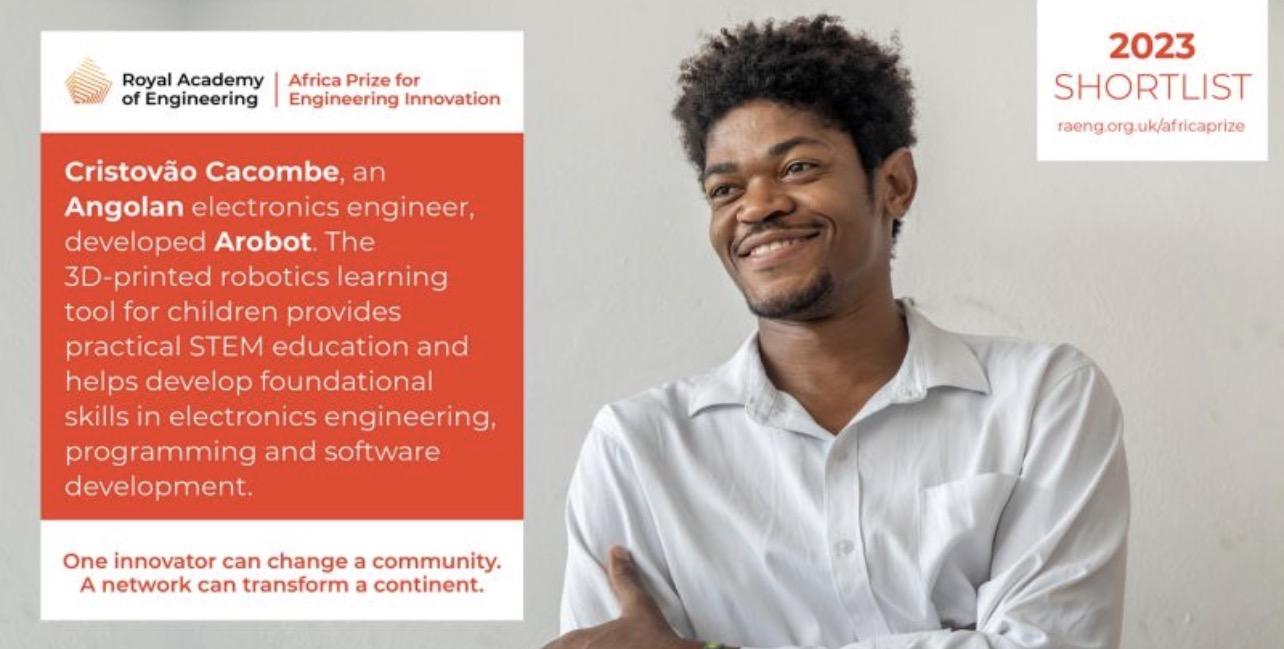
Cristóvão Cacombe
Cristóvão Cacombe’s story is the kind that carries both urgency and hope. It is the story of a young Angolan engineer who looked at a major gap in education and refused to accept it as normal. In a country where many students have ambition but limited access to practical robotics laboratories, tools, and technical learning spaces, he chose not to wait for a perfect system to appear. He decided to build something that could bring robotics closer to children and young people. That invention became Arobot, a learning tool designed to make robotics education more accessible, practical, and exciting for students in Angola.
At the center of this story is not just a machine, but a mission. Cristóvão Cacombe is described by the Royal Academy of Engineering as an Angolan electronics engineer who created Arobot to respond to the lack of robotics labs in schools in his country. The problem he was trying to solve was clear. Africa’s technology sector is growing, yet the number of students and professionals with practical engineering and programming skills has not always kept pace with that growth. That creates a skills gap, and gaps like that can quietly limit the future of thousands of young people. Arobot was built as a direct response to that challenge.
To understand why Arobot matters, it helps to understand what it is. Arobot is a robotics learning kit for children. It is modeled after the kupapata, a three wheeled motorbike widely recognized in Angola. That design choice is meaningful because it gives the invention a local cultural identity. It is not simply a copy of a foreign educational tool. It is something designed with Angolan life in mind, something familiar in shape but innovative in function. The robot uses two motors connected to a microcontroller. It communicates by Bluetooth with an open source electronic prototyping platform, which allows learners to create and program interactive objects. It is battery powered, and its body and wheels are made from recycled 3D printed plastic. It also includes ultrasonic and ultraviolet sensors, allowing students to code real actions such as obstacle avoidance and path following.
One of the strongest ideas behind Arobot is that it does not arrive as a finished mystery box. It comes unassembled. Students build it from 3D printed parts, usually in groups of four, which encourages teamwork and collaboration. After building it, they move into coding and testing. With the aid of instructions and video support, they can program the robot in C++, Scratch, and other programming languages. This means the invention is not just a toy and not just a piece of hardware. It is a full learning experience that combines design, assembly, electronics, software, experimentation, and problem solving. In one tool, Cacombe and his team created an entry point into engineering.
That is where Cristóvão Cacombe’s vision becomes especially important. Many people talk about preparing African youth for the future. Fewer people build tangible tools that allow that preparation to happen in real classrooms and real communities. Arobot is practical. Students can touch it, assemble it, code it, make it move, and understand how hardware and software interact. For many young learners, that type of direct experience can be the difference between merely hearing about technology and truly believing they can become part of it.
His work did not emerge in isolation. Cacombe is also tied to Arotec, the Angolan startup behind broader educational technology efforts. According to reporting and Africa Prize materials, Arotec was founded around 2019 or 2020 and focuses on developing educational kits in science and technology, along with software solutions, simulators, and training programs. The company’s broader goal is to make technical education more available, not only through hardware like Arobot but through courses and learning systems as well. The Africa Prize 2024 interactive showcase notes that Arotec offers products such as the Arobot kit and an oil rig simulator, while also running Arotec Academy for practical courses in robotics, mechatronics, and instrumentation.
This matters because it shows that Arobot was never just a one off idea. It belongs to a wider educational ecosystem. Cristóvão Cacombe seems to have understood that technology training is strongest when it is supported by institutions, mentoring, competitions, and community. The Royal Academy of Engineering page says he and his team operate eight technical education centers where Arobot lessons are offered, alongside an online platform providing robotics, STEM, and AI courses. That combination of physical and digital learning expands the reach of the invention. It means Arobot is both a product and a platform for wider talent development.
Recognition soon followed. Cacombe and Arobot were selected for the Africa Prize for Engineering Innovation shortlist. Multiple reports from 2022 and 2023 identify Arobot as one of the inventions chosen for this major continental engineering innovation program. The significance of that recognition goes beyond prestige. The Africa Prize has become one of the most visible platforms for highlighting African engineering solutions that respond to real problems. For an Angolan inventor focused on robotics education, being shortlisted signaled that this was not just a local classroom project. It was an idea with continental relevance.
The strength of the invention lies partly in how clearly it answers a real need. In many parts of Africa, students are often expected to prepare for a digital future without access to the tools that make digital literacy truly practical. They may learn theory, but without equipment, experimentation can remain limited. Arobot narrows that distance. It allows learners to move from passive learning to active building. It turns abstract topics into concrete actions. A child who assembles a robot, powers it, pairs it through Bluetooth, writes simple code, and watches it react to sensors is not just memorizing information. That child is beginning to think like an engineer.
There is also something thoughtful about the material design. The use of recycled 3D printed plastic gives Arobot an environmental dimension, even if its main purpose is educational. It shows awareness that modern innovation does not have to ignore sustainability. In educational technology, design choices often shape cost, local manufacturability, and adaptability. Arobot’s structure suggests it was built with practicality in mind. It needed to be teachable, portable, and suitable for repeated learning environments.
Cristóvão Cacombe’s work also appears connected to a larger movement in robotics training and youth mentorship in Angola. He has been identified as team organiser for Angola’s 2022 FIRST Global team. FIRST Global is an international robotics competition that brings together students from countries around the world. On the team page, Cristovao Mario Cacombe is listed among the mentors and organisers, and the page notes that the team emerged from Angola’s first national robotics championship organized by Arotec, with more than 500 students participating. That is an important detail because it shows that his contribution extends beyond inventing a tool. He has also helped build pathways for students to compete, represent Angola internationally, and grow through robotics.
That role as a builder of systems may be one of the most important parts of his legacy. It is possible for a talented inventor to create a good product and stop there. Cacombe appears to have pushed further. He helped organize learning, competition, mentorship, and visibility. A 2024 LinkedIn indexed post cited by search results states that he was organizing the third edition of the national robotics competition in Angola, working with schools and student teams, and that a winning team from 2022 went on to compete globally and earned a bronze medal. While indexed search snippets should be treated more cautiously than full official reports, they align with the broader picture of sustained robotics leadership around his work.
There is also evidence that Arotec and Cacombe have continued to grow in profile. Reporting from late 2024 notes that Arotec presented at Web Summit 2024 and was described as an Angolan startup focused on technological solutions for education. Another report says the company worked with around 50 educational institutions in Angola and had raised about fifty thousand dollars in investment by late 2024. Those reports suggest that the original idea behind Arobot has been scaling through partnerships, visibility, and institutional adoption. The same reporting presents Arotec as more than a single product company. It is portrayed as a broader educational technology initiative rooted in Angola but looking outward toward African and international expansion.
An official 2025 Royal Academy of Engineering news post goes even further in showing impact over time. It states that since 2021, Arobot has expanded its services to 15 cities across Angola and trained more than 7,000 students. That is one of the clearest signs that Cristóvão Cacombe’s invention moved beyond prototype status into measurable educational reach. Training thousands of students across multiple cities means the work is no longer symbolic. It has entered the realm of direct national impact.
This scaling tells a deeper story about what invention means in an African context. Innovation is often celebrated at the moment of launch, but the harder challenge is continuation. Can a useful idea survive beyond headlines. Can it reach real people. Can it keep functioning in difficult conditions. Can it fit local realities in price, language, culture, and infrastructure. Arobot’s continuing expansion suggests that Cacombe and his team have managed at least part of that difficult journey. They created something relevant, and then they kept moving with it.
His story also reflects a broader change in how Africa is thinking about education and technology. For years, the continent has often been discussed mainly as a consumer of imported tools. But inventors like Cristóvão Cacombe complicate that narrative. Arobot was designed locally, shaped by a local transportation symbol, and targeted at a local educational need. The company behind it built capacity in training and competition inside Angola. That is not just consumption. That is creation. It is local engineering responding to local reality while still connecting with global innovation spaces like the Africa Prize and Web Summit.
There is something especially powerful about focusing on children and students. When people think of engineering breakthroughs, they often imagine massive industrial machines, medical devices, or high finance technology. But an educational robot can be just as transformative because it changes who gets to participate in the future. Arobot is not only about the functions of motors and sensors. It is about confidence. It is about exposure. It is about changing what a child believes is possible. Once students begin to build and program something with their own hands, technology stops being distant. It becomes personal. It becomes reachable. That shift can influence career choices, entrepreneurial ambition, and national talent pipelines for years. This is an inference drawn from the educational design and reach reported for Arobot and Arotec.
The details of Arobot’s functionality support that educational mission well. Its sensors allow students to explore real programming logic. Its Bluetooth capability connects the physical object to software learning. Its compatibility with laptops and phones gives it flexibility. Its unassembled form turns learning into making. Its recycled plastic structure hints at local production and sustainability. Its group based assembly encourages teamwork rather than isolated trial and error. Piece by piece, the invention was designed not just to impress, but to teach.
The image of the kupapata is also a clever part of the story. In many innovation ecosystems, successful products are those that feel familiar enough to invite trust and novel enough to spark curiosity. By modeling the robot after a recognizable Angolan three wheeled motorbike, Cacombe grounded the invention in a visual language students already knew. This kind of local reference can make technology feel less foreign and more owned by the community using it. That may seem like a small design decision, but small decisions often shape adoption.
What makes Cristóvão Cacombe stand out is that his work sits at the intersection of invention, education, entrepreneurship, and mentorship. He created a product. He helped build a company around educational technology. He contributed to national robotics training. He supported student participation in global competitions. He brought his work onto international stages. Each of those parts reinforces the others. The inventor strengthens the mentor. The mentor strengthens the startup. The startup strengthens the students. The students strengthen the national ecosystem.
In Angola, where technical and scientific education still faces infrastructure and access challenges, that kind of layered contribution matters a great deal. It suggests a practical model for change. Do not wait for perfect conditions. Build tools that fit your reality. Create learning spaces. Train students. Enter competitions. Form partnerships. Improve visibility. Scale step by step. That is the rhythm that seems to run through Cristóvão Cacombe’s journey.
His story is also part of a larger African story, one where young engineers are no longer only responding to imported agendas. They are defining their own priorities. In this case, the priority is not simply robotics for prestige. It is robotics for access. Robotics for education. Robotics for national capacity building. That is what gives Arobot its meaning. It is an invention, but it is also an argument. It argues that African children deserve tools that let them build the future, not just admire it from a distance. This concluding interpretation is based on the documented educational purpose and expansion of Arobot.
So when people speak about Cristóvão Cacombe, they are not only speaking about the creator of a robot. They are speaking about an Angolan innovator who saw a missing piece in the learning journey of young people and chose to engineer a response. Through Arobot and Arotec, he helped turn robotics from an abstract dream into a hands on experience for students. He showed that innovation can be local, culturally grounded, technically useful, and socially ambitious at the same time.
And that may be the most important part of the whole story. Arobot is not only about what it can do when powered on. Its deeper power lies in what it awakens in the students who use it. Curiosity. Confidence. Technical skill. Teamwork. Imagination. Those things are harder to measure than sensors and motors, but they are often the real engines of national progress. Cristóvão Cacombe’s contribution is that he built a tool that carries all of those possibilities in motion.

Categories
Read More
On September 7, 2025, while Nigerians were still mourning the killing of over 130 citizens in a single day, the Department of State Services (DSS) found time — not to protect lives, not to hunt terrorists or kidnappers — but to write to Meta (Facebook’s parent company) demanding the removal of activist Omoyele Sowore’s page. Why? Because he criticised President Bola...

Robben Island Far out in the cold waters of Table Bay, just a few kilometers from the city of Cape Town, lies a small rocky island that once held the dreams of a nation behind iron bars. This island is Robben Island, a place whose prison walls witnessed some of the most powerful scenes in the history of the struggle for freedom in South Africa. Today the island is quiet....
Abia – Alex Otti (Labour Party – LP) Adamawa – Ahmadu Umaru Fintiri (PDP) Akwa Ibom – Umo Eno (APC) Anambra – Charles Chukwuma Soludo (APGA) Bauchi – Bala Mohammed (PDP) Bayelsa – Douye Diri (APC) Benue – Hyacinth Alia (APC) Borno – Babagana Umara Zulum (APC) Cross...

Sting Sting, whose real name is Gordon Matthew Thomas Sumner, is a British singer, songwriter, bassist, and actor known for his distinctive voice and influential career in rock and pop music. He first gained fame as the lead singer of the band The Police before launching a successful solo career. Sting was born on October 2, 1951, in Wallsend, England. Early Life and Background Sting...

Muhammadu Sanusi II In the ancient city of Kano, where centuries of royal drums echo through narrow streets and sandstone walls whisper stories of empires, a child was born into legacy. That child would grow to become one of Nigeria’s most outspoken intellectuals, a central banker who shook financial giants, and later a monarch whose voice could not be silenced. He is Muhammadu...