Environ
The Arena of Blood and Glory: The Untold Story of El Jem Amphitheatre in Tunisia
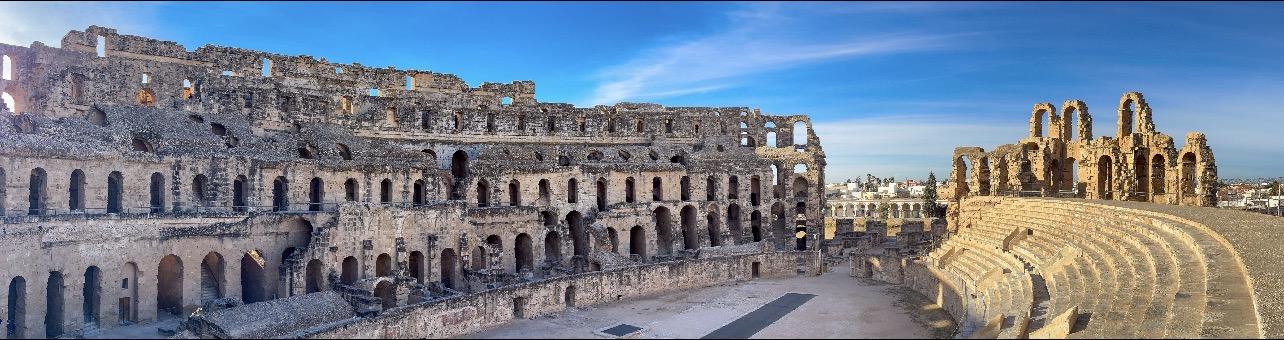
El Jem Amphitheatre
In the heart of Tunisia, surrounded by olive groves and quiet desert winds, stands one of the most powerful reminders of ancient history in Africa. Massive stone walls rise toward the sky, arches stretch endlessly around a circular structure, and beneath the ground lie dark corridors that once held animals and gladiators waiting for battle.
This is the El Jem Amphitheatre, one of the largest and most impressive Roman monuments ever built outside of Rome itself.
Today it stands as a silent monument visited by tourists and historians. But nearly two thousand years ago this place was filled with thunderous cheers, roaring animals, clashing swords, and the dramatic spectacles of Roman entertainment.
Thousands of spectators once gathered here to watch gladiators fight for survival, criminals face wild beasts, and warriors compete in brutal contests of strength and courage. The amphitheatre was not just a building. It was a symbol of power, control, and the reach of the Roman Empire deep into Africa.
The story of El Jem is the story of empire, wealth, rebellion, and survival across centuries.
The Rise of Roman Africa
To understand the importance of El Jem Amphitheatre, we must first travel back to the time when North Africa became part of the powerful Roman Empire.
Before Rome controlled the region, North Africa was dominated by the ancient civilization of Carthage. Carthage had been one of the greatest trading empires in the Mediterranean. But after the famous Punic Wars between Carthage and Rome, Rome destroyed Carthage in 146 BCE and gradually took control of the region.
The land that is now Tunisia became part of the Roman province known as Africa Proconsularis.
This region quickly became one of the most important territories in the Roman world.
The fertile lands of North Africa produced huge quantities of wheat and olive oil. These goods were shipped across the Mediterranean to feed the growing population of Rome.
Roman cities began to appear across the region. Roads, temples, baths, and theatres were built. Roman culture spread quickly, mixing with local traditions.
Among the cities that grew wealthy during this period was a place called Thysdrus.
The Ancient City of Thysdrus
The modern town of El Jem was once the ancient Roman city of Thysdrus.
During the second and third centuries Thysdrus became extremely prosperous because of olive oil production. Olive farms stretched across the surrounding countryside, and massive presses were used to extract oil that would be exported throughout the empire.
The wealth generated by this industry made the local elite incredibly powerful.
Roman citizens living in Thysdrus wanted to show their prosperity and loyalty to Rome. One of the most effective ways to do this was by building monumental public structures.
And so the idea of constructing a giant amphitheatre was born.
The Birth of a Giant Arena
Around the year 230 CE construction began on what would become the El Jem Amphitheatre.
The builders were inspired by the famous Colosseum in Rome. Their goal was to create a massive arena that would display the greatness of Roman civilization in Africa.
The structure was built using enormous blocks of stone rather than concrete, which was commonly used in Roman architecture elsewhere.
The amphitheatre rose nearly forty meters high and could hold around thirty five thousand spectators.
To imagine its scale is astonishing.
At that time Thysdrus itself probably had a population of only a few thousand people. This means the amphitheatre was built not only for the city but also for visitors traveling from surrounding regions.
It was the third largest amphitheatre in the Roman world after the Colosseum in Rome and the amphitheatre at Capua in Italy.
Its outer walls were decorated with elegant arches arranged in multiple levels. Inside the arena corridors and stairways allowed thousands of spectators to enter and leave efficiently.
Beneath the arena floor were underground chambers where animals and gladiators waited before being brought into the arena.
Life Inside the Arena
The amphitheatre was the center of entertainment in Roman society.
Spectators gathered to watch events known as gladiatorial games.
These games were not simply sport. They were dramatic spectacles designed to entertain the public and demonstrate the power of Rome.
Gladiators were trained fighters who battled each other using swords, shields, tridents, and other weapons. Some were prisoners of war. Others were slaves or criminals. A few volunteered in search of fame and fortune.
The battles could be deadly, but they also followed certain rules and traditions.
Some gladiators became famous heroes admired by crowds.
Wild animal hunts were another popular event. Exotic animals such as lions, leopards, bears, and even elephants were brought from different parts of the empire to fight hunters or prisoners in the arena.
These spectacles were both thrilling and terrifying.
For the Roman authorities these games served an important political purpose. They entertained the population and reinforced the power of the empire.
When thousands of people cheered inside the amphitheatre they were celebrating not only the fighters but also the strength of Rome itself.
A Symbol of Wealth and Status
The construction of the El Jem Amphitheatre reflected the enormous wealth of Thysdrus.
Only a prosperous city could afford to build such a massive structure.
Local elites likely financed much of the project in order to gain political influence and social prestige.
Hosting games and public events was a way for wealthy citizens to demonstrate generosity and loyalty to the Roman state.
In this way the amphitheatre became both a cultural and political symbol.
It showed that Thysdrus was not just another provincial town but an important part of the Roman world.
The Great Revolt of Thysdrus
However the history of the amphitheatre is also tied to a dramatic rebellion against Rome.
In the year 238 CE the citizens of Thysdrus revolted against the Roman emperor Maximinus Thrax.
The emperor had imposed heavy taxes and harsh policies that angered many wealthy landowners.
Local leaders in Thysdrus declared support for a new emperor named Gordian.
This event became known as the Revolt of Gordian.
Although the revolt began with enthusiasm it was quickly crushed by Roman forces.
The rebellion failed and many participants were executed.
This uprising marked a turning point in the city’s history.
Although Thysdrus remained important for some time its political power declined.
Decline of the Roman World
As centuries passed the Roman Empire itself began to weaken.
Political instability, economic troubles, and external invasions gradually reduced Roman control across many regions.
North Africa experienced invasions by the Vandals in the fifth century.
Later the Byzantine Empire regained control for a time before the arrival of Arab armies in the seventh century.
During these changes the amphitheatre slowly lost its original purpose.
Gladiatorial games disappeared as Roman culture faded.
The once lively arena became quiet.
But the massive structure remained standing.
A Fortress in Times of War
In later centuries the amphitheatre took on a completely different role.
Because of its strong walls and strategic position it was used as a fortress during conflicts.
Local populations sometimes sheltered inside the structure during attacks.
One famous story involves a Berber leader named Al Kahina who resisted Arab expansion in North Africa during the seventh century.
Legends say that fighters used the amphitheatre as part of their defensive strategies.
Although the historical details remain debated the story reflects how the structure continued to serve local communities long after the Roman era.
Damage and Survival
Over time parts of the amphitheatre were damaged by earthquakes and human activity.
Some stones were removed and reused in nearby buildings.
In the seventeenth century Ottoman forces even damaged sections of the walls while suppressing a local rebellion.
Yet despite all these challenges the amphitheatre survived.
Its strong stone construction helped preserve much of the structure.
Today visitors can still walk through its corridors and stand in the arena where gladiators once fought.
Recognition as a World Heritage Site
In modern times historians and archaeologists began recognizing the incredible historical value of El Jem.
The amphitheatre is one of the best preserved Roman monuments in the world.
In 1979 it was officially designated a UNESCO World Heritage Site.
This recognition highlights its importance not only for Tunisia but for global history.
The monument provides insight into Roman architecture, entertainment, and the cultural life of ancient Africa.
Why El Jem Amphitheatre Is Historic
El Jem Amphitheatre is historic for several reasons.
First it demonstrates the reach of the Roman Empire into North Africa and the integration of African cities into Roman culture.
Second it represents the wealth and prosperity that existed in ancient North African societies through agriculture and trade.
Third it stands as one of the largest and best preserved Roman amphitheatres in the world.
Finally it tells the story of changing civilizations from Roman rule to Islamic expansion and modern Tunisia.
Few structures in the world have witnessed so many historical transformations.
A Silent Witness of Time
Today the amphitheatre stands quietly under the Tunisian sun.
Birds fly through its arches and visitors walk along ancient stone paths where Roman citizens once gathered.
The roar of crowds and clash of weapons are gone, replaced by the sound of wind moving through the ruins.
Yet the structure still speaks.
Its walls tell stories of gladiators seeking glory, emperors displaying power, rebellions challenging authority, and generations of people who found shelter within its massive stones.
El Jem Amphitheatre is more than an ancient ruin.
It is a witness to two thousand years of human history and one of the greatest historical treasures on the African continent.


Catégories
Lire la suite
Mary Njoku Mary Njoku is a Nigerian actress, producer, and entrepreneur widely recognized for her contributions to Nollywood and her role in building one of Africa’s leading film production companies. She is the founder of Rok Studios and a key figure in modern Nigerian cinema. Mary Remmy Njoku was born on March 20, 1985, in Amuwo Odofin, Lagos State, Nigeria. Early Life and...

A High Court in Nairobi, Kenya, has declared the abduction and transfer of the leader of the Indigenous People of Biafra (IPOB), Mazi Nnamdi Kanu, from Kenya to Nigeria in June 2021 as illegal and a gross violation of his fundamental rights. In a landmark judgment delivered by Justice E.C. Mwita on June 24, in documents obtained by THE WHISTLER on Friday, the court ruled that the Kenyan...

Niyi Osundare: Some poets write from ivory towers. Others write from the soil. The life of Niyi Osundare belongs to the second kind. His poetry carries the rhythm of village drums, the anger of political protest, and the tenderness of rain on parched earth. He is not merely a writer of verses. He is a public voice, a cultural custodian, and a man who believes poetry must live among the...

Denrele Edun Denrele Edun is a Nigerian television host, actor, model, and media personality known for his bold fashion style, energetic personality, and strong presence in the entertainment industry. His full name is Adenrele Oluwafemi Edun, and he was born on June 13, 1981, in Hamburg, Germany. Early Life and Background Denrele Edun was born in Germany but raised in Lagos,...

Human rights activist and lawyer, Dele Farotimi, has criticised the red-carpet reception and speech of President Bola Tinubu during his visit to Benue State. Naija News reports that Benue, a food-producing state in Nigeria’s North-Central zone, has been under heavy attacks by suspected herdsmen for some time. However, the killings in the last few weeks have been without a break as no...