Environ
Algeria The Land of Warriors Empires and Unbreakable Spirit
Algeria
Algeria is a land where deserts whisper ancient secrets and Mediterranean waves carry memories of empires long gone. From prehistoric hunters carving stories into stone to modern revolutionaries fighting for independence, the story of Algeria is one of resilience, culture, conquest, and identity. It is a nation shaped by time, struggle, and an unbreakable spirit.
The Earliest Footprints
Long before Algeria became a nation, it was home to early human civilizations. Archaeological discoveries in places like Tassili n Ajjer reveal rock paintings that date back thousands of years. These images show hunters, animals, rituals, and daily life, proving that Algeria was once greener and filled with wildlife.
The first known people of the region were the Berbers, also called the Amazigh. They are the indigenous people of North Africa. For centuries, Berber tribes lived across the mountains, plains, and deserts of what is now Algeria. They developed their own languages, traditions, and systems of leadership.
These early communities were skilled farmers, traders, and warriors. They interacted with other Mediterranean civilizations, especially the Phoenicians, who arrived along the coast around 1000 BCE.
The Phoenicians and Carthage
The Phoenicians, a seafaring people from the eastern Mediterranean, established trading posts along the Algerian coast. One of the most powerful Phoenician cities was Carthage, located in present day Tunisia. Carthage became a major influence in North Africa.
Algerian coastal towns such as Hippo Regius and Icosium developed as important centers of trade. The region was drawn into the Punic Wars between Carthage and Rome. Eventually, Rome defeated Carthage and took control of North Africa.
Roman Algeria
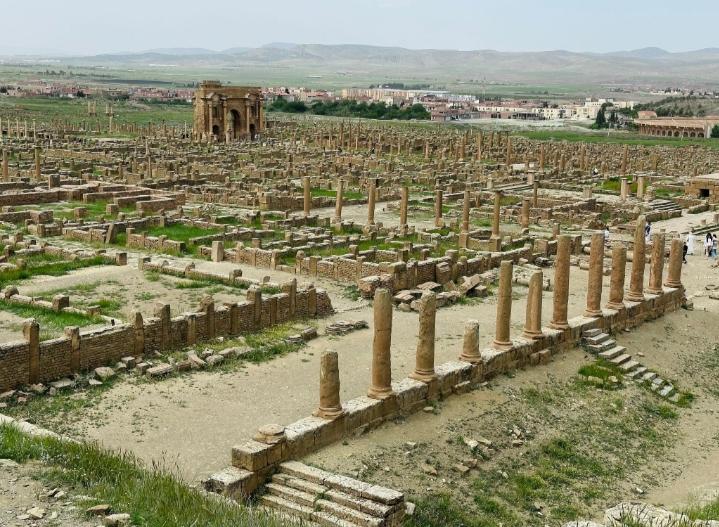
Under Roman rule, Algeria became part of the Roman Empire. Cities flourished. Roads, aqueducts, temples, and theaters were built. Some of the most impressive Roman ruins in the world still stand in Algeria today, especially in Timgad and Djemila.
Roman Algeria was prosperous. Agriculture thrived, especially the production of grain and olives. The region became known as one of the breadbaskets of the Roman Empire.
One of the most famous figures from this period was Saint Augustine, born in Hippo Regius in 354 CE. He became one of the most influential Christian theologians in history.
However, Roman control weakened over time. In the fifth century, the Vandals invaded. Later, the Byzantine Empire briefly ruled parts of the region. But a new chapter was about to begin.
The Arrival of Islam
In the seventh century, Arab Muslim armies arrived in North Africa. They brought Islam, which would forever change Algeria’s cultural and religious identity.
The spread of Islam was not immediate or simple. There were battles and resistance, particularly from Berber leaders like Queen Kahina, who fought against Arab expansion. But eventually, Islam became the dominant religion.
Over time, the Arab and Berber populations blended, creating a unique Algerian identity. Arabic became widely spoken, though Berber languages continued to thrive in many regions.
Algeria became part of various Islamic dynasties, including the Umayyads, Abbasids, Fatimids, and Almoravids. Cities like Tlemcen and Algiers grew into centers of trade, scholarship, and culture.
The Ottoman Era
In the sixteenth century, Spain attempted to control parts of the Algerian coast. In response, local leaders sought help from the Ottoman Empire.
By 1516, Algeria became part of the Ottoman Empire. Algiers became a powerful city under Ottoman rule. It was known for its naval strength and corsairs, who controlled parts of the Mediterranean.
For over three centuries, Algeria remained under Ottoman authority. Although it was technically part of the empire, it had a large degree of local autonomy. The ruler, known as the Dey of Algiers, governed the territory.
But Europe was changing. Colonial ambitions were rising. Algeria would soon face one of the most brutal chapters in its history.
French Colonization
In 1830, France invaded Algeria. What began as a military campaign quickly turned into full colonization.
France did not treat Algeria as just a colony. It declared Algeria part of France itself. Large numbers of European settlers moved into the country. They took land from local Algerians and built European style cities.
The indigenous population suffered deeply. Land was confiscated. Cultural and religious practices were restricted. Many Algerians were pushed into poverty.
Resistance began almost immediately. Leaders like Emir Abdelkader organized armed resistance against French forces. Although he fought bravely, France eventually defeated him.
For over 130 years, Algeria remained under French rule. During this time, inequality grew. European settlers enjoyed full rights, while Muslim Algerians faced discrimination and limited opportunities.
The War of Independence
By the mid twentieth century, the desire for freedom could no longer be contained.
In 1954, the National Liberation Front launched a revolution against French rule. What followed was one of the bloodiest wars of decolonization in history.
The Algerian War of Independence lasted nearly eight years. It involved guerrilla warfare, bombings, torture, and brutal repression. Villages were destroyed. Thousands were killed.
The conflict divided France itself. But the determination of the Algerian people was unbreakable.
In 1962, after years of struggle, Algeria gained independence. The victory came at a high cost, with estimates of hundreds of thousands of Algerians losing their lives.
On July 5, 1962, Algeria became a free nation.
Building a New Nation
Independence brought hope, but also challenges. The country had to rebuild after years of war. Many European settlers left, creating economic gaps.
Algeria adopted a socialist inspired system and nationalized its oil and gas resources. The energy sector became the backbone of the economy.
In the decades that followed, Algeria faced political struggles and periods of instability. The 1990s were particularly painful, marked by a civil conflict between the government and Islamist groups.
Despite these challenges, Algeria remained resilient. Today, it is one of Africa’s largest countries and a key player in regional politics and energy markets.
Culture and Identity
Algeria’s culture is a rich blend of Berber, Arab, Islamic, Ottoman, and French influences. Its music ranges from Rai to Chaabi. Its cuisine features couscous, tagines, and rich Mediterranean flavors.
Languages spoken include Arabic, Tamazight, and French. Islam remains the dominant religion, shaping daily life and traditions.
The Sahara Desert covers much of the country, while the northern coastline offers fertile lands and bustling cities like Algiers, Oran, and Constantine.
Modern Algeria
Today, Algeria stands as a symbol of resistance and independence in Africa. Its history of struggle against colonialism inspires many nations.
From prehistoric rock art to Roman cities, from Islamic empires to revolutionary fighters, Algeria’s journey is long and powerful.
It is a story of a people who refused to disappear. A land that endured conquest but preserved its soul. A nation that fought for its name, its culture, and its future.
Algeria is not just a country on the map. It is a living history of courage and endurance.


Catégories
Lire la suite
The Office of the Secretary to the Government of the Federation (OSGF), headed by George Akume, plans to spend ₦496 million in 2026 on just three heavy-duty photocopier machines and office furniture, according to Nigeria’s budget documents. The budget line states it is for the “purchase and installation of heavy-duty photocopy machines for cabinet affairs offices and supply of...

Reminisce Reminisce, whose real name is Remilekun Khalid Safaru, is a Nigerian rapper, singer, and songwriter widely respected for blending Yoruba language with hip hop and Afrobeats. Born on January 26, 1981, in Kaduna State, Nigeria, he hails from Ogun State in southwestern Nigeria. Over the years, Reminisce has built a strong reputation as one of the leading indigenous rappers...
Pa Kasumu Pa Kasumu, born Kayode Odumosu, was one of the most beloved veteran actors in the Yoruba sector of Nollywood. Known for his humorous roles, expressive face, and unforgettable voice, he became a household name in Nigeria, especially among lovers of Yoruba films. His life was a story of talent, resilience, struggle, and legacy. Early Life and Background Kayode Odumosu...

Yomi Fash Lanso Yomi Fash Lanso is a veteran Nigerian Nollywood actor, director, producer, and master of ceremonies widely known for his roles in Yoruba language films. For decades he has been one of the most respected and recognizable faces in the Yoruba movie industry. His powerful voice, expressive acting, and ability to interpret complex characters have made him a favorite among...

Final Epilogue: What Grows Back My name is Toke. I am forty-one years old today. I light no candles. I cut no cake. I do not celebrate years that remember me. I lived quietly after Zainab. That was my punishment. No mansion. No drivers. No soft life sermons on Instagram. I moved inland. A small flat. A regular job. Synthetic wigs stacked neatly like harmless lies. For a long time, it...