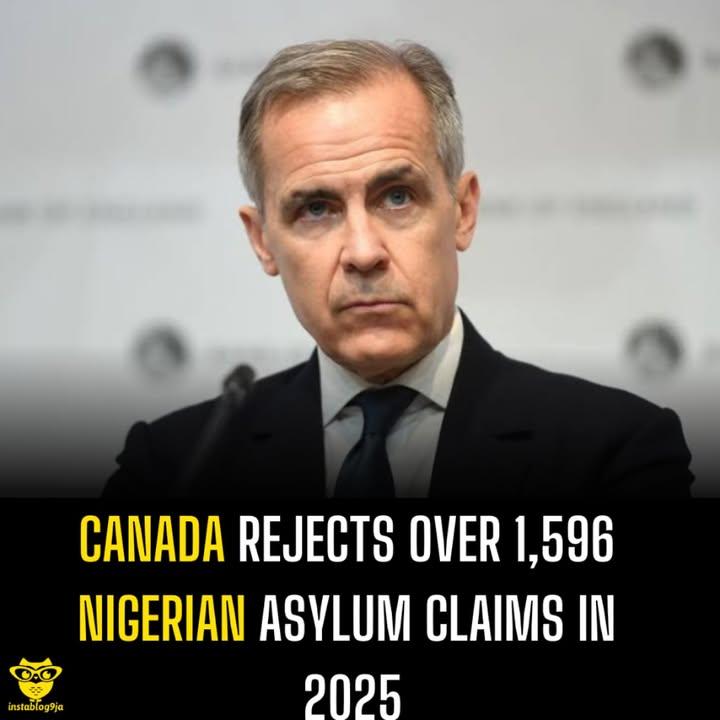
• Canada Rejects Over 1,596 Nigerian Asylum Claims in 2025.

    Canada has denied 1,596 asylum applications from Nigerians between January and August 2025, fresh data from the Immigration and Refugee Board (IRB) show. 

    Out of 3,548 claims filed so far, 2,292 were accepted—an approval rate of about 65 per cent, higher than in previous years.

    Nigeria remains one of the top sources of asylum seekers in Canada, alongside Mexico, India, Haiti and Colombia. Analysts link the surge to insecurity caused by Boko Haram and economic hardship. Most claimants are hosted in Ontario and Alberta.

    Under Canadian law, the IRB grants protection if applicants meet the UN definition of refugees or face risks such as tort¥re or cruel treatment in their home countries. 

    Social groups considered include women, LGBTQ+ individuals and people living with HIV/AIDS. Claims are usually filed at ports of entry or through immigration officers before referral to the Refugee Protection Division.

    Despite the recent rise in approvals, Nigerian claims have historically faced high rejection rates. Between 2013 and 2024, the IRB denied 13,171 applications and accepted 10,580. Rejections peaked in 2019 with 3,951 cases. In 2024 alone, 811 were denied, while 2,230 were approved.

    Nigeria ranked eighth among the top 10 countries with the most successful claims last year, following Turkiye, Mexico, Colombia, Iran, Pakistan, Haiti, and Afghanistan.

    Speaking on the trend, Imaobong Ladipo-Sanusi, Executive Director of the Women Trafficking and Child Labour Eradication Foundation, said many Nigerians misunderstand refugee laws, leading to rejections. 

    “Documentation is crucial. Coming irregularly gets you rejected. But migration must be safe, orderly and regular, and those truly in need of protection should be protected,” she said.
    Canada Rejects Over 1,596 Nigerian Asylum Claims in 2025. Canada has denied 1,596 asylum applications from Nigerians between January and August 2025, fresh data from the Immigration and Refugee Board (IRB) show.  Out of 3,548 claims filed so far, 2,292 were accepted—an approval rate of about 65 per cent, higher than in previous years. Nigeria remains one of the top sources of asylum seekers in Canada, alongside Mexico, India, Haiti and Colombia. Analysts link the surge to insecurity caused by Boko Haram and economic hardship. Most claimants are hosted in Ontario and Alberta. Under Canadian law, the IRB grants protection if applicants meet the UN definition of refugees or face risks such as tort¥re or cruel treatment in their home countries.  Social groups considered include women, LGBTQ+ individuals and people living with HIV/AIDS. Claims are usually filed at ports of entry or through immigration officers before referral to the Refugee Protection Division. Despite the recent rise in approvals, Nigerian claims have historically faced high rejection rates. Between 2013 and 2024, the IRB denied 13,171 applications and accepted 10,580. Rejections peaked in 2019 with 3,951 cases. In 2024 alone, 811 were denied, while 2,230 were approved. Nigeria ranked eighth among the top 10 countries with the most successful claims last year, following Turkiye, Mexico, Colombia, Iran, Pakistan, Haiti, and Afghanistan. Speaking on the trend, Imaobong Ladipo-Sanusi, Executive Director of the Women Trafficking and Child Labour Eradication Foundation, said many Nigerians misunderstand refugee laws, leading to rejections.  “Documentation is crucial. Coming irregularly gets you rejected. But migration must be safe, orderly and regular, and those truly in need of protection should be protected,” she said.
    0 Σχόλια ·0 Μοιράστηκε ·1χλμ. Views
  • UK Prime Minister Keir Starmer Orders Arrest, Deportation of Illegal Migrants.

    UK Prime Minister, Keir Starmer, has announced stricter measures against illegal migration, warning that anyone living or working unlawfully in the country will face arrest, detention, and deportation.

    In a Facebook post, Starmer reaffirmed his government’s zero-tolerance approach to irregular migration and unlawful employment, stating: “Illegal entry means detention. Illegal work means arrest. Foreign national offenders will be deported.”

    The Labour leader also restated on X (formerly Twitter) that migrants crossing the English Channel illegally would not be allowed to remain in the UK. “We will not reward illegal entry.

    If you cross the Channel unlawfully, you will be detained and sent back,” he wrote. Official figures from the Home Office show that more than 29,000 migrants have crossed the Channel in small boats so far in 2025, a record number and nearly 50% higher than the same period last year.

    The surge has sparked protests in several towns and cities, including London, Skegness, and Gloucester, where asylum seekers are being accommodated in hotels. At least five protesters were arrested in west London over the weekend.
    UK Prime Minister Keir Starmer Orders Arrest, Deportation of Illegal Migrants. UK Prime Minister, Keir Starmer, has announced stricter measures against illegal migration, warning that anyone living or working unlawfully in the country will face arrest, detention, and deportation. In a Facebook post, Starmer reaffirmed his government’s zero-tolerance approach to irregular migration and unlawful employment, stating: “Illegal entry means detention. Illegal work means arrest. Foreign national offenders will be deported.” The Labour leader also restated on X (formerly Twitter) that migrants crossing the English Channel illegally would not be allowed to remain in the UK. “We will not reward illegal entry. If you cross the Channel unlawfully, you will be detained and sent back,” he wrote. Official figures from the Home Office show that more than 29,000 migrants have crossed the Channel in small boats so far in 2025, a record number and nearly 50% higher than the same period last year. The surge has sparked protests in several towns and cities, including London, Skegness, and Gloucester, where asylum seekers are being accommodated in hotels. At least five protesters were arrested in west London over the weekend.
    0 Σχόλια ·0 Μοιράστηκε ·644 Views
  • Trump’s Visa Sanctions Tied to Nigeria’s Rejection of U.S Asylum Deal.

    Nigeria’s refusal to accept asylum seekers from the United States is one of the key reasons behind the recent visa restrictions imposed by President Donald Trump, TheCable has learned. Sources familiar with the matter said the Trump administration had been pressuring several countries to temporarily host asylum seekers while their cases often taking up to seven years are processed.

    While some nations agreed to the arrangement, Nigeria declined. According to diplomatic insiders, Trump responded with a hardline approach, a tactic he’s known to use in negotiations such as his trade disputes by introducing steep penalties to gain leverage.

    This culminated in Tuesday’s announcement by the US embassy, which revealed that most non-immigrant and non-diplomatic visas issued to Nigerians would now be valid for only three months and allow a single entry.

    Though the embassy cited visa reciprocity concerns, specific details were not disclosed. Initial speculation online blamed the move on Nigeria supposedly discontinuing five-year visa issuance to Americans, but those claims have since been proven false.

    In fact, Nigerian visas for US citizens when issued at the embassy can still range from three months to five years with either single or multiple entry, depending on the category. Nigeria had recently introduced an e-visa system on March 1 to simplify the application process and replace the inefficient visa-on-arrival setup.

    The e-visa is valid for 90 days from the date of issuance and permits a single entry with a maximum stay of 30 days.
    Trump’s Visa Sanctions Tied to Nigeria’s Rejection of U.S Asylum Deal. Nigeria’s refusal to accept asylum seekers from the United States is one of the key reasons behind the recent visa restrictions imposed by President Donald Trump, TheCable has learned. Sources familiar with the matter said the Trump administration had been pressuring several countries to temporarily host asylum seekers while their cases often taking up to seven years are processed. While some nations agreed to the arrangement, Nigeria declined. According to diplomatic insiders, Trump responded with a hardline approach, a tactic he’s known to use in negotiations such as his trade disputes by introducing steep penalties to gain leverage. This culminated in Tuesday’s announcement by the US embassy, which revealed that most non-immigrant and non-diplomatic visas issued to Nigerians would now be valid for only three months and allow a single entry. Though the embassy cited visa reciprocity concerns, specific details were not disclosed. Initial speculation online blamed the move on Nigeria supposedly discontinuing five-year visa issuance to Americans, but those claims have since been proven false. In fact, Nigerian visas for US citizens when issued at the embassy can still range from three months to five years with either single or multiple entry, depending on the category. Nigeria had recently introduced an e-visa system on March 1 to simplify the application process and replace the inefficient visa-on-arrival setup. The e-visa is valid for 90 days from the date of issuance and permits a single entry with a maximum stay of 30 days.
    0 Σχόλια ·0 Μοιράστηκε ·539 Views
  • REVEALED: Trump’s Visa Restrictions Tied to Nigeria’s Rejection of U.S. Asylum Deal.

    Fresh details have emerged linking the recent visa clampdown on Nigerians by former U.S. President Donald Trump to Nigeria’s refusal to accept asylum seekers—particularly deportees from American prisons.

    Minister of Foreign Affairs, Ambassador Yusuf Tuggar, made part of the revelation while speaking on Channels Television’s Politics Today on Thursday evening.

    Tuggar disclosed that the U.S. had been pressuring African countries, including Nigeria, to receive Venezuelan deportees, many of whom are ex-convicts.

    He described the request as unjust.

    “You have to also bear in mind that the US is mounting considerable pressure on African countries to accept Venezuelans to be deported from the US, some straight out of prison,” Tuggar said.

    “It will be difficult for a country like Nigeria to accept Venezuelan prisoners into Nigeria. We have enough problems of our own. We cannot accept Venezuelan deportees to Nigeria, for crying out loud. We already have 230 million people. You will be the same people that would castigate us if we acquiesce to accepting Venezuelans from US prisons to be brought in,” he added.

    The minister’s comments come amid speculation that Trump’s imposition of a 10 per cent tariff on Nigerian exports, alongside the new U.S. visa restrictions, were retaliatory responses to Nigeria’s stance on asylum deportees and its recent outreach to BRICS nations.

    Tuggar, however, dismissed the notion that the tariff hike was directly linked to President Bola Tinubu’s attendance at the BRICS summit in Brazil.

    “The issue of tariffs may not necessarily have to do with us participating in BRICS,” he said.
    REVEALED: Trump’s Visa Restrictions Tied to Nigeria’s Rejection of U.S. Asylum Deal. Fresh details have emerged linking the recent visa clampdown on Nigerians by former U.S. President Donald Trump to Nigeria’s refusal to accept asylum seekers—particularly deportees from American prisons. Minister of Foreign Affairs, Ambassador Yusuf Tuggar, made part of the revelation while speaking on Channels Television’s Politics Today on Thursday evening. Tuggar disclosed that the U.S. had been pressuring African countries, including Nigeria, to receive Venezuelan deportees, many of whom are ex-convicts. He described the request as unjust. “You have to also bear in mind that the US is mounting considerable pressure on African countries to accept Venezuelans to be deported from the US, some straight out of prison,” Tuggar said. “It will be difficult for a country like Nigeria to accept Venezuelan prisoners into Nigeria. We have enough problems of our own. We cannot accept Venezuelan deportees to Nigeria, for crying out loud. We already have 230 million people. You will be the same people that would castigate us if we acquiesce to accepting Venezuelans from US prisons to be brought in,” he added. The minister’s comments come amid speculation that Trump’s imposition of a 10 per cent tariff on Nigerian exports, alongside the new U.S. visa restrictions, were retaliatory responses to Nigeria’s stance on asylum deportees and its recent outreach to BRICS nations. Tuggar, however, dismissed the notion that the tariff hike was directly linked to President Bola Tinubu’s attendance at the BRICS summit in Brazil. “The issue of tariffs may not necessarily have to do with us participating in BRICS,” he said.
    0 Σχόλια ·0 Μοιράστηκε ·883 Views
Fintter https://fintter.com