About
About
The Night Ulaga Walked Through Fear and Tradition
Ulaga
In many parts of southeastern Nigeria, when the air grows quiet and the elders begin to lower their voices, a certain name is spoken with caution. Ulaga. Some call it Ojuju. Others simply call it the one you do not joke with.
This is not just a masquerade. It is a presence. A force. A tradition that has walked through generations, carrying both reverence and fear in equal measure.
The story of Ulaga does not begin with costumes or performances. It begins in belief.
Long before modern lights filled the villages, the Igbo people held a deep understanding that the world of the living and the world of the spirits were not separate. They overlapped. They touched. And sometimes, they spoke to each other.
Masquerades were the bridge.
They were not seen as ordinary humans in disguise. No. Once the mask was worn, the man disappeared. What remained was spirit. Ancestors returned. Forces unseen took form. And among these forces, some were gentle, guiding, and celebratory.
Others were not.
Ulaga belonged to the second kind.
It is said that the first time Ulaga appeared, it was not during a festival. It came during a time of disorder in the community. People had begun to ignore the elders. Sacred laws were broken. Respect faded. And with that, fear also disappeared.
That was when Ulaga came.
Not dancing. Not entertaining.
It came to restore balance.
The elders would later say that Ulaga was not created by man alone. It was inspired by something deeper, something older than memory. Its design was deliberate. Its movements were calculated. Everything about it was meant to command attention, and more importantly, obedience.
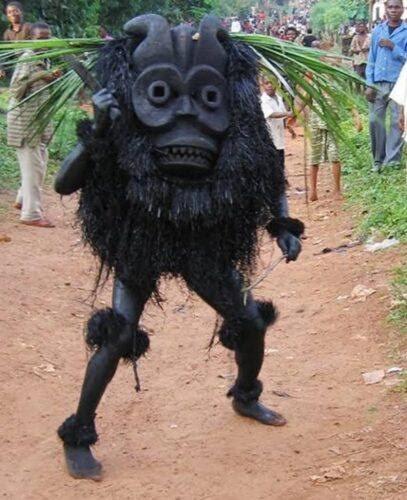
The costume itself tells a story. Layers upon layers of rough, dark materials, sometimes mixed with raffia, leather, and symbolic objects. The mask is often terrifying, exaggerated, almost unnatural. Wide eyes that seem to see beyond the physical. A mouth that looks like it could speak curses or judgment.
But it is not just the appearance.
It is how Ulaga moves.
Slow at first. Then sudden. Unpredictable. Like something that does not follow human rhythm. When it enters a space, people scatter, not because they are told to, but because something inside them tells them to move.
Children are warned from a young age.
Do not stand in its path.
Do not call its name.
Do not challenge it.
Because Ulaga is not there to play.
In storytelling circles, elders often describe a particular night that explains why Ulaga became known as the most feared.
It was during a festival, one meant for celebration. Music filled the air. Drums echoed across the village square. People danced freely, forgetting, for a moment, the strict boundaries of tradition.
Then Ulaga appeared.
At first, some thought it was part of the performance. But the mood shifted quickly. The drumming slowed. Conversations stopped. Even the wind seemed to pause.
Ulaga did not dance.
It walked straight into the crowd.
A young man, full of pride and ignorance, refused to move. He laughed, thinking it was just another masquerade under a mask. He stepped closer instead of stepping back.
That was his mistake.
What happened next is told in whispers.
Ulaga did not strike him violently, but it did something worse. It humiliated him. Publicly. Completely. The kind of humiliation that stays with a person longer than pain.
From that day, the lesson was clear.
Ulaga does not tolerate disrespect.
And so the fear grew.
But to understand Ulaga only as something cruel is to miss the deeper truth.
Cruelty, in this context, is often misunderstood.
In traditional society, order was everything. There were no police as we know them today. No courts in the modern sense. Justice was enforced through systems that blended spirituality and community authority.
Masquerades like Ulaga were enforcers.
They punished wrongdoing. They maintained discipline. They reminded people that actions had consequences, not just in the physical world, but in the spiritual one as well.
If someone stole, Ulaga might visit.
If someone disrespected sacred customs, Ulaga would appear.
If someone threatened the peace of the community, Ulaga would respond.
To outsiders, this looked harsh. Even brutal at times.
But to those within the culture, it was necessary.
Because fear, when used wisely, becomes a tool for order.
Still, there are stories that blur the line.
Stories of Ulaga chasing people deep into the night. Stories of harsh punishments that went beyond what some would consider fair. Stories that make younger generations question whether tradition sometimes went too far.
And this is where the debate begins.
Is Ulaga truly cruel?
Or is it simply misunderstood?
Some elders argue that what people call cruelty is actually discipline. That without figures like Ulaga, communities would lose their structure, their respect for authority, their connection to ancestral values.
Others, especially in modern times, see it differently. They see fear used as control. They see moments where power may have been abused. They question whether every action taken in the name of tradition was justified.
Both views exist.
Both are valid in their own way.
But one thing remains undeniable.
Ulaga commands respect.
Even today, in villages where modern life has softened many traditions, the mention of Ulaga still carries weight. During certain festivals, when the masquerade appears, the crowd still parts. The laughter still fades. And for a brief moment, the old world returns.
A world where spirits walk among humans.
A world where tradition is law.
A world where Ulaga is not just seen, but felt.
There is also a deeper layer that many do not speak about openly.
The secrecy.
Not everyone is allowed to know who becomes Ulaga. The identity is hidden, protected. This secrecy adds to the fear. Because when you cannot separate the human from the spirit, the illusion becomes stronger.
Is it your neighbor behind the mask?
Is it a chosen initiate?
Or is it truly something beyond human?
No one tells you.
And that uncertainty keeps the power alive.
In some communities, women and uninitiated individuals are not allowed to come close. Not just for safety, but to preserve the sacredness of the masquerade. Ulaga is not for everyone to understand. It is for those who are ready, those who have been initiated into the deeper knowledge of the culture.
This exclusivity also contributes to the fear.
What you do not fully understand, you naturally fear.
Yet, beyond the fear, there is beauty.
Yes, beauty.
Because Ulaga represents continuity. A connection to ancestors. A living tradition that has survived generations, colonial disruptions, and modern influence.
It is a reminder that culture is not just about comfort. Sometimes, it is about confrontation. About facing the parts of society that require discipline, structure, and respect.
As the years pass, the role of Ulaga continues to evolve. In some places, its presence is more symbolic now, less harsh, more controlled. In others, it remains as intense as ever, holding tightly to the ways of the past.
But the stories remain.
Stories of fear.
Stories of respect.
Stories of lessons learned the hard way.
And every time the drums begin to beat in a certain rhythm, every time the elders exchange knowing glances, people still ask quietly:
Is Ulaga coming out tonight?
Because if it is, then the village must be ready.
Ready to remember.
Ready to respect.
Ready to step aside.
And in that moment, as the masquerade emerges from the shadows, towering, silent, and powerful, one truth becomes clear.
Ulaga is not just feared because of what it does.
It is feared because of what it represents.
The unyielding force of tradition.
The voice of ancestors.
And the reminder that some things in life are not meant to be taken lightly.

Categorías
Read More
At least four residents have been killed and several homes destroyed following a renewed bandit attack on Wawa community in Borgu Local Government Area of Niger State. The attack, which occurred on Friday evening between 8:00pm and 8:30pm, reportedly targeted Damala village, located behind the Woko–Daba mining area. Local sources said the assailants struck suddenly, killing four people...
The criminal defamation trial of Senator Natasha Akpoti-Uduaghan was adjourned on Tuesday after Federal Government lawyers failed to appear before the FCT High Court in Maitama. Justice Chizoba Oji informed the court that the Attorney-General of the Federation had requested a new date, but the adjournment notice was served to the defence only hours before the hearing—far short of the...

Victoria’s POV Having Daniel around felt unreal like I was living inside one of my daydreams. Every morning I woke up and half-expected to find the house quiet again, to realize that his visit had only happened in my sleep. But then I’d hear his voice from the living room, or feel his arm tighten around me, and I’d smile before my eyes even opened. That week couldn’t...

Chinua Achebe Before Africa began telling its own stories to the world in its own voice, much of its image had been shaped by outsiders. It was often portrayed as silent, primitive, or voiceless. Then came a young man from eastern Nigeria who decided to write a novel that would change everything. His name was Chinua Achebe, and with one book, he altered the course of global literature. But...
A devastating air disaster has struck Ahmedabad, India, as an Air India Boeing 787-8 Dreamliner crashed into a residential area shortly after takeoff, claiming the lives of at least 265 people. The ill-fated flight, bound for London, reportedly lost communication shortly after leaving Ahmedabad airport. Onboard were 242 passengers and crew, including: 169 Indians 53 British nationals 7...