Σχετικά
Menelik II The Crown That Refused to Bow and the Glory of Adwa
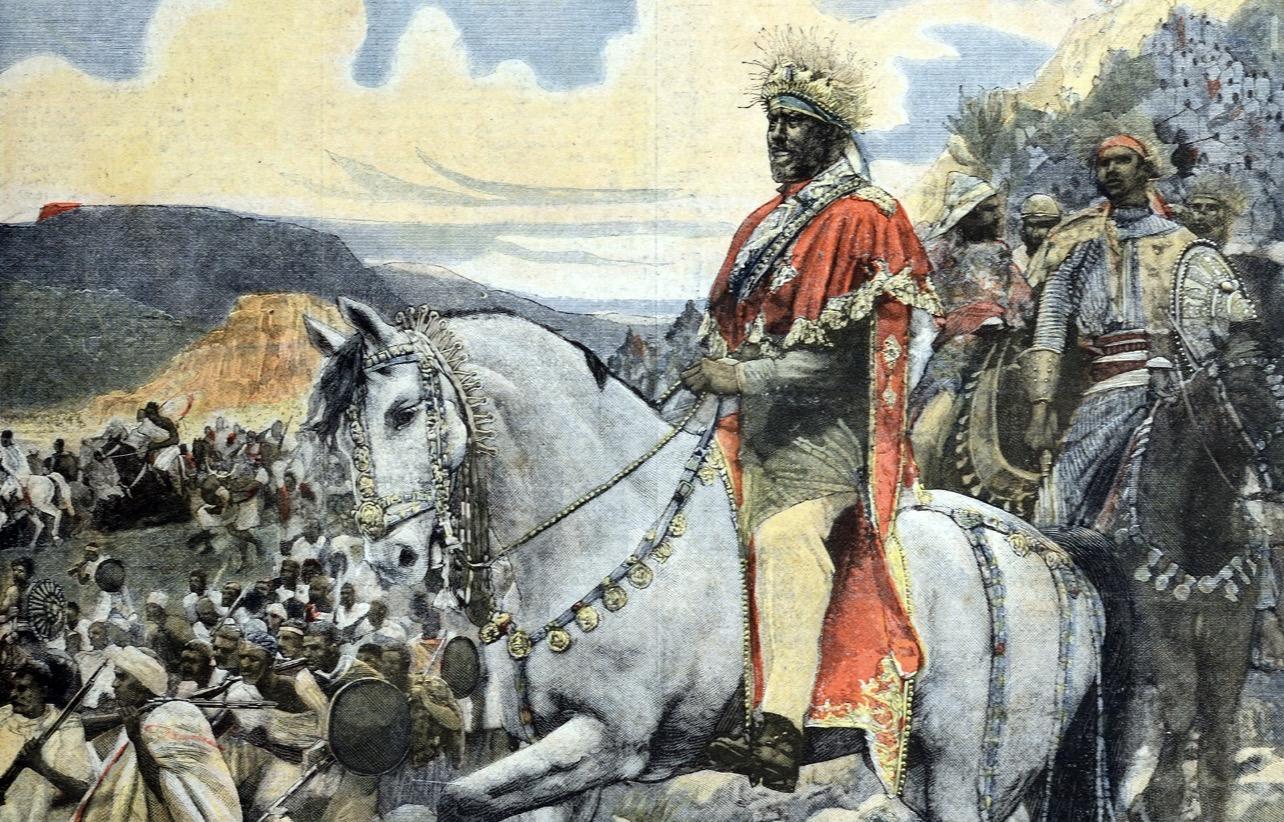
Menelik II
There are moments in African history that feel larger than time itself, moments when a people stand at the edge of erasure and answer the world with courage. In those moments, one name can become more than the name of a ruler. It can become a memory, a warning, a prayer, and a symbol. In Ethiopia, that name is Menelik II.
He is remembered as an emperor, a strategist, a builder of modern Ethiopia, and above all as one of the great symbols of African sovereignty because under his rule Ethiopia defeated an invading European army at Adwa in 1896 and preserved its independence in an age when much of Africa was being partitioned by colonial powers.
To speak of Menelik II is to enter a story filled with captivity, patience, ambition, betrayal, war, nation building, and the fierce refusal to let Africa be spoken for by outsiders. His life does not move like a quiet river. It moves like a mountain storm. It rises from imprisonment, expands into power, and reaches its most unforgettable moment on the battlefield of Adwa, where Ethiopia sent a message so powerful that it echoed across the continent and far beyond it.
Menelik II was born Sahle Mariam in 1844 in Shewa, a powerful kingdom in the Ethiopian highlands. He was the son of Haile Melekot, the king of Shewa, and he belonged to the Solomonic line, the dynasty that tied Ethiopian kingship to deep sacred and royal traditions. Later he took the name Menelik II, linking himself to the legendary Menelik I and to a long political memory that gave Ethiopian monarchy both prestige and spiritual depth.
But the boy who would become emperor did not begin life on a throne. His early years were shaped by upheaval. In 1855 Emperor Tewodros II moved against Shewa, deposed Menelik’s father, and the young Sahle Mariam was taken captive. He spent about a decade in confinement before escaping in 1865 and returning to Shewa, where he reclaimed his position and became king. That long stretch of captivity was not a small episode in his life. It was a school of endurance. It taught him how fragile power could be and how much patience history sometimes demands from those who intend to shape it.
One can imagine the young prince in those years, watching, listening, learning how rulers break and how kingdoms survive. Captivity can crush a person, but sometimes it tempers the mind like iron in fire. Menelik emerged not as a defeated child of a fallen house but as a determined claimant ready to rebuild. When he returned to Shewa and assumed the kingship, he was not merely inheriting a regional throne. He was beginning the long climb toward imperial power.
Shewa under Menelik became a base of strength. He was patient where others were reckless. He consolidated authority, expanded influence, and waited for the right moment. Ethiopia at the time was not a neatly unified modern nation state in the way people think of states today. It was a complex empire of regions, nobles, loyalties, and rival centers of power. Menelik understood that ruling Ethiopia would require more than bravery in battle. It would require timing, diplomacy, and the careful management of allies and rivals.
The chance came after the death of Emperor Yohannes IV in 1889. Menelik moved decisively. He declared himself emperor in March 1889 and was later crowned Menelik II, beginning the reign that would define his name forever. By then he had already grown from a regional ruler into a national contender. Now he stood at the center of Ethiopian politics, ready to shape the future of the empire.
Yet Menelik’s story is not only the story of succession. It is the story of a ruler who understood the dangerous world around him. The late nineteenth century was the era of the European scramble for Africa, when colonial powers were seizing land, drawing borders, and treating African societies as prizes to be divided. Across the continent, ancient polities and growing kingdoms alike faced invasion, coercion, or subjugation. Ethiopia stood in the path of that imperial hunger. Menelik knew that if the country was to survive, it had to act with intelligence, not illusion.
He negotiated, purchased modern weapons, built diplomatic ties, and maneuvered among rival foreign powers. He was not naive about European intentions. He saw that diplomacy could buy time, but he also understood that paper agreements could become traps. That truth became painfully clear in the Treaty of Wichale signed in 1889 between Ethiopia and Italy. The treaty had different meanings in its Amharic and Italian versions. The Italian text implied that Ethiopia was becoming an Italian protectorate, while the Amharic text did not compel such a surrender of sovereignty. This deception became one of the great turning points in Menelik’s reign.
A lesser ruler might have submitted, pleaded, or accepted a compromise dressed up as peace. Menelik did not. He rejected the Italian claim, and the road to war opened. What Italy expected, however, was not what it would meet. Colonial arrogance had made many European states believe African resistance would collapse before organized modern armies. They mistook conquest elsewhere for a law of nature. Ethiopia under Menelik would shatter that illusion.
Before the great battle came preparation. Menelik called the nobility to arms and mobilized a vast force. Regional rulers, nobles, soldiers, and ordinary people rallied. Empress Taytu Betul also played a formidable role in the resistance and in the broader political life of the period. This was not simply one man riding into battle with a sword and a dream. It was a state and a society gathering themselves in defense of independence. Ethiopia’s armies were large, motivated, and increasingly equipped with modern firearms. Menelik had spent years preparing for the possibility that diplomacy would fail. When the moment came, Ethiopia was not helpless.
Then came Adwa.
To understand why Adwa means so much, one must feel the weight of that date. On March 1, 1896, Ethiopian forces defeated the Italian army at the Battle of Adwa. It was a decisive victory. It was not a minor skirmish that later storytellers exaggerated. It was a major military defeat for a European colonial power at the hands of an African empire defending its sovereignty. In an age when colonial propaganda tried to portray Africa as weak, divided, and destined for subjugation, Adwa stood like a thunderclap.
Menelik’s victory changed more than the immediate battlefield. It forced Italy to recognize Ethiopia’s independence in the Treaty of Addis Ababa later that same year. Ethiopia preserved its autonomy while much of the continent remained under colonial rule. This transformed Menelik from a strong emperor into a continental symbol. Adwa became proof that empire from Europe could be resisted and defeated. For Africans and people of African descent across the world, that mattered beyond words. It fed imagination, pride, and political hope.
One can picture the news of Adwa moving across oceans and cities, crossing into the minds of people who had been told that African resistance was futile. In that sense Menelik’s triumph belonged not only to Ethiopia. It became part of a wider black historical memory. Adwa was Ethiopian, but it was also African in meaning. It told the colonized and the threatened that defeat was not inevitable. It told the arrogant that Africa was not theirs for the taking.
That is why Menelik II is so often remembered as a symbol of African sovereignty. Sovereignty is not only a legal word. In history it is often paid for with vigilance, sacrifice, and blood. Menelik defended it at the moment when the balance of power seemed stacked against Africa. His Ethiopia did not simply survive by luck. It survived because it was led by a ruler who combined strategic patience, diplomatic skill, and military resolve.
But Menelik’s story did not end at Adwa. Victory in war gave him something that many rulers never receive: the authority to shape a stronger state after the battle. He used that authority to continue expanding and consolidating the Ethiopian Empire, pushing its borders close to the outline of the modern country. Under his rule, Ethiopia became larger, more centralized, and more visible on the international stage. Britannica describes him as one of Ethiopia’s greatest rulers and notes that he expanded the empire almost to its present day borders.
He also became associated with modernization. During his reign, Ethiopia saw important changes in administration and infrastructure. Addis Ababa, which had begun developing in the late 1880s with the encouragement of Empress Taytu and Menelik’s court, became the center of political power and grew rapidly. His era also saw the strengthening of diplomatic relations, the growth of ministries and institutions, and steps toward modern state organization. These developments did not create a modern nation in a single sweep, but they gave Ethiopia a stronger administrative and symbolic center.
The image of Menelik in Ethiopian memory is therefore not only that of a battlefield ruler. He is also remembered as a founder figure in the making of modern Ethiopia. The state he ruled was older than he was, and Ethiopia had deep imperial traditions before his reign, but his period of rule marked a major stage in territorial consolidation and modern political formation. That is why many accounts call him the founder of the modern Ethiopian state, or at least one of its chief makers.
Still, no serious telling of Menelik’s life should pretend his legacy is simple. Great rulers often leave behind both admiration and pain. Menelik is celebrated for preserving Ethiopian independence and for defeating colonial invasion, yet historians and commentators also point to the brutal violence that accompanied imperial expansion into southern and other regions. These campaigns brought more peoples under imperial rule, but they also carried suffering, coercion, and long memories of grievance. His legacy, therefore, is heroic in one dimension and contested in another.
That complexity does not erase Adwa, but it does deepen the story. Menelik was not a figure carved from pure myth. He was a ruler of power and consequence, acting within a hard world, expanding an empire while defending it. To remember him honestly is to hold both truths at once: he preserved Ethiopia’s independence against colonial conquest, and his state building came at severe human cost in some regions. Historical memory becomes stronger, not weaker, when it can carry that complexity.
Even with that complexity, the symbolic force of Adwa remains enormous. In the broader history of Africa, very few nineteenth century battles carry the same emotional and political power. For Pan African thinkers, black intellectuals, anti colonial activists, and ordinary people hungry for examples of African victory, Adwa became a beacon. Menelik did not merely defend a throne. He helped preserve one of the few African states that remained formally independent through the great wave of colonial partition. That mattered not only to Ethiopians but to global black consciousness.
There is something almost cinematic in the way Menelik stands in memory. He begins as a captive prince, waits, escapes, builds a base, reads the ambitions of foreign empires, is nearly trapped by a deceptive treaty, refuses subordination, mobilizes his people, defeats an invader, and then turns victory into state consolidation. It is the arc of a ruler who understood that survival in history demands more than courage alone. It demands intelligence, calculation, and the ability to see danger before it fully arrives.
And yet for all his strategy, Menelik’s memory is not cold. People do not remember him only because he was shrewd. They remember him because he came to embody a refusal. In a century when many African societies faced humiliating treaties and military defeat, Menelik’s Ethiopia said no. That no was spoken through negotiations, preparations, mobilization, and finally battle. It was a no with rifles, organization, and leadership behind it. It was a no the world had to hear.
His reign also invites reflection on the nature of sovereignty itself. Sovereignty is often discussed as something fixed, a matter of maps and law, but Menelik’s life shows that sovereignty can be fragile, contested, and constantly defended. Ethiopia was not secure simply because it existed. It remained sovereign because it could defend itself politically and militarily at a critical moment. Menelik’s achievement was not abstract. It was embodied in choices, preparations, and risks.
By the early twentieth century, age and illness began to overtake him. Accounts note that strokes weakened him in his later years, and by the final phase of his reign others increasingly handled affairs of state. He died in 1913 in Addis Ababa, leaving behind an empire stronger and more internationally recognized than the one he had inherited. By then his name had already entered the realm of lasting national memory.
But history rarely lets a great figure rest quietly. Menelik’s memory continued to grow after his death. In Ethiopia he remained central to stories of statehood and victory. Across Africa and the diaspora, Adwa remained one of the proudest anti colonial milestones of the modern age. Long after the guns of 1896 fell silent, the battle kept speaking. It spoke in the confidence of later resistance movements. It spoke in the pride of peoples who needed historical proof that Europe was not unbeatable. It spoke in every retelling of Ethiopia’s endurance.
If one imagines Menelik II not as a statue but as a living figure, one sees a man shaped by both inheritance and danger. He was born into royalty, but royalty alone could not have saved Ethiopia. He lived in a century when diplomacy could conceal conquest and where weakness invited domination. He chose not to misread the times. He did not assume tradition alone would protect the empire. He armed, negotiated, maneuvered, and when necessary fought. In that sense he belonged both to the old imperial world of Ethiopia and to the emerging modern political order.
There is also a wider human lesson in his story. Some leaders inherit crises. Others define themselves by how they meet them. Menelik inherited a fractured and dangerous environment, yet he turned that danger into one of the most decisive African victories of the nineteenth century. He did not stop history from moving. He stepped into it and forced it to take Ethiopia seriously.
That is why his name still carries such force. Menelik II is not remembered simply because he ruled long or because he wore a crown. He is remembered because at a decisive hour he stood for the right of an African state to remain its own master. He became a symbol because symbols are forged where memory meets meaning. Adwa gave his reign that meaning in bright, unforgettable form.
And so the story remains.
A captive prince escapes and returns.
A regional king waits and rises.
A treaty tries to reduce a nation.
An emperor refuses.
An invading army comes with colonial certainty.
At Adwa it is broken.
Ethiopia remains standing.
Africa remembers.
That is Menelik II in the imagination of history. A ruler of great ambition and deep consequence. A nation builder and a war leader. A complex emperor whose legacy includes both triumph and controversy. But above all, in the age of conquest, he became one of the clearest symbols that African sovereignty could endure, fight back, and win.
When people speak of him today, they are not only speaking of one man in one century. They are speaking of a moment when Africa answered empire with resistance and dignity. They are speaking of an emperor whose greatest victory became larger than his throne. They are speaking of Menelik II, the crown that refused to bow.

Κατηγορίες
Διαβάζω περισσότερα
The Minister of the Federal Capital Territory (FCT), Nyesom Wike, has reportedly travelled to the United Kingdom to receive medical attention, four years after publicly dismissing the need for political leaders to seek treatment abroad. According to SaharaReporters, sources close to the minister revealed that Wike has been diagnosed with congestive heart failure and is currently under medical...

Selecting a China Valve Manufacturer involves more than comparing specifications and reviewing catalog data. Industrial valves operate within demanding pipeline systems where pressure variation, temperature fluctuation, and chemical exposure create continuous operational challenges. Once equipment is installed, consistent technical communication and responsive assistance become essential to...

My name is Rose Raymond, and for as long as I can remember, my body has been the subject of whispers, jokes, and cruel laughter. I was thin so thin that people felt entitled to comment on it as if it were a public noticeboard. “Broomstick,” they called me. “You should borrow flesh,” others laughed. At first, I pretended it didn’t hurt. But words have a way...

At this year’s Ojude Oba Festival, Aṣọ-Òkè fashion once again took center stage. Both women and men dazzled in stunning handwoven cloths, rich brocades, and regal headpieces that reflected deep Yoruba heritage. What makes this tradition so powerful? These fabrics aren’t picked overnight—families plan months ahead, choosing colors and patterns that express status,...
John Dumelo John Dumelo is a Ghanaian actor, producer, entrepreneur, and politician widely recognized as one of West Africa’s most prominent film stars. Born John Setor Dumelo on February 3, 1984, in Accra, Ghana, he has built a multifaceted career spanning entertainment, agriculture, and public service. Early Life and Education John Dumelo was born and raised in Accra,...