Σχετικά
Makeda The Wise Queen Whose Journey Turned Wisdom Into Legend
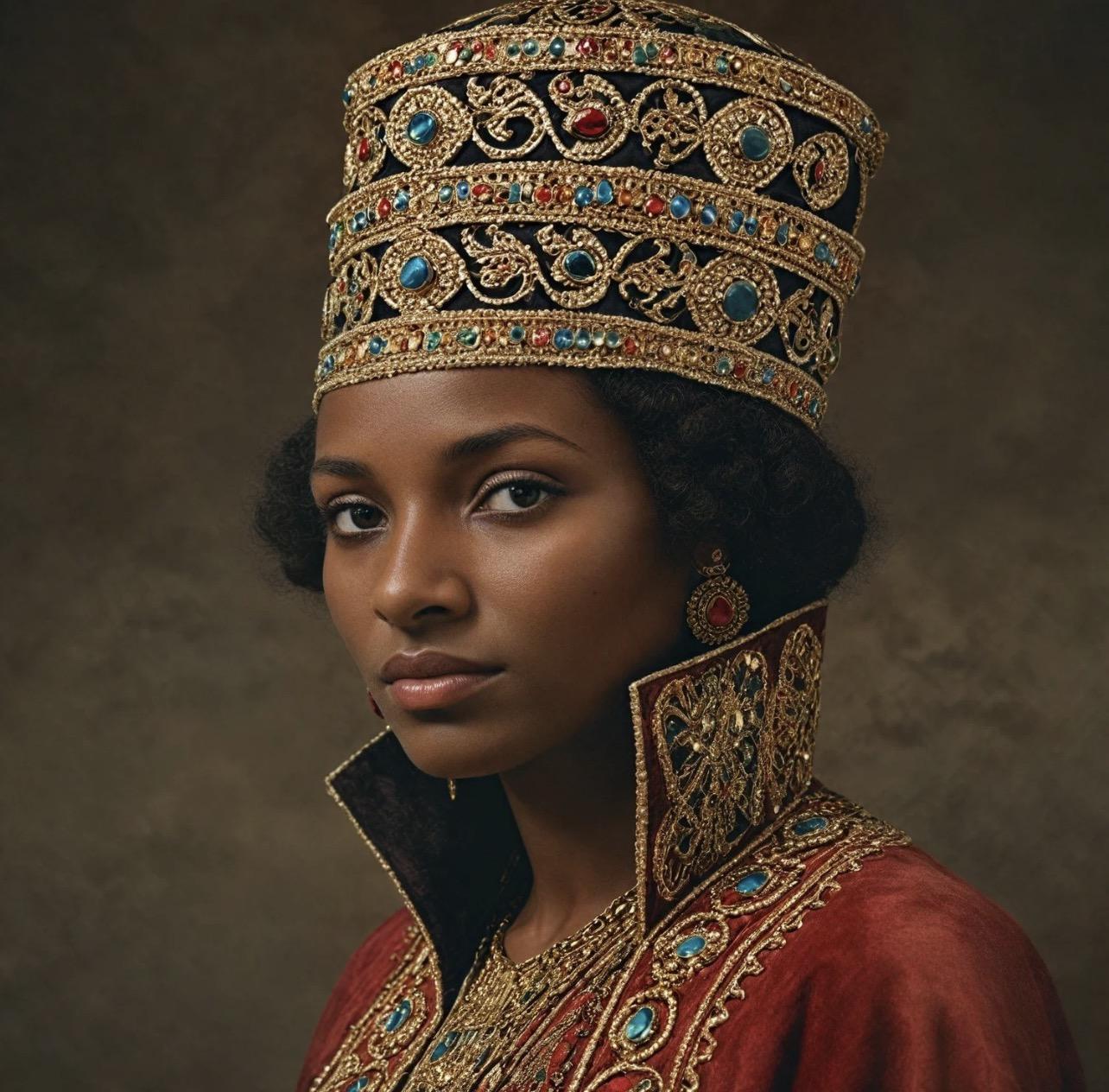
Makeda
There are some names in history that sound less like ordinary names and more like the opening line of a song. Makeda is one of them. In the traditions of Ethiopia and Yemen, she is remembered as the Queen of Sheba, a ruler of wealth, intelligence, grace, and astonishing political wisdom. Her story has traveled across deserts, seas, palaces, temples, scriptures, and fireside storytelling for centuries. She appears in ancient sacred texts and in royal traditions, not simply as a beautiful queen or a famous visitor, but as a woman whose mind was so respected that kings listened when she spoke. In Ethiopian tradition she is called Makeda, and in broader ancient tradition she is tied to Sheba, a kingdom often associated with southern Arabia, especially present day Yemen, though her story has long been deeply rooted in Ethiopian memory as well.
To tell her story properly, one must begin not with Solomon, not with caravans, and not with riddles, but with the idea of what it meant to be a queen in the ancient world. A king might conquer by force and be feared for his armies. A queen who ruled successfully had to master other things as well. She had to command loyalty in courts where ambition never slept. She had to understand trade, reputation, timing, diplomacy, faith, and the dangerous art of appearing calm while reading the hearts of men. Makeda is remembered as exactly such a ruler. Her legend endured because she was not portrayed as a silent ornament of royalty. She was portrayed as a sovereign mind.
The world around her was a world of movement and exchange. Across the Red Sea, cultures touched one another through trade, migration, and memory. The lands associated with Sheba were famous for wealth, incense, luxury goods, and long distance commerce. Ancient caravans crossed difficult terrain carrying frankincense, myrrh, spices, gold, and precious goods that linked Arabia, the Horn of Africa, the Levant, and beyond. Modern historians continue to debate the exact historical setting of the Queen of Sheba, and whether the center of her kingdom should be placed more firmly in Yemen, Ethiopia, or in a broader Red Sea world shaped by both. What is clear is that both Ethiopian and Arabian traditions claimed her, and that this very dual memory reflects how connected those regions were in antiquity.
In the biblical tradition, the Queen of Sheba hears of Solomon’s fame and travels to test him with hard questions. She arrives with wealth, splendor, and curiosity. The story is elegant and compact, but like many ancient stories, it became larger wherever it traveled. In Ethiopian tradition, especially in the Kebra Nagast, she is not simply a queen passing through another king’s court. She becomes Makeda, a foundational figure whose visit changes the future of a dynasty. In later Islamic tradition she is often known as Bilqis, another sign of how powerfully her image crossed languages, religions, and civilizations.
Imagine then the court of Makeda before her great journey. Let us picture a ruler in full command of a prosperous kingdom. The mornings in her palace begin before sunrise, when servants move quietly and officials gather with tablets, reports, and news from roads, borders, markets, and ports. Merchants from distant lands bring stories as valuable as their cargo. Priests interpret signs. Advisers debate policy. Envoys wait to be received. And at the center of it all is a woman who listens more than she speaks, not because she is unsure, but because she knows that a ruler who hears everything often understands more than a ruler who talks too soon.
Makeda’s wisdom in tradition is not dry or academic. It is living wisdom. It is the kind that understands people. It is the ability to ask the question hidden behind the obvious one. It is the gift of seeing what pride is trying to hide. When stories say she journeyed to test Solomon with hard questions, they reveal something essential about her. She was not content to hear praise and accept it blindly. She wanted to see for herself. She wanted proof. She wanted to measure the mind of another ruler the way merchants weigh gold.
That decision alone reveals her greatness. Powerful rulers often fear one another, envy one another, or avoid one another. Makeda did something more difficult. She chose encounter. She chose diplomacy. She chose curiosity over insecurity. In the traditions that remember her, this journey is not a random visit. It is the act of a queen who understands that knowledge is power and that conversation between rulers can shape the destiny of nations.
So she prepared.
The caravan that carried her into legend has dazzled imaginations for centuries. One can almost see it moving across the land in shimmering heat. Camels laden with treasures. Servants and guards moving in ordered lines. Fine fabrics, perfume, spices, ivory, gold, and precious stones. Standards bearing royal symbols lifting in the wind. Musicians perhaps, scribes certainly, guards without question. The road itself would have been long and difficult, crossing landscapes that did not care whether a traveler was rich or poor. Dust would cling to silk as easily as to plain cloth. Heat would test endurance. Yet Makeda went forward, because rulers who wait for comfort do not make history.
In many retellings, people focus on the splendor of what she brought. But the greatest thing she carried was not gold. It was intellect. She came to Solomon’s court not to surrender, not to flatter, and not to be dazzled into silence. She came prepared to ask, to observe, to compare, and to judge. The biblical and later traditional accounts center strongly on this meeting of wisdom. She heard of Solomon’s renown and tested him with difficult questions, and the story presents the exchange as one of the great encounters of royal intelligence in the ancient world.
Now imagine Jerusalem as she enters. Foreign courts often studied each other through ritual. Every gesture mattered. How a ruler sat, who stood closest, what gifts were offered first, how greetings were spoken, what musicians played, how quickly answers came to difficult questions, even how servants moved within a palace all revealed something about power. Makeda would have noticed everything. Solomon too would have understood that he was not merely welcoming a guest. He was being examined.
And this is what makes the story so enduring. Their meeting is not told as a simple romance at first. It is told as an encounter of minds. The queen asks difficult questions. Solomon answers. She watches. He responds. The air between them is full of respect sharpened by challenge. This is diplomacy in its most elegant form. No swords are drawn, no armies clash, yet something significant is at stake. Reputation is being weighed. Authority is being measured. Two thrones are meeting through intelligence rather than war.
The old traditions love this moment because it allows wisdom to become dramatic. Riddles and questions become a kind of royal contest. Makeda is not shamed by curiosity. She is honored for it. Solomon is not diminished by being tested. He is elevated by answering well. Both rulers grow larger in the story because both are portrayed as capable of greatness.
In the biblical account, the Queen of Sheba is deeply impressed by what she witnesses, including Solomon’s wisdom, his court, and the order of his kingdom. She gives him gifts and receives gifts in return. The exchange is rich, dignified, and unforgettable. In Ethiopian tradition, the story grows more intimate and more foundational. Makeda remains in Solomon’s realm for a period of learning, and her visit becomes the beginning of a dynastic future through their son Menilek. That later Ethiopian account, found in the Kebra Nagast, became central to the traditional origin story of the Solomonic line in Ethiopia.
Yet even when later tradition brings love, lineage, and destiny into the story, Makeda never loses her dignity as a ruler. She is not swallowed by another person’s glory. She remains luminous in her own right. This is one of the reasons her name endured so strongly in Ethiopian memory. She became more than a visitor in a foreign king’s tale. She became mother, founder, queen, and a bridge between sacred history and royal identity. Ethiopian tradition made her central, not secondary.
But let us return to the woman herself, beyond the ceremonial descriptions. What kind of inner strength must Makeda have possessed? Royal diplomacy is often imagined as graceful conversation and rich clothing, but beneath that surface lies something harder. A diplomat must carry both openness and caution in the same heart. Makeda had to know how much to reveal and how much to conceal. She had to be impressive without seeming insecure, warm without becoming vulnerable, and intelligent without turning conversation into hostility. She had to represent not just herself, but her entire kingdom.
That is why her journey remains so compelling. It was a diplomatic mission wrapped in legend. She did not ride out in anger. She did not travel to threaten conquest. She traveled to create a relationship through wisdom. In a world where rulers often measured one another by force, that choice speaks volumes. It suggests a queen confident enough to believe that minds could meet where weapons did not need to.
Even the gifts she carried can be read this way. Gold and spices were not only displays of wealth. They were diplomatic language. To arrive with abundance was to say, I come from a kingdom of substance. I am not begging entry into your greatness. I stand in my own. True diplomacy has always relied on this balance between respect and self respect. Makeda understood it perfectly.
Across the centuries, listeners and readers have also been fascinated by the mystery surrounding her home. Was Sheba in Arabia, especially in the Sabaean world of Yemen? Was the queen remembered in Ethiopia because of deep early ties across the Red Sea and later national tradition? Was the story shaped by both geography and legend until it became impossible to separate one from the other completely? Scholars still examine these questions, and archaeology has not produced a final answer that closes the debate. But in some ways, the uncertainty is part of her power. Makeda belongs to a crossroads of civilizations. She stands where Africa and Arabia look toward one another across water and memory.
In Ethiopia, her legacy became especially profound. The Kebra Nagast transformed the Queen of Sheba into Makeda and linked her to Menilek, the traditional founder of the Solomonic royal line. That tradition later gave Ethiopian monarchy an origin story rooted in sacred prestige and ancient continuity. For centuries, Ethiopian imperial identity drew strength from this memory. Even though historians distinguish between legend, royal ideology, and provable history, the cultural power of Makeda in Ethiopian tradition is undeniable. She was remembered as the wise queen whose journey carried not just gifts, but the future.
And what of Yemen? There too the legacy of Sheba is immense. The ancient kingdom of Saba in southern Arabia remains one of the leading historical settings associated with the Queen of Sheba. The region’s monumental past, temple culture, inscriptions, and trade wealth give weight to the Arabian side of the tradition. In the broader memory of the ancient Near East and Arabia, the queen became linked with the splendor of Saba and with the long route of incense and commerce that enriched the area.
So Makeda lives in more than one landscape. She is a queen of the highlands and the caravan road, of the palace and the sea crossing, of sacred story and political imagination. This layered identity helps explain why she has lasted so long. She can be approached as a biblical figure, a legendary Arabian queen, an Ethiopian royal ancestor, an Islamic figure under another name, and a symbol of female wisdom across civilizations. Few ancient women occupy so many worlds at once.
Her fame for wisdom is perhaps the most beautiful part of the legend. Beauty fades in stories unless it is tied to something deeper. Wealth impresses for a moment, then becomes ordinary in memory. But wisdom remains radiant. Makeda’s greatness is that she is remembered not only for what she had, but for how she thought. She asked questions. She traveled for understanding. She recognized intelligence in another ruler without losing her own standing. She practiced diplomacy as an art.
That makes her surprisingly modern. Even today, the world admires leaders who can negotiate without weakness, engage across cultures without losing identity, and pursue knowledge without fear. Makeda embodies all three. She is regal, but not remote. Curious, but not naive. Strong, but not cruel. She reminds us that some of the greatest political acts in history are not battles, but meetings.
In storytelling traditions, such women often become larger than history because they represent an ideal people do not want to lose. Makeda became that ideal. She is wisdom wearing a crown. She is diplomacy arriving on camelback. She is royal power softened by intelligence rather than hardened by arrogance. Even when later stories surround her with splendor, what remains unforgettable is her mind.
One can imagine her return journey after her time with Solomon. The road home would not have been the same road she traveled before, even if the sand and stones were unchanged. She would return carrying new knowledge, new reflections, perhaps new tenderness, perhaps new purpose. Her attendants might notice that she was quieter at times, more inward. Great encounters do that. They alter the interior life. They send a person home changed, not diminished, but enlarged.
And in Ethiopian tradition, that return is not an ending but a beginning. From it comes Menilek, and from Menilek the royal lineage that later Ethiopian tradition would celebrate. Whether approached as sacred tradition, national narrative, or literary memory, the importance of Makeda in that chain is enormous. Without her, the entire story changes. She is the hinge on which dynastic meaning turns.
Still, even without dynastic claims, she would remain unforgettable. Why? Because every age needs stories of women whose greatness is not accidental. Makeda is not remembered because something happened around her. She is remembered because she acted. She decided. She traveled. She tested. She learned. She influenced. She stands among those rare legendary women whose presence changes the scale of the narrative itself.
There is also something deeply moving about the way her story resists narrow ownership. Ethiopia treasures her as Makeda. Arabian tradition ties her to Sheba and Saba. Judaism, Christianity, and Islam all preserve versions of her meeting with Solomon. Instead of reducing her importance, this wide embrace expands it. It shows that some figures become vessels into which whole civilizations pour admiration. Makeda became one of those vessels.
In the end, whether one approaches her through scripture, epic tradition, royal ideology, or cultural memory, the image that rises most strongly is this: a queen secure enough to seek wisdom beyond her own court. That is rare. Many rulers want admiration, but not correction. Many want fame, but not testing. Many want tribute, but not conversation between equals. Makeda wanted truth. That desire is what makes her noble.
She rode out not as a wanderer, but as a sovereign. She asked questions not as a skeptic hungry for mockery, but as a ruler hungry for understanding. She entered another court not in fear, but in disciplined confidence. She left behind one of the most enduring female legends in the ancient world.
So when people speak of Makeda, Queen of Sheba, famed for wisdom and royal diplomacy, they are speaking of more than a beautiful story from long ago. They are speaking of a model of leadership. They are speaking of a woman whose intelligence became her crown as surely as gold ever did. They are speaking of a queen who crossed borders and entered memory forever.
And perhaps that is why she still feels alive. Somewhere in the imagination of history, the caravan is still moving. The dust still rises. The gifts still shine in the sun. The palace doors still open. And Makeda, poised and watchful, still steps forward with the calm of a ruler who knows that the right question can be more powerful than an army.
That is her greatness.
Not merely that she ruled.
Not merely that she was rich.
Not merely that kings welcomed her.
But that she understood the deepest secret of lasting power.
Wisdom travels farther than force.
And because she knew that, her name still does.

Κατηγορίες
Διαβάζω περισσότερα
Chacha Eke Faani Chacha Eke, whose full name is Charity Eke Faani, is a Nigerian actress known for her emotional roles in Nollywood films. She gained popularity for portraying romantic and dramatic characters and has remained a recognized face in contemporary Nigerian cinema. Early Life and Background Chacha Eke was born on July 17, 1987, in Ebonyi State, Nigeria. She hails...

The Land That Speaks When the first light of dawn stretches across the red earth of the village, the land begins to whisper its ancient stories. Old farmers say the soil remembers everything. In the quiet farming village of Nkokonjeru, elders often sit beneath the great baobab tree. Their conversations drift between memories, seasons, and proverbs passed down through generations. To...
Innocent Ujah Idibia 2Baba, formerly known as 2Face Idibia, is one of the most respected and influential figures in African music. Widely regarded as a pioneer of modern Afrobeats and Nigerian pop, he has shaped the sound of contemporary African music for over two decades. Early Life and Background 2Baba was born Innocent Ujah Idibia on September 18, 1975, in Jos, Plateau State, Nigeria. He...

Beauty Tukura Beauty Tukura is a Nigerian beauty queen, entrepreneur, model, and reality television personality. She became widely known after winning Miss Nigeria 2019 and later appearing on Big Brother Naija. Early Life and Background Beauty Tukura whose full name is Beauty Etsanyi Tukura was born on October 21, 1997, in Taraba State, Nigeria. She comes from the Tiv ethnic group in...

Seyi Edun Seyi Edun is a Nigerian Nollywood actress, film producer, and entrepreneur known for her work in the Yoruba movie industry. She has built a reputation for her energetic performances, strong screen presence, and dedication to the growth of Yoruba cinema. Over the years she has appeared in several movies and has also produced films of her own. Early Life and Background Seyi...