About
About
Afomia Andualem and Agelgil: The Ethiopian Innovator Turning Farm Waste into a New Future
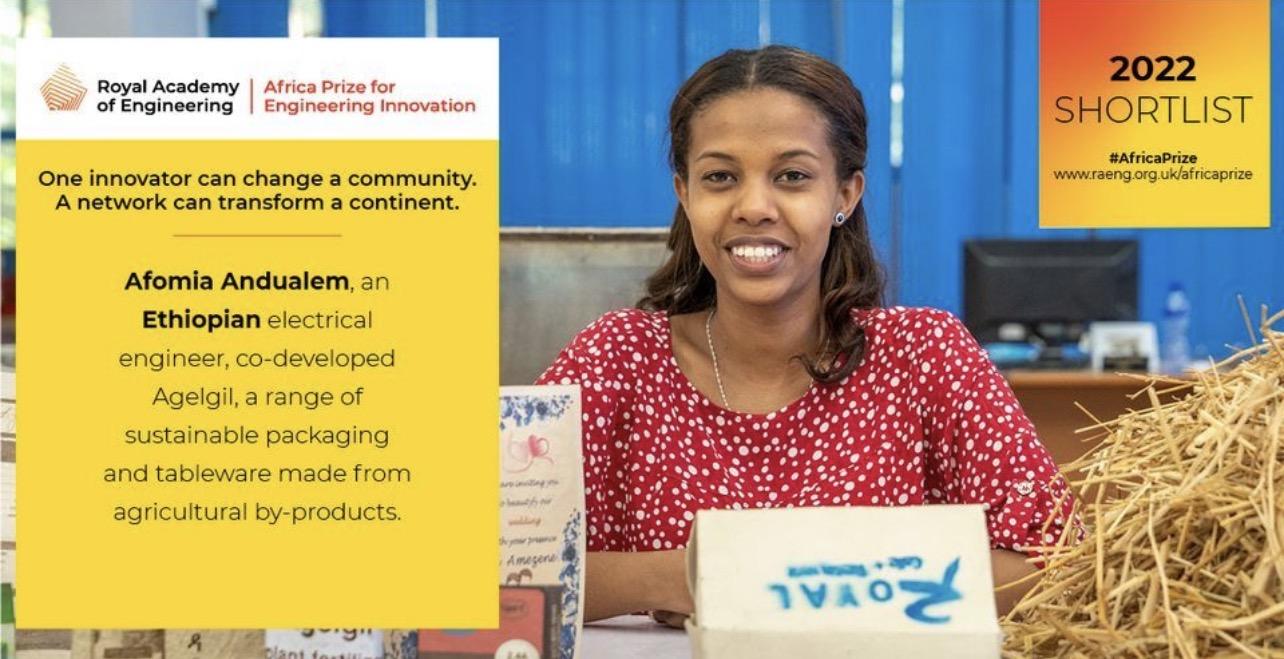
Afomia Andualem
Afomia Andualem’s story is the kind that begins in a local problem and grows into a continental idea. In Ethiopia, where farming is central to daily life and where agricultural leftovers are often seen as waste, she looked at what many people ignored and saw a resource. Instead of accepting a system where crop residue is burned, plastic packaging keeps piling up, and paper products depend heavily on trees, she and her team built Agelgil, a company that transforms agricultural by products into sturdy packaging and tableware. The innovation was strong enough to earn recognition from the Africa Prize for Engineering Innovation, which highlighted both her process and the machinery her team developed to convert crop waste into reliable packaging.
At the center of her work is a simple but powerful question. What if the things people throw away after harvest could become the material for a cleaner industry. Agelgil answers that question with products made from wheat straw, rice straw, barley straw, sugarcane bagasse, and even water hyacinth, an invasive plant that has caused serious environmental problems around Lake Tana. Rather than seeing these materials as useless leftovers, Afomia Andualem and her colleagues built a manufacturing model around them. The result is a range of sustainable packaging and tableware designed to reduce plastic use, reduce pressure on forests, and create more value for farming communities.
Her background helps explain why she could see the problem in more than one dimension. Afomia Andualem is an entrepreneur and co founder of Agelgil Eco Packaging in Ethiopia. She studied electrical engineering and also holds a degree in management, a combination that gave her both technical and business perspectives. BIC Africa describes her as a leader promoting eco friendly packaging solutions in Ethiopia, while the Royal Academy of Engineering identifies her as an electrical engineer whose team developed the core process and machinery behind Agelgil. That mix of engineering and management matters because her work is not just about inventing an object. It is about building a system that can produce, scale, sell, and keep delivering impact over time.
Agelgil itself grew out of a university environment. According to the Royal Academy of Engineering, the Agelgil team met as students at Bahir Dar University and ran the business from an incubator space provided by the university. That detail is important because it shows how the invention did not appear from nowhere. It came from collaboration, research minded thinking, and the willingness of young innovators to test ideas against real world problems. What began in an academic setting became a practical enterprise aimed at solving several connected issues at once.
To understand why Afomia Andualem’s invention matters, it helps to look at the challenge she was facing. Plastic waste is a global crisis, but Ethiopia has its own particular pressure points. The Royal Academy of Engineering notes that Ethiopia is Africa’s biggest importer of plastic as a raw material and that the country’s plastic use per person nearly tripled over the last decade. At the same time, paper based alternatives still often depend on wood and petroleum based energy. So the usual replacement for plastic is not always as environmentally clean as it first appears. Agelgil tries to step into that gap by offering packaging made without trees and with a model built around cleaner inputs and circular use of waste.
This is what makes the invention more than a simple packaging brand. Afomia Andualem did not only launch a company selling cups, plates, tubes, egg trays, and paperboard. She helped create a production process that rethinks raw materials from the ground up. In the Africa Prize profile, Agelgil is described as a sustainable range of packaging and tableware made from agricultural by products, while the later investor profile describes the company as a manufacturer of one hundred percent tree free hard paper and cardboard packaging. That means the invention sits at the intersection of materials science, environmental design, local supply chains, and manufacturing innovation. It is both a product and a process innovation.
The words process and machinery are especially important in understanding her work. Many people can imagine turning plant matter into paper in theory, but the difficult part is creating a dependable industrial method that consistently produces sturdy packaging. The Royal Academy of Engineering specifically states that Afomia Andualem and her team developed both the process and the key machinery required to turn crop waste into reliable packaging. That suggests technical work on how to prepare raw materials, how to convert them into pulp or board, how to shape or press them into finished goods, and how to do all of this in a way that meets commercial needs. It is engineering aimed at utility, not just laboratory demonstration.
One of the most striking parts of the Agelgil story is its use of materials that are often treated as a burden. In Ethiopia, crop waste such as rice, barley, and wheat straw may be used for heating or cooking, but large amounts are also burned to clear fields. Burning residue may solve one short term farming problem, but it can create others, including wasted material and environmental harm. Afomia Andualem saw another route. If this residue could be collected, processed, and turned into packaging, then farms would not only produce food. They would also produce industrial raw material. That changes the meaning of waste. It becomes feedstock for a new economy.
Then there is water hyacinth, a plant that has become notorious in many African water bodies. Around Lake Tana in Ethiopia, the Royal Academy of Engineering notes that water hyacinth has hampered fishing and tourism. Agelgil sources this invasive plant along with crop waste, converting an ecological nuisance into an input for manufacturing. Few aspects of the invention capture its elegance better than this. It does not merely replace one product with another. It actively cleans part of the environment by creating demand for a material that communities would otherwise struggle to control. In that sense, Agelgil is not only about packaging. It is also about landscape restoration, livelihoods, and practical environmental management.
The company’s zero waste ambition deepens that story. In the 2024 investor profile, Agelgil states that it has developed an innovative production process that is virtually zero waste. The Royal Academy of Engineering adds that waste created during manufacturing is turned into fertilizer and sold back to local farmers. This is one of the most compelling features of Afomia Andualem’s invention because it completes a circular loop. Agricultural leftovers come into the factory. Packaging goes out to market. Production waste becomes fertilizer. Fertilizer returns to farms. What might have been a linear chain of extraction, use, and disposal becomes a more regenerative cycle.
This circular approach also has an economic side. The Agelgil model provides farmers and nearby communities with additional income streams through the sourcing of crop waste and water hyacinth. In many innovation stories, communities appear only as consumers. In Afomia Andualem’s work, they are also suppliers and beneficiaries. The supply chain is built around local relationships, and the value created by the factory does not end at its gates. It moves outward into farms, unions, communities, and regional enterprises. The company later explained that it works through partnerships with farmers, farmer unions, and research centers to maintain a sustainable and reliable raw material supply chain.
That is one reason her invention stands out in conversations about African entrepreneurship. Too often, innovation is imagined as something imported from abroad or designed for elite markets. Agelgil is different. It begins with Ethiopian realities. It uses Ethiopian agricultural by products. It speaks to the packaging scarcity faced by local enterprises. And it grows from knowledge developed by a local team. The 2024 investor profile says the company aims to address the critical problem of packaging scarcity faced by local enterprises in Ethiopia and beyond. So the invention is solving an environmental problem and an industrial one at the same time. Businesses need packaging. Farms need better value from residue. Lakeside communities need relief from invasive plants. Agelgil ties those needs together.
The recognition she received through the Africa Prize for Engineering Innovation helped bring wider attention to this work. The Royal Academy of Engineering selected Afomia Andualem as part of its 2022 cohort, presenting Agelgil as a serious engineering response to plastic waste, tree based paper dependency, and agricultural waste burning. Another report notes that she was the second innovator from Ethiopia ever selected for the Africa Prize. Such recognition matters because it validates the technical and commercial promise of the invention and can open doors to mentorship, investors, visibility, and networks. It tells the wider world that this is not merely a good intention project. It is a strong engineering business with regional significance.
Still, awards alone do not define Afomia Andualem’s contribution. The deeper meaning of her work lies in how she reimagines material culture. Packaging is one of those things most people barely notice. A tray, a box, a cup, a tube, a plate. These are everyday items, used quickly and forgotten. Yet they shape enormous environmental consequences because they are produced in huge quantities. Plastic packaging lasts far longer in the environment than in human hands. Tree based packaging can shift pressure onto forests. By building strong packaging from agricultural by products, Afomia Andualem is changing one of the quiet infrastructures of modern life. She is asking whether the ordinary things people touch every day can come from systems that heal rather than harm.
Her story is also the story of interdisciplinary thinking. An engineer might focus on machinery. A business graduate might focus on market demand. A sustainability advocate might focus on waste reduction. A community organizer might focus on local livelihoods. In Agelgil, these strands come together. The company’s product range includes paperboard, cups, plates, tubes, canisters, and egg trays. Its business model emphasizes both profitability and social and environmental responsibility. This is not accidental. It reflects the outlook of a founder who can move between technical design, enterprise building, and social impact language with confidence.
The scale of the challenge also shows why persistence matters. Replacing conventional packaging is not easy. Factories and buyers care about consistency, price, durability, supply volume, and ease of adoption. A beautiful idea is not enough. To survive in the market, Agelgil has to prove that sustainable alternatives can be reliable and commercially viable. The available profiles suggest that the company has been moving beyond concept stage and into growth. In the 2024 investor community profile, Agelgil is described as being at the scaling stage, founded in 2021, with an ambition to expand production capacity and enter international markets. That indicates the invention has moved from prototype thinking toward real enterprise development.
There is also a symbolic dimension to Afomia Andualem’s journey. She represents a generation of African women in engineering and entrepreneurship who are not waiting for permission to shape industrial futures. She has been profiled in business acceleration programs focused on women entrepreneurs, and more recent public posts describe her as a Mandela Washington Fellow and a winner of Woman in STEAM of the Year from Africa Startup Ecosystem Builders. While those later recognitions come from profile and public post sources rather than the core technical pages, they reinforce the picture of someone whose influence now reaches beyond one startup into mentorship, advocacy, and leadership.
Yet the strongest part of her story remains the original act of observation. She looked at what was already around her. Straw after harvest. Water hyacinth in the lake. Plastic in the market. Scarcity in local packaging. Then she asked not what should be imported, but what could be made from what Ethiopia already had in abundance. That kind of imagination is one of the most powerful forms of invention. It does not simply create something new. It rearranges the value of what already exists.
In many African economies, the challenge is not only the lack of resources. It is the underuse of resources that are already present but poorly connected to industry. Crop residue is abundant, but without the right machinery and process it remains waste. Water hyacinth is widespread, but without enterprise it remains a nuisance. Local demand for packaging is real, but without manufacturing capacity businesses depend on other materials and supply systems. Agelgil’s genius is in connecting these broken pieces into one working chain.
This is why the invention deserves to be described carefully. Afomia Andualem did not just invent a plate or a box. She helped invent a new material pathway and business logic. Agelgil takes underused biological materials and turns them into market ready packaging. It relies on engineered processing and machinery. It aims for very low waste. It generates local income opportunities. It addresses environmental pressure from both plastic use and invasive plants. It reduces dependence on timber based inputs for packaging. That is a layered innovation with environmental, industrial, and social dimensions.
There is also something hopeful in the name of the company’s journey through university and incubator spaces. Too often, higher education in Africa is accused of being too theoretical or disconnected from everyday life. Agelgil offers a different picture. Students met, identified problems, built a solution, and carried it into the market. Bahir Dar University was not only a place of learning. It became part of the invention’s early ecosystem. That matters for how young people imagine the purpose of education. Knowledge can stay in lecture halls, or it can move into factories, farms, and communities. In Afomia Andualem’s story, it moved outward.
Her work also speaks to the future of manufacturing in Africa. The continent does not have to choose between growth and sustainability as if they were enemies. Agelgil suggests a third path where manufacturing grows through sustainable resource use, local sourcing, and circular design. A factory can create products and still reduce waste. A business can make money and still improve environmental outcomes. Farmers can gain extra income from what they used to throw away. Communities can benefit when invasive biomass becomes economically valuable to remove. This is the sort of integrated thinking that many climate and development discussions talk about in theory. Afomia Andualem is trying to make it real in practice.
It is also worth remembering that packaging is tied to nearly every sector. Food businesses need containers. Retailers need boxes. Producers need protective materials. As African economies grow and urbanize, demand for packaging will grow too. The question is whether that future will be built mostly on plastics and tree intensive systems or whether companies like Agelgil can change the default. If they succeed, the impact could spread far beyond Ethiopia. The investor profile already speaks of serving local and continental enterprises and looking toward international markets. That means the invention is rooted in Ethiopia but not confined to it.
What makes Afomia Andualem especially compelling is that her story is neither purely scientific nor purely inspirational. It is practical. It has machines, raw materials, supply chains, products, and customers. It is built on the hard work of turning an idea into a functioning company. That grounded quality gives the story weight. When people hear about sustainability, they often imagine slogans. Agelgil offers hardware, material transformation, manufacturing discipline, and commercial intent. It makes sustainability tangible.
The broader lesson from her story is simple but profound. Innovation does not always begin with the search for something rare. Sometimes it begins with paying serious attention to the ordinary. A field after harvest. A weed spreading across water. A shortage in the market. A young engineer asking whether waste has been misunderstood. Afomia Andualem turned that attention into invention. Through Agelgil, she created a way to convert neglected biomass into useful products, while drawing a line between environmental restoration and industrial production.
In the end, her achievement is not only that she made packaging from farm waste. It is that she made people look again at what value can mean. Value can be in residue. Value can be in repair. Value can be in cleaner supply chains. Value can be in giving farmers a second income from what was once discarded. Value can be in replacing materials that damage the environment with ones drawn from cycles of renewal. That is the real power of Agelgil. It changes not just what packaging is made from, but how people imagine the relationship between agriculture, industry, and the environment.
Afomia Andualem’s story is still being written. The available public profiles already show a founder whose company has moved from university roots into scaling conversations, investor engagement, and wider recognition across African entrepreneurship spaces. But even if one stopped the story here, the significance would remain clear. She has shown that engineering in Africa can be deeply local and globally relevant at the same time. She has shown that sustainability can be designed into the bones of a business. And through Agelgil, she has offered a practical answer to one of the most urgent questions of our time: how to make the everyday materials of life without deepening the damage around us.

Categorie
Leggi tutto
NEWSPAPER HEADLINES FOR MONDAY 9TH JUNE 2025 PUNCH APC kicks as PDP alleges Aiyedatiwa abandoned Akeredolu’s projects NiMet forecasts thunderstorms, rain for three days Group wants INEC to register new political party Mutfwang seeks action against poverty in Plateau Bayelsa gov urges joint action against ocean rise threat 3,012 kidnappings, 3,584 killings recorded in 15 months –...

Terwase Akwaza, popularly known as Gana, was one of the most feared and controversial figures in Benue State, Nigeria, from 2015 until his death in 2020. Born in Gbishe village, he grew up amid poverty and hardship, with rumors swirling that he possessed supernatural powers. What began as petty theft soon escalated. Gana evolved into a full-fledged warlord, leading a militant group that...

A Lagos High Court in Ikeja has dismissed the defamation lawsuit filed by Olalekan Fatodu and Leeman Communications Limited against journalist Omoyele Sowore and Sahara Reporters, awarding ₦500,000 in costs against Fatodu. Justice Oyindamola Ogala struck out the case on Tuesday, ruling that the claimants failed to prove that the allegedly defamatory content was published to a third...

Mitchell Elegbe Mitchell Elegbe is a Nigerian entrepreneur and business leader best known as the founder, Group Managing Director, and Chief Executive Officer of Interswitch Group, one of Africa’s best-known digital payments companies. He has led the company since it began operations in 2002 and is widely regarded as one of the key figures in the growth of electronic payments in Nigeria...
Epa Masquerade In the heart of Yoruba land, where drums speak louder than words and traditions walk among the living, there exists a presence so powerful that even the bravest men lower their eyes when it passes. It is not a king, not a warrior, not even a spirit you can easily name. It is something more ancient, more commanding, and more feared. It is the Epa Masquerade. Long before...