


Virtue Oboro and Crib A Glow: The Nigerian Mother Who Turned Pain Into a Life Saving Innovation
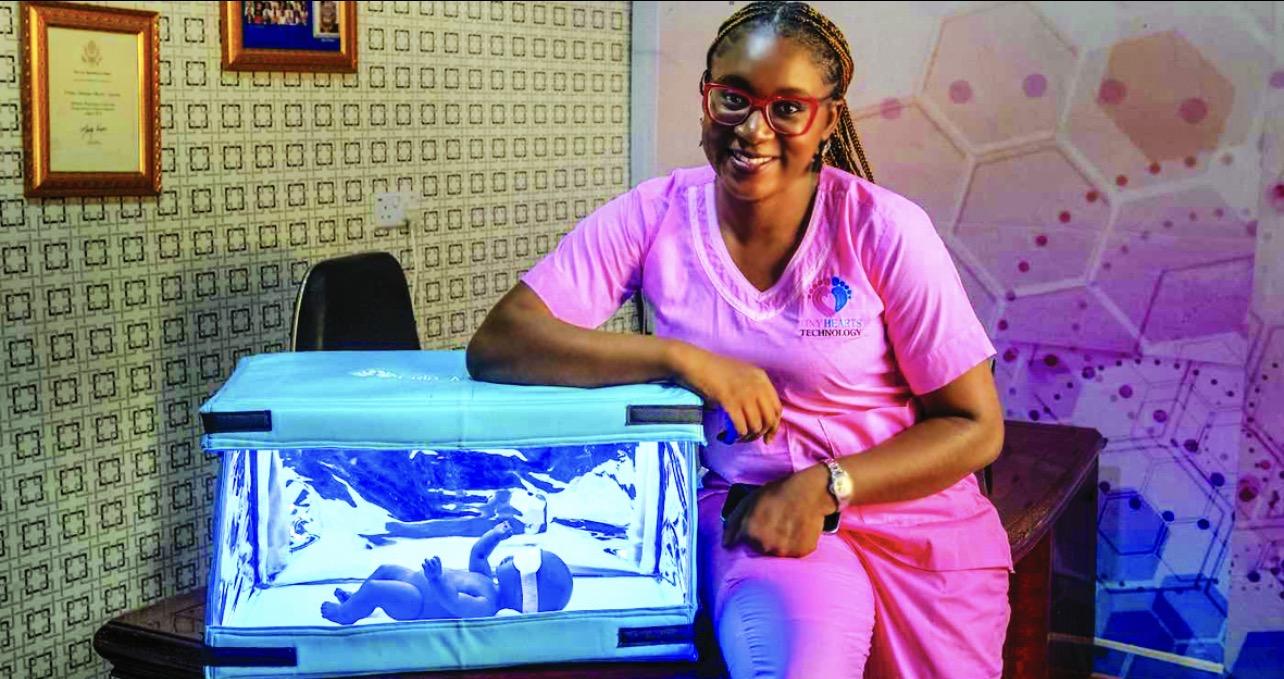
Virtue Oboro
Virtue Oboro’s story begins where many powerful inventions begin, in a moment of fear.
She was not sitting in a grand laboratory surrounded by machines and experts when the idea for Crib A Glow came to her. She was a mother. Her newborn son was sick. The diagnosis was neonatal jaundice, a condition that is common in babies but can become dangerous when treatment is delayed or unavailable. In many places, jaundice is treated quickly with phototherapy, but in Nigeria and many other parts of Africa, access to reliable treatment can be difficult because equipment is expensive, hospitals are overstretched, and electricity is unstable. That gap between what should be simple and what was actually happening changed the course of her life.
To understand why her invention matters, it helps to understand the problem she was facing. Neonatal jaundice happens when a baby has too much bilirubin in the blood. Mild jaundice is common, but severe cases can become deadly or leave a child with permanent complications such as brain damage, hearing loss, cerebral palsy, or developmental difficulty if treatment does not come quickly enough. In wealthier settings, phototherapy under blue light is routine. In many under resourced communities, it is not routine at all. Devices may be too costly, too fragile, or too dependent on uninterrupted electricity. The treatment exists, but for many families it remains painfully out of reach.
That was the reality Virtue Oboro came face to face with when her son fell ill. Several profiles of her work trace the birth of Crib A Glow directly to that experience. Her son suffered severe jaundice after birth, and the experience shook her deeply. It was not just the illness itself that left a mark on her. It was the realization that many mothers could lose their babies, or watch them suffer preventable injury, simply because the right equipment was not available where it was needed most. That realization stayed with her. It refused to leave. Instead of moving on after her child recovered, she turned her fear into a mission.
What makes her journey especially striking is that she did not begin as a medical insider. One report described her as a professional graphic designer who went on to build a health innovation after her son’s experience. Other profiles describe her more broadly as an entrepreneur, inventor, and problem solver. Whatever label is used, the central truth is the same. She saw a deadly problem up close and decided not to wait for someone else to solve it. She stepped into an unfamiliar field because the need was urgent and personal.
The invention she helped create was Crib A Glow, a foldable portable phototherapy crib designed to treat newborn jaundice. It uses blue LED light, the standard therapeutic principle behind phototherapy, but reimagines the delivery in a way that fits the realities of resource constrained communities. Official descriptions of the innovation emphasize that it is solar powered, affordable, and designed for both health facilities and parents in places where stable electricity and advanced neonatal infrastructure are not guaranteed. The device is meant not only to treat babies, but also to make treatment more accessible in the places where conventional hospital equipment often fails to reach.
That is what separates Crib A Glow from a nice idea. It is not innovation for applause. It is innovation shaped by practical conditions. In many hospitals, especially outside large urban centers, power outages are not occasional inconveniences. They are part of daily life. Imported medical devices can be expensive to buy and expensive to maintain. Families may also face long travel times to facilities that actually have working equipment. By creating a solution that could function with solar power and be deployed more flexibly, Virtue Oboro was not merely inventing a new object. She was redesigning access.
Stories about successful inventions often make the final result look smooth, but the path was not smooth. Reporting on Crib A Glow notes that it took four failed attempts and several trials before the product worked as intended. That detail matters. It reveals a founder who was not discouraged by early setbacks. She and her collaborators kept refining the design until it became a viable solution. That spirit of repeated testing is at the heart of real invention. The breakthrough is rarely the first try. It is usually what comes after disappointment, revision, and stubborn belief.
She did not build it alone. Accounts of the company’s growth explain that Virtue and her husband began work on the idea after their son’s jaundice crisis, and that the team later grew to include engineers, designers, and pediatricians. Another report notes that she worked with medical professionals and biomedical engineers while developing the early prototype. This collaboration was crucial. The invention sat at the crossroads of medicine, engineering, and lived maternal experience. It required clinical credibility, technical design, and emotional urgency, all at once.
In time, the work grew into Tiny Hearts Technology, the company connected to Crib A Glow. Official company materials present Tiny Hearts as an organization focused on improving newborn care, supporting frontline health workers, and producing medical devices and consumables that help infants and mothers access more affordable quality care. The company’s mission language is direct and powerful, centered on saving lives one medical equipment at a time. That is not just branding. It reflects the origin story of the company itself. Tiny Hearts did not begin with an abstract business model. It began with a tiny patient and a mother’s refusal to accept helplessness.
Crib A Glow is important because it addresses both treatment and context. Conventional phototherapy often assumes a stable hospital system. Crib A Glow was built with the opposite assumption, that care has to survive in difficult conditions. Official descriptions say it is aimed at healthcare facilities and parents in resource constrained regions. Earlier reporting also noted that the cribs could be sold to hospitals and health centers and rented directly to new mothers, a model that widened the reach of the device beyond conventional institutional purchasing. That kind of flexibility matters in places where many families cannot wait for large systems to catch up.
The impact figures around Crib A Glow have grown over time as the company expanded. In 2019, reporting connected to the Africa Innovation Challenge said the innovation had already helped treat more than 600 babies. Later reporting and organizational profiles described the number as hundreds of thousands, then over half a million, then over a million. Tiny Hearts’ official website now says the organization has saved more than 1,000,000 lives, worked with more than 400 hospitals, and sold more than 1000 products. Even allowing for the fact that impact numbers evolve as organizations scale and that different sources capture different moments in time, the broad picture is clear. What began as a response to one child’s illness has grown into a system that has reached many families and facilities.
Recognition followed. Virtue Oboro became a finalist in the 2022 Africa Prize for Engineering Innovation, one of the continent’s most respected innovation platforms. The Royal Academy of Engineering described Crib A Glow as a foldable phototherapy crib that treats and monitors jaundiced newborns and highlighted its potential to reduce infant mortality and improve neonatal care access. Her work was also recognized through the Africa Innovation Challenge backed by Johnson and Johnson, which profiled Crib A Glow as a portable solar powered phototherapy crib for newborn jaundice. These recognitions matter not just as awards, but as validation from respected institutions that the invention was meeting a real need in a meaningful way.
Still, awards are not the heart of this story. The heart of the story is what happens in a room when a sick baby is placed inside a device that can help save that baby’s life. A child who might have gone untreated gets a chance. A mother who might have gone home in fear has reason to hope. A nurse in a facility with limited resources has a tool that fits the environment rather than fighting it. This is where the power of Crib A Glow becomes real. It moves innovation away from conference stages and into neonatal wards, clinics, and homes where every hour can matter.
Virtue Oboro’s story also tells us something deeper about the kind of innovation Africa needs and already produces. Too often, technology stories on the continent are told through the lens of apps, funding rounds, and imported ideas. Crib A Glow belongs to another tradition, one where invention rises from direct experience with broken systems and where solutions are designed around local realities rather than borrowed assumptions. It is not simply African because it was made in Nigeria. It is African because it was shaped by the actual conditions of African healthcare, including unstable power, affordability barriers, distance, and overstretched infrastructure.
It is also a story about mothers as inventors. Many people think of motherhood and innovation as separate worlds, but in Virtue Oboro’s life they became one. Her authority did not begin with a laboratory degree. It began with witness. She saw the risk with her own eyes. She felt the panic. She understood the emotional and medical cost of delay. That experience gave her a kind of clarity that no abstract market research could provide. She knew the problem mattered because it had entered her own home. In that sense, Crib A Glow was born from love, but not the soft sentimental version of love. It was born from the fierce kind of love that studies, builds, tests, fails, tries again, and refuses surrender.
Another notable part of her work is that she has not focused only on hardware. Profiles connected to her work mention education and awareness around neonatal jaundice. One account notes that maternal jaundice education was a key part of the effort. Another says she has served as campaign coordinator for Yellow Alert Foundation, a nonprofit focused on training nurses, midwives, and community health workers across rural Nigeria. This is a crucial extension of the mission. A device matters, but so does knowledge. Families and healthcare workers need to identify jaundice early, understand its risks, and know when treatment is urgent. By connecting equipment with education, Virtue’s work attacks the problem from more than one angle.
That educational dimension may be one reason the impact has grown. When a health innovation spreads, it usually does not spread by technology alone. It spreads through trust, training, and understanding. A nurse has to know how to use it. A mother has to believe it can help. A facility has to see the value in adopting it. A team has to keep it maintained. An ecosystem has to form around it. Tiny Hearts appears to have understood that early. Beyond manufacturing devices, it has positioned itself around care, support, and neonatal health access.
There is something deeply symbolic in the name Crib A Glow. A crib is associated with rest, safety, and the beginning of life. Glow suggests light, warmth, and healing. The invention turns those associations into function. The child lies in what looks close to a place of rest, but the light is doing serious therapeutic work. It is a reminder that healing does not always have to look cold or intimidating. In the hands of a thoughtful inventor, medical treatment can be made more humane, more flexible, and more reachable.
The growth of Tiny Hearts also shows that Virtue Oboro was not content with a one time breakthrough. The company’s recent materials describe home care pathways, nursing support, and continued deployment around newborn jaundice care. That suggests an evolution from product invention toward a broader care model. The original spark was the crib, but the wider mission is neonatal survival and maternal support. In other words, the invention opened the door, but the vision kept expanding.
Her journey has also become a model for socially grounded entrepreneurship. She is frequently described as a co founder, designer of Crib A Glow, and healthcare innovator. That combination matters because entrepreneurship in this sense is not about building something flashy and exiting quickly. It is about building something necessary, sustaining it, and making it serve people who are often ignored by conventional markets. Newborns in under resourced communities are not a glamorous target audience for global venture culture, but they are among the most important people any society can choose to serve.
There is a quiet moral force in that choice. When a founder commits her talent to babies who cannot speak for themselves, to mothers in fear, and to hospitals doing their best under strain, she is making a statement about what progress should mean. Progress is not only faster phones, trendier platforms, or larger valuations. Sometimes progress is a blue light inside a portable crib in a clinic where power is unreliable and hope is fragile. Sometimes progress is a baby who goes home healthy because one woman turned private pain into public purpose.
Virtue Oboro’s recognition beyond Nigeria also reflects how strongly her story resonates across borders. International fellow networks, entrepreneurship platforms, and engineering showcases have all profiled her work. The reason is simple. While the problem of neonatal jaundice is universal, the burden falls hardest where treatment systems are weakest. A solution that is affordable, portable, and designed for unstable infrastructure is valuable far beyond one city or one country. That is why Crib A Glow has been described not merely as useful, but as a solution with the potential to change millions of lives.
And yet the most moving detail may still be the first one. Before there were awards, before there were hospitals and scaling figures, before there was official recognition, there was simply a mother trying to make sure another baby would not face what her son faced. That emotional origin gives the whole story its gravity. It keeps the invention human. It reminds us that some of the best ideas are not born from the desire to become famous. They are born from the refusal to watch preventable suffering continue.
So what exactly did Virtue Oboro invent?
She helped invent and develop Crib A Glow, a portable foldable solar powered phototherapy crib for newborn babies suffering from jaundice. It uses blue LED light to help reduce dangerous bilirubin levels in infants. It was designed specifically for places where standard treatment can be too expensive, inaccessible, or dependent on unstable electricity. It serves hospitals, health centers, and in some care models even families directly, making jaundice treatment more reachable for newborns in underserved communities. Over time, this invention became the flagship product of Tiny Hearts Technology and the foundation of a wider mission around neonatal care, awareness, training, and support.
That invention matters because it addresses both medical need and social inequality. It understands that a cure is not enough if people cannot access it. It understands that a machine is not enough if it breaks under local conditions. It understands that a mother’s fear can be transformed into a blueprint, a prototype, a company, a movement, and a second chance for children she may never meet.
In the end, Virtue Oboro’s story is not only about invention. It is about what can happen when compassion becomes design and design becomes action. She looked at a deadly gap in care and filled it with light. She turned one family’s moment of terror into an answer for thousands and then for many more. She showed that Nigeria does not have to wait for imported miracles when its own innovators can build solutions rooted in local truth. She proved that one woman’s determination can travel from a hospital crisis to national impact and from personal grief to public healing.
That is why Crib A Glow is more than a device.
It is a promise.
It is the promise that a child born in a place with limited resources still deserves advanced care.
It is the promise that a mother’s pain can become protection for other mothers.
It is the promise that African innovation can be intimate, practical, world class, and life saving all at once.
And at the center of that promise stands Virtue Oboro, a Nigerian innovator who saw darkness closing in around newborn lives and answered with light.

الأقسام
إقرأ المزيد
Victoria Kimani Victoria Kimani is a Kenyan singer, songwriter, actress, and entrepreneur known for her bold personality, sultry voice, and pan-African music influence. Often described as one of East Africa’s leading female artists, she gained continental recognition through hit songs, high-profile collaborations, and her time signed to one of Africa’s biggest...

Adebayo Salami In the early days of Nigerian entertainment, before “Nollywood” became a global word, the industry was powered by travelling theatre and raw talent. That was the world Adebayo Salami stepped into as a young boy—long before millions would know him by the name Oga Bello. A boy with a gift for performance Adebayo Salami was born on 9 May in Lagos (most...

Victoria’s Mother POV There are stories a mother keeps folded deep in her heart, stories she never plans to tell until the day they begin to knock loudly on her conscience. This was one of those stories. I sat alone in my room that evening, my wrapper pulled tight around me, my mind far away from the present. Victoria’s laughter floated in from outside, careless and free, and it...

Taiwo Aromokun Taiwo Aromokun is a Nigerian actress, producer, and entrepreneur known for her work in the Yoruba Nollywood industry. She is admired for her beauty, talent, and strong presence in Nigerian films. Early Life and Background Taiwo Aromokun was born on May 31, 1980, in Lagos State, Nigeria. She hails from Osun State and grew up in southwestern Nigeria, where she was...

In response to widespread speculation and online buzz, the Department of State Services (DSS) has officially debunked rumors of an impending arrest of renowned political economist Prof. Pat Utomi and other individuals linked to the so-called “shadow government” movement. Speaking through its spokesperson, Dr. Peter Afunanya, the DSS made it clear that there is “no truth...

