


Cletus Ekpoh and the Big Idea That Turned Waste Into Worth
Cletus Ekpoh
Cletus Ekpoh’s story is the kind of Nigerian innovation story that deserves to be told slowly, because it is not only about a machine. It is about a way of seeing what other people ignore. Where many people see heaps of rubbish, blocked drains, burned plastic, and scattered cans, he saw lost value. He saw danger, yes, but he also saw raw material, jobs, cleaner cities, and a chance to build something useful with local engineering. That vision became Waste to Wealth Enhancer, a four part recycling system designed to help informal waste collectors process waste into valuable material instead of leaving it to pollute the environment.
At the center of this story is a Nigerian polymer engineer who chose to work on a problem that many people complain about but very few truly solve. Cletus Ekpoh is described by the Royal Academy of Engineering as a Nigerian polymer engineer, and his invention was created to tackle illegal dumping of rubbish, unregulated landfills, and the open burning of plastic. Those are not small issues. They are daily realities in many communities where plastic waste clogs waterways, pollutes the air, and creates health risks for people living nearby. Waste to Wealth Enhancer was designed as a practical answer to those challenges, especially for the people closest to the problem, the waste pickers and small scale recyclers working at dump sites.
To understand why his invention matters, it helps to picture the environment it was built for. Across many urban and semi urban areas, waste is not handled in a neat, modern, fully mechanized system. A large amount of sorting and recovery is done informally by individuals who search through mixed waste for items that still have value. These workers are often hardworking, under supported, and exposed to unsafe conditions. They rescue recyclable materials from spaces that are dirty, smoky, and physically demanding. Yet even when they collect useful plastic or aluminium, they may not have the tools to process those materials into a form that is easier to store, transport, or sell at higher value. That gap is where Cletus Ekpoh focused his engineering attention.
His invention is called Waste to Wealth Enhancer, often shortened to WWE. It is not one machine but a four part recycling system. That distinction is important, because he was not trying to solve only one piece of the recycling chain. He was thinking about a fuller process from collection to conversion. The system includes an agglomerating machine, a crushing machine, an extrusion machine, and a manual compressor for aluminium cans. Together, these units help turn different kinds of waste into processed materials that can enter secondary manufacturing and support a circular economy.
The first unit is the agglomerating machine. This part focuses on soft polythene plastic such as discarded water sachets. In Nigeria, sachet water is extremely common, which means the waste from it is also everywhere. These thin plastic sachets can easily pile up in drains, open spaces, and landfill sites. According to the Royal Academy of Engineering, Ekpoh’s agglomerating machine uses self generated heat to convert this polythene into a solid form. After that, the mass is cooled with water and cut into pellets using rotating blades in a vertical drum. Those pellets do not remain waste. They become feedstock that can be upcycled into new plastic film, nylon agricultural bags, and other recycled products. In simple terms, the machine helps move waste from nuisance to raw material.
That first machine tells you a lot about how Ekpoh thinks. He does not merely want waste to disappear. He wants it transformed into something useful and tradable. That is a very different mindset from disposal alone. Disposal says get rid of it. Recycling at his level says process it, preserve the value in it, and return it to production. That difference is what makes his work more than sanitation. It is engineering tied directly to enterprise.
The second unit is the crushing machine, and this one handles hard plastic waste. Not all plastic looks or behaves like water sachet film. Some plastic comes as buckets, chairs, battery casings, kegs, and bottles. These materials need a different treatment. Ekpoh’s crushing machine uses a horizontal drum or chamber fitted with blades that break the hard plastics into flakes measuring about 2 to 8 millimetres. These flakes fall through holes at the bottom of the cylinder and can then be used in the production of new plastic goods such as paint buckets, interlocking moulds, and clothes hangers. That means items that once littered streets or piled up in dumps can return to economic life in a new form.
This part of the invention matters because hard plastic is everywhere in homes, markets, workshops, and industrial areas. Once broken or discarded, it often stays in the environment for a very long time. By turning it into flakes that manufacturers can reuse, the crushing machine creates a bridge between waste collection and remanufacturing. It also makes the material easier to handle, more compact, and more valuable than it would be in its original discarded shape.
The third unit is the extrusion machine, and it shows the ambition behind the system. Ekpoh was not content with only shredding or pelletizing waste. He also designed a machine that helps create a new product from the processed material. The extrusion machine uses the pellets from the first unit to produce tubular plastic film. The pellets are poured into a barrel containing an extrusion screw shaft, heated until molten, and then blown into thin film with the help of an air compressor. The film then passes through rollers that compress it into a two ply sheet of polythene which can be cut into shopping bags and agricultural bags. This is a significant step because it adds value beyond basic processing. It takes the recycled plastic closer to a finished commercial product.
That third step gives the story extra power. It means Waste to Wealth Enhancer is not simply about helping communities gather waste more efficiently. It is also about enabling local production. In places where imported goods can be expensive and small manufacturers need affordable materials, recycled plastic film can support practical business activity. It can serve agriculture, retail, packaging, and everyday household use. The invention therefore connects environmental cleanup with small scale industrial opportunity.
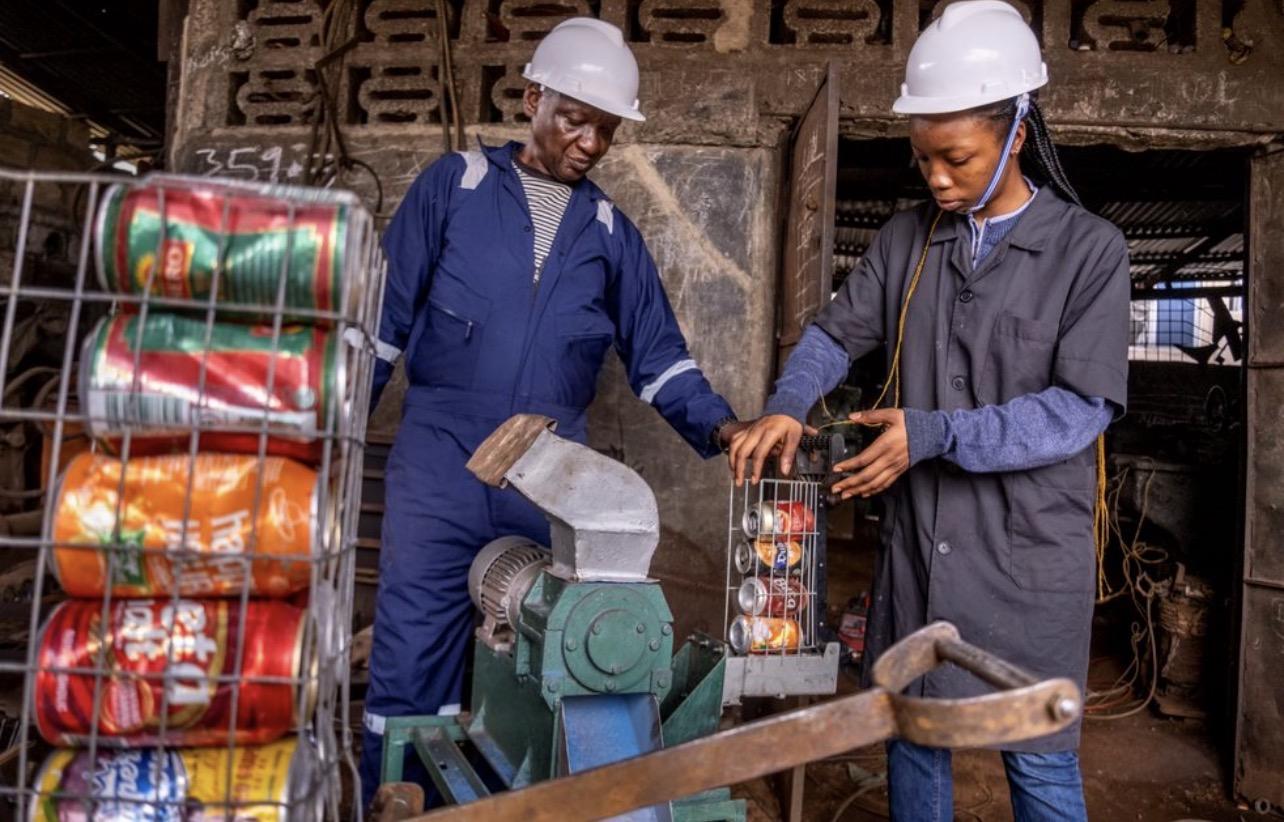
The fourth unit is a manual compressor for aluminium cans. This machine crushes a can to about 10 percent of its original size, making it easier to store and transport. Once compressed, the cans are more manageable for downstream recycling processes such as casting into ingots, moulds, clamps, and other metal products. This is another smart choice. Aluminium often holds recycling value, but bulkiness can make transport and storage inefficient. By reducing volume dramatically, Ekpoh’s manual compressor helps waste collectors and recyclers handle more material with less space and lower movement difficulty.
Together, the four units form a thoughtful system. Soft plastic is pelletized. Hard plastic is flaked. Recycled pellets can be turned into film. Aluminium cans are compressed for easier movement and reuse. Each machine targets a specific material stream and a specific problem in the waste chain. That is why the invention stands out. It is not random. It is structured. It reflects an engineer who studied the realities of waste and designed a modular response to them.
Another important detail is that the machines are described as compact and portable, and they are made from locally sourced metals. That matters for several reasons. First, portability means they can be used where the waste actually is, including dump sites and collection points. Second, local fabrication can reduce dependence on imported industrial equipment, which is often costly and harder to maintain. Third, building with locally sourced materials can strengthen local skills, repair culture, and manufacturing confidence. Ekpoh was not only inventing a machine. He was also showing that African engineering can produce context appropriate tools with local resources.
This local relevance is one of the strongest parts of his story. Too many technologies fail because they are designed far away from the conditions in which they are supposed to work. Ekpoh’s approach appears different. His machines are meant for the realities of informal waste systems, for operators who may not have advanced technical training, and for environments where durability, simplicity, and affordability matter. He himself said that job creation and financial empowerment are the first goals, and that the machines can be operated by a layperson who can turn recycling into a regular source of income. He also said he wants Africa to buy into the idea as a response to the serious environmental threat posed by unregulated waste disposal and inadequate recycling.
That statement reveals the heart of the invention. Waste to Wealth Enhancer is not just a technical project. It is a social and economic project. It aims to democratize recycling by making the tools usable beyond large corporations or heavily capitalized plants. In many places, informal workers are already doing the labor of recovery. What they often lack is equipment that moves them up the value chain. If a waste picker can process material into pellets, flakes, or compressed cans, that person may earn more than if they sold raw scattered waste. That change can mean better income, more dignity, and a stronger small business foundation.
The name Waste to Wealth Enhancer captures this philosophy perfectly. It does not claim that waste magically becomes wealth on its own. It says the system enhances the process. It improves the transition from discarded material to something useful and valuable. That is an honest and practical name. It recognizes that transformation requires labor, tools, knowledge, and markets, but also insists that the value is there waiting to be unlocked.
Ekpoh’s work gained wider recognition when he was shortlisted in the 2023 Africa Prize for Engineering Innovation run by the Royal Academy of Engineering. He was listed among the entrepreneurs selected for the programme and was specifically named on the shortlist for the One to Watch prize at the 2023 final event. News coverage at the time also identified him as one of the Nigerian innovators shortlisted for the competition. This recognition matters because the Africa Prize is known for supporting scalable African engineering solutions to major local challenges. Being selected placed his work in a continental conversation about practical innovation, entrepreneurship, and impact.
Recognition, however, is only one chapter in a story like this. The deeper value lies in what the invention says about the future of engineering in Nigeria. For many years, conversations about innovation have often focused on software, apps, and digital platforms. Those are important, but hardware innovation remains vital, especially in sectors like waste management, agriculture, fabrication, and energy. Ekpoh’s invention reminds us that engineering progress also happens through metal, blades, drums, screws, compressors, and production systems. It happens in workshops as much as on screens. It happens when someone studies a physical problem and builds a working answer with materials that can be sourced locally.
There is also something deeply symbolic about tackling waste. Waste is what society throws away. It is what people stop valuing. To build an invention around it is to challenge a wider habit of neglect. In a sense, Cletus Ekpoh’s work tells two stories at once. One story is about plastic, cans, pollution, and machines. The other is about overlooked possibilities. Just as waste pickers are often overlooked, the materials they collect are overlooked too. His system says both the people and the materials deserve another look. There is value in them. There is potential in them. There is a future in treating them differently.
For Nigeria in particular, this message is powerful. The country has a huge population, vibrant enterprise culture, and serious environmental pressure in many places. Urban growth creates more demand for packaging and consumer goods, which in turn creates more waste. Drainage systems become clogged. Open burning releases harmful smoke. Unregulated dumping damages land and water. Local governments, private actors, and communities all struggle with the scale of the challenge. An invention like Waste to Wealth Enhancer does not solve every part of that system, but it contributes a grounded and useful piece of the answer. It focuses on recovery, processing, and value creation where they are badly needed.
There is reason to think that inventions like this can ripple outward beyond their first use case. A portable recycling machine is not only a tool. It can become part of a training program, a youth employment effort, a local recycling hub, a women led cooperative, a market waste initiative, or a small manufacturing chain. When technology is practical enough, it can travel across communities and adapt to new contexts. That is one reason his emphasis on layperson operation is so important. Simplicity can multiply impact.
His story also fits into a broader African movement toward circular economy thinking. The circular economy tries to keep materials in use for as long as possible rather than following a straight line of make, use, and dump. Ekpoh’s system does exactly that. It rescues materials from the waste stream, processes them, and returns them to production. In that sense, he is not merely solving a local sanitation issue. He is participating in a much larger shift in how economies think about materials, value, and sustainability.
At a human level, though, the beauty of the story is easier to grasp. Imagine a place where plastic waste is scattered all around. Imagine someone who earns little from picking through it. Imagine a machine nearby that can turn that low value mess into pellets, flakes, film, or compressed metal ready for sale or further production. Suddenly the picture changes. The environment gets cleaner. The worker’s position improves. Local manufacturing gets material. A nuisance becomes an opportunity. This is why the phrase waste to wealth feels more than catchy in his case. It describes a real chain of transformation.
It is also worth noting that public web snippets connected to his professional presence describe him as an engineer, innovator, industrialist, and consultant, and one snippet notes recognition as Engineer of the Year by the Nigerian Society of Engineers. I have not relied on those claims heavily here because the most detailed public source available is his Africa Prize profile, but even those snippets suggest a professional path rooted in engineering practice, industry, and innovation.
What stands out most in the end is not only the invention itself, but the mindset behind it. Cletus Ekpoh appears to belong to the class of builders who respond to visible everyday problems with tools that ordinary people can use. That kind of innovation may not always arrive with flashy headlines, but it can change real lives. It can help a worker earn more. It can reduce the amount of plastic burned in the open. It can make a dump site less chaotic. It can feed raw material back into local production. It can prove that a machine fabricated from local metals in Nigeria can answer a serious environmental challenge with intelligence and practicality.
That is why his story deserves attention. He did not invent a luxury item. He did not build for convenience alone. He built for necessity. He looked at waste and saw more than dirt. He saw a broken chain in need of repair. Then he designed machines to repair it. In doing so, he gave shape to an idea that is both simple and profound. What a society throws away can still hold value. What an economy overlooks can still create livelihoods. What pollutes a community can, with the right engineering, become part of its renewal.
Cletus Ekpoh’s Waste to Wealth Enhancer is therefore more than a recycling system. It is a statement about African ingenuity, Nigerian resilience, and the power of practical engineering. It says solutions do not always need to come from distant factories or expensive imports. They can be imagined, fabricated, and deployed close to the problem. They can be built for local hands and local realities. They can protect the environment while strengthening enterprise. And sometimes, the most powerful invention begins with something as ordinary and unwanted as a torn water sachet lying on the ground.
In the story of innovation, many people chase what is new. Cletus Ekpoh’s work reminds us that another kind of innovation matters just as much. It is the kind that sees old problems clearly, understands materials deeply, and builds tools that help communities rise through usefulness. That is the real brilliance of his work. He did not just ask how to remove waste. He asked how to recover value, create jobs, and give discarded material another life. In that question lies the full meaning of Waste to Wealth Enhancer, and in that answer lies the enduring strength of his contribution.

الأقسام
إقرأ المزيد
Eucharia Anunobi Eucharia Anunobi is a veteran Nigerian actress, producer, and ordained evangelist widely known for her bold roles in early Nollywood films. With a career spanning decades, she has successfully transitioned from a controversial screen personality to a respected Christian minister. Early Life and Background Eucharia Anunobi was born on May 25, 1965, in...

One of the most significant and rapidly expanding of all MPLS Market Opportunities lies in providing secure, high-performance private connectivity to public cloud services. The era of the enterprise data center as the sole center of gravity for IT is over. The modern enterprise operates in a hybrid, multi-cloud world, and requires a network that can seamlessly and securely connect its...

Clarence Olafemi Clarence Olafemi is a Nigerian politician best known for serving as the acting governor of Kogi State in 2008. He also became notable as a former Speaker of the Kogi State House of Assembly and as one of the political figures from Kogi West who remained active in state politics for many years. Early Life and Background Clarence Olafemi was born in Mopa Muro Local Government...
Priyanka Chopra Jonas Priyanka Chopra Jonas is an Indian actress, film producer, singer, and global icon known for her successful career in both Bollywood and Hollywood. Born on July 18, 1982, in Jamshedpur, India, she rose to international fame after winning the Miss World pageant in 2000 and later becoming one of the most influential actresses in the world. Early Life and...

Ikorodu is one of those places in Lagos that doesn’t feel like it was “built yesterday.” Step into it and you can sense it—this isn’t just a modern suburb that Lagos swallowed. Ikorodu is a proper old Yoruba town, with roots, structure, and a long memory. Long before Lagos became a giant sprawl of estates and expressways, Ikorodu already had what many places are...

