


 Σχετικά
Boitumelo Nkatlo Story: How South Africa’s Affordable AMD Solution Turns Toxic Mine Water Into Safe Water
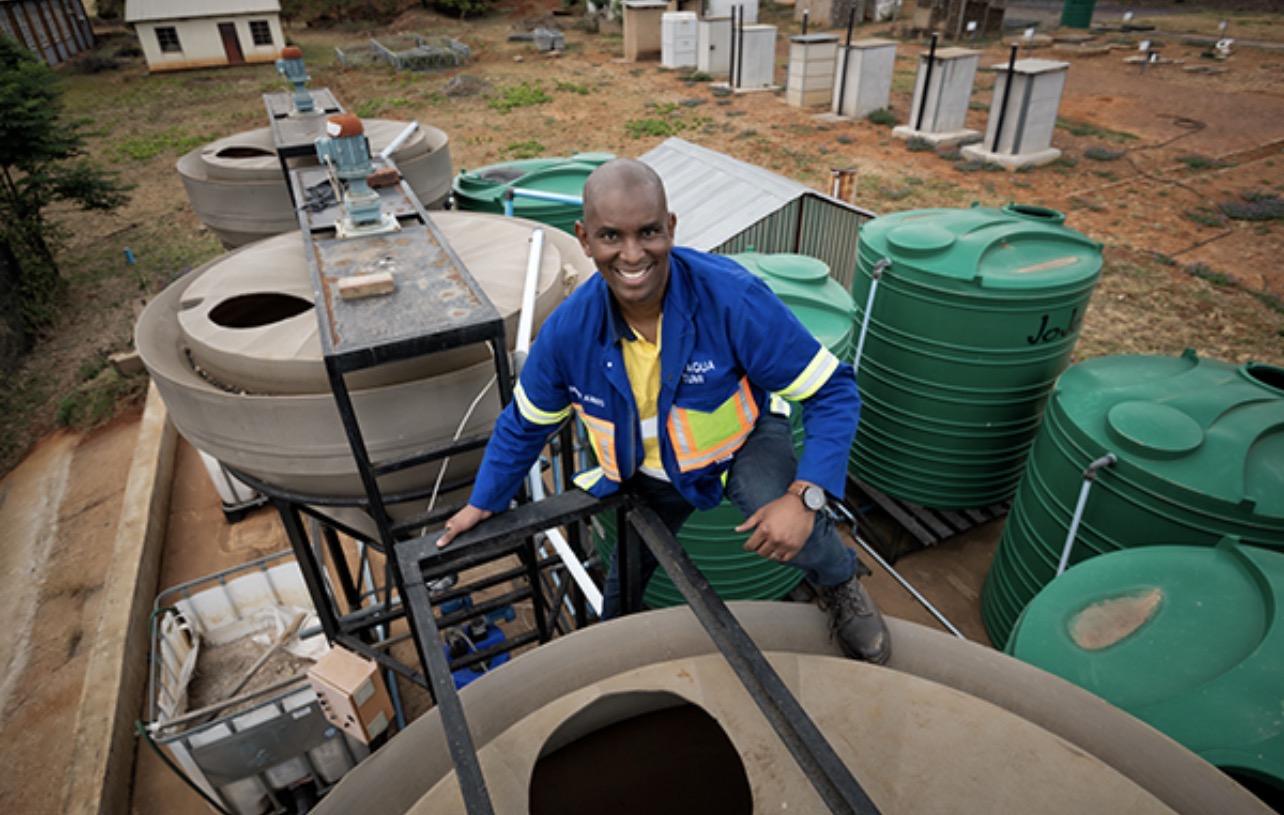
Boitumelo Nkatlo
Boitumelo Nkatlo’s story begins in a country where mining has built cities, created fortunes, and powered industries, yet also left behind one of the quietest and most dangerous environmental problems of all. In many mining regions of South Africa, water does not always remain water in the ordinary sense. It can become acidic, stained by dissolved metals, and unsafe for human use. This polluted runoff, known as acid mine drainage, has long threatened rivers, landscapes, and communities. Boitumelo Nkatlo looked at that problem and saw not only danger, but also possibility. He became known for developing Affordable AMD Solution, a technology designed to treat acid mine drainage by using industrial waste to recycle contaminated water into water suitable for human consumption.
He is a South African engineer and innovator associated with BN Aqua Solutions, the company through which his water treatment work has gained public recognition. Public profiles and reporting describe him as a chemical engineering graduate from the University of Johannesburg, while other profiles describe him as a metallurgical engineer and founding director of BN Aqua Solutions. Across these sources, one point is consistent: his work sits at the intersection of mining, water treatment, waste reuse, and practical engineering for public benefit.
What makes his invention stand out is not just that it treats dirty water. Many technologies can do that at some scale. What makes his work important is the problem he chose to attack and the way he chose to attack it. Acid mine drainage is not an abstract laboratory challenge. It is a real and expensive burden in mining economies. It forms when sulfide minerals are exposed to air and water, producing sulfuric acid and dissolved iron that contaminate surrounding water systems. Nkatlo’s Affordable AMD Solution was developed to address that exact process by treating this acidic wastewater and doing so with the help of industrial waste materials, which helps lower cost and strengthens the circular economy idea behind the solution.
To understand the meaning of his work, it helps to understand the landscape that shaped it. South Africa is one of the most mining intensive countries on the continent. For generations, gold, coal, and other mineral extraction have been central to the economy. But old mines and active mine sites can leave behind a toxic legacy. Water finds its way through exposed rock, reacts chemically with minerals, and emerges contaminated. That contaminated water can flow into rivers and groundwater systems, threatening ecosystems and reducing the supply of water that can be safely used by people, farms, and businesses. This is especially serious in a country that already faces water stress and recurring concern about water security. Reporting on Nkatlo’s innovation consistently places it within this national challenge of water scarcity and polluted mine runoff.
Nkatlo’s path appears to have been shaped by direct exposure to the mining industry rather than by distant academic theory alone. A profile on BN Aqua Solutions says he was involved in challenging mine and processing developments and had been engaged with acid mine drainage work from 2014 onward, under laboratory conditions with support from the University of Johannesburg and prototype building support from the CSIR. Another source says he worked in the mining industry for more than 14 years and identified the shortcomings and cost burdens tied to conventional AMD treatment systems. That matters because some inventors begin with a concept, while others begin with a wound they have seen up close. Nkatlo appears to belong to the second group.
It is easy to imagine the moment when the problem became personal for him. A metallurgist or engineer on mining projects would see how much water is consumed, wasted, and contaminated. He would see water that could no longer be used without expensive treatment. He would see operations paying for fresh water while polluted water accumulated nearby. He would also see the contradiction in a country where communities need reliable water, while valuable volumes of water remain trapped inside a contamination problem. One entrepreneur profile says he was struck by the millions of liters of water contaminated by mining activities each day in South Africa. That image is powerful because it captures both the scale of the challenge and the scale of the missed opportunity.
From that tension came Affordable AMD Solution. The available public descriptions say the technology treats acid mine drainage using waste metallurgical or industrial slag. In other words, one waste stream helps clean another waste stream. That is a compelling engineering idea because it lowers dependence on more expensive treatment inputs while also finding productive use for a material that might otherwise be discarded. BN Aqua Solutions has described the approach as cost effective, environmentally responsible, and circular. Public descriptions also say the process can recover saleable minerals, which suggests the technology may create value not only by cleaning water but also by enabling recovery from contaminated streams.
The phrase Affordable AMD Solution is important in itself. The affordability is not a side note. It is one of the core reasons the innovation attracted attention. Water treatment often fails to scale not because the science is impossible, but because the economics are hard. If the cost is too high, adoption slows. If the chemicals are expensive, operations hesitate. If the infrastructure is too complex, only large institutions can use it. By focusing on a lower cost route that uses locally available waste materials, Nkatlo positioned his invention as something that might work not just in theory, but in real industrial settings where budgets, logistics, and supply chains matter.
There is also a deeper elegance in his approach. Many modern sustainability ideas talk about circular economies, but not every innovation truly embodies that principle. Nkatlo’s solution appears to do exactly that. It treats harmful acidic mine water with another industrial byproduct, transforming a double burden into a double opportunity. Instead of treating pollution as a dead end, the system reframes it as a starting point for recovery, reuse, and value creation. This is one reason his work resonated with entrepreneurship and engineering platforms beyond South Africa. It speaks a language that industries, governments, and climate focused observers increasingly understand: waste can become resource when engineering is imaginative enough.
Recognition followed. Nkatlo was selected for the 2023 cohort and shortlist of the Africa Prize for Engineering Innovation, run by the Royal Academy of Engineering. Official Africa Prize pages describe him as a South African chemical engineer whose Affordable AMD Solution tackles acid mine drainage in the mining sector by using industrial waste to recycle contaminated water for human consumption. That shortlist mattered because the Africa Prize is a high profile platform for innovators solving major practical problems across the continent. Being named among the shortlisted innovators placed his work before a continental and international audience.
This kind of recognition is never only about prestige. It often signals that an invention has crossed a difficult threshold. Many ideas remain unknown because they stay within laboratories, classrooms, or local circles. When an innovation enters a prize shortlist of this level, it usually means experts have recognized not just its scientific merit, but its potential usefulness, originality, and relevance. For Nkatlo, that meant his work was no longer just a response to a local problem. It became part of a broader African story about engineering for survival, resilience, and development.
Media attention reinforced that message. South African and regional reports highlighted him as one of the local innovators competing for major continental engineering honors. Coverage emphasized that his technology could turn acidic mine drainage into potable water and help address water scarcity. A University of Johannesburg news report earlier described him as an alumnus turning contaminated mine water into a resource. This theme appears again and again in the public record around him: not simply cleaning pollution, but converting what seems unusable into something valuable and life supporting.
That idea has huge moral force in Africa, where engineering often matters most when it is close to daily life. Water is not a luxury problem. It shapes health, agriculture, industry, dignity, and stability. A technology that can increase available safe water has consequences far beyond technical performance charts. Nkatlo himself has publicly framed the aims of BN Aqua Solutions around reducing drinking water costs for mines, increasing South Africa’s drinking water capacity, and supporting food security through agricultural and irrigation use of treated water. Those goals reveal the scope of his thinking. He is not speaking only about a mine site. He is speaking about an ecosystem of need.
His story also shows the importance of universities and innovation support systems. The public descriptions of his journey mention the University of Johannesburg and the CSIR in connection with laboratory work, intellectual property, and prototype building. That kind of support matters for deep tech and engineering ventures, especially those addressing industrial scale environmental problems. An inventor may have the insight, but turning insight into a working treatment system requires testing, validation, infrastructure, and institutional partnerships. Nkatlo’s progress suggests what becomes possible when a committed individual is backed by technical and developmental ecosystems.
His entrepreneurial identity grew alongside the engineering. BN Aqua Solutions was established in 2016 according to entrepreneur profiles, and it has been presented as a Pretoria based company focused on acid mine drainage treatment and broader circular waste solutions. Public company and profile pages position Nkatlo as founder or director, and in some places as CEO. These roles matter because inventing and building a company are not the same skill. One requires scientific and technical thinking. The other requires persistence, persuasion, funding efforts, networking, and the ability to explain complex value in language that investors, institutions, and customers can understand. Nkatlo appears to have done both.
That entrepreneurial dimension became even more visible when he won recognition through Regent Business School and Honoris United Universities connected to his project, which earned him an opportunity to attend Harvard Business School’s Africa Business Conference. Reports on that achievement described his invention as a project addressing water scarcity by transforming acid mine drainage into safe drinking water using waste metallic materials. While the trip itself is a separate milestone, it shows how his work began to travel beyond engineering circles into business and leadership spaces. Innovation of this kind must do that if it is to scale.
There is something especially striking about the symbolism of his invention in the South African context. Mining has long extracted wealth from the earth, but also imposed environmental costs on communities and landscapes. Nkatlo’s work turns back toward the same sector and asks whether engineering can heal some of what extraction has damaged. He does not deny the industrial world. He works inside its realities. He uses one industrial residue to solve another industrial consequence. In that sense, his story is not anti industry. It is post neglect. It suggests that development in the future must include repair. This is an inference based on the reported design and purpose of his solution, but it fits the facts that public sources consistently emphasize.
His invention also speaks to a recurring African challenge: imported solutions do not always fit local conditions. Technologies designed elsewhere can be too expensive, too maintenance heavy, or too dependent on inputs that are hard to source. Nkatlo’s use of locally available industrial waste changes that equation. It points to a homegrown method rooted in local industrial ecology. That may be one reason his innovation has been framed as affordable and practical. It is not just solving a South African problem. It is solving it in a South African way.
Public reporting does not provide every detail of his early life, family background, or personal childhood journey, so it would be wrong to invent those parts. But even without them, the outline of his professional life tells a compelling story. He studied engineering, entered the mining world, encountered an environmental crisis embedded in industrial practice, and chose not to look away. He built a response. He tested it. He organized a venture around it. He sought partnerships. He presented the work to local and international audiences. He kept pushing until the innovation was visible enough to be shortlisted for major awards and highlighted in media coverage about climate, engineering, and African entrepreneurship.
That kind of persistence deserves attention because environmental engineering is rarely glamorous in its early stages. It involves trial, contamination chemistry, process design, prototyping, and long periods of proving that a method works reliably enough to matter. The public record around BN Aqua Solutions suggests that the project grew over years, with laboratory work dating back to at least 2014 and company establishment in 2016. This was not a sudden miracle. It was an accumulation of effort.
What he invented, in plain terms, is a method for treating acidic mine polluted water using industrial waste materials so that the water can be recovered for safe use, including human consumption according to multiple public descriptions. That is the heart of the invention. Around that core is a broader set of possible benefits: reduced treatment cost, improved water availability, reuse of waste slag, reduced environmental burden from mine runoff, support for irrigation and food security, and potentially the recovery of commercially useful minerals from the process.
This makes Nkatlo part of an important generation of African innovators whose work is grounded in necessity. His story is not about building something flashy for applause. It is about building something useful for survival and progress. The true beauty of that kind of invention is that it expands what people think is possible. Toxic mine water is usually seen as an ending. His work treats it like a beginning. Industrial waste is usually seen as something to dump. His process treats it like a tool. Scarcity is usually described as fate. His story turns it into an engineering challenge.
And that may be the deepest lesson in Boitumelo Nkatlo’s journey. Great innovation often comes from people who refuse to accept the obvious meaning of a problem. Most people see poison and step back. An engineer sees variables. Most people see waste and discard it. An innovator sees an untapped input. Most people see a long standing environmental crisis and assume only governments or giant corporations can change it. A determined founder builds a prototype and starts anyway.
In that sense, his story belongs not only to South Africa, but to the wider African imagination. It is a story about engineering with conscience. It is a story about local knowledge meeting serious scientific effort. It is a story about how one person working close to an industry can identify the blind spot everyone else has normalized. And it is a story about turning damage into possibility.
Boitumelo Nkatlo did not simply invent a treatment system. He helped reframe a national burden as a solvable challenge. He showed that the toxic inheritance of mining does not have to remain untouched. He proved that affordability can be part of innovation, not an afterthought. He demonstrated that a solution born in African conditions can speak to global conversations about water security, circular economy, and environmental repair.
As his work continues to mature, the larger promise around it remains clear. South Africa needs more water solutions that fit its realities. Africa needs more inventors willing to work on difficult infrastructure and environmental problems. The world needs more examples of technology that does not just consume resources, but restores them. Nkatlo’s Affordable AMD Solution stands at that crossroads.
His legacy is still being written, but the foundation is already strong. He is remembered publicly as the engineer who looked at acid mine drainage and refused to see only contamination. He saw a resource hidden inside a crisis. He saw that with the right chemistry, persistence, and vision, poisoned water could become drinkable again. In a continent where practical invention can change lives at scale, that is not a small achievement. It is the kind of story that deserves to travel far.

Κατηγορίες
Διαβάζω περισσότερα
Herbert Macaulay Herbert Macaulay is widely regarded as the father of Nigerian nationalism. He was a political activist, engineer, journalist, and nationalist leader who played a major role in the early struggle against British colonial rule in Nigeria. Born on November 14, 1864, in Lagos, he became one of the earliest voices demanding greater political rights and self governance for...
The Chairman of the African Democratic Congress (ADC) in Kano State, Alhaji Musa Ungoggo, has sharply criticised the Nigerian government over what he described as selective justice in the country’s security and judicial system. Speaking to party members and supporters, Ungoggo questioned why the leader of the Indigenous People of Biafra (IPOB), Nnamdi Kanu, remains in detention while...

A chieftain of the All Progressives Congress (APC), Mallam Salihu Isa Nataro, has called on the Vice President, Senator Kashim Shettima, to consider resigning from office in response to doubts about his relevance to the administration, following President Bola Ahmed Tinubu’s appointment. Nataro, who was a gubernatorial contender in Kebbi State, disclosed that even before the confusion...

Jim Parsons Jim Parsons is an American actor and producer best known for his role as Sheldon Cooper in the popular television sitcom The Big Bang Theory. His performance as the brilliant but socially awkward scientist made him one of the most recognized comedy actors in television history. Jim Parsons was born James Joseph Parsons on March 24, 1973, in Houston, Texas, United...
June 8, 2025 marked the 27th anniversary of the death of Nigeria’s former military head of state, General Sani Abacha. While every anniversary often stirs old debates about his legacy, this year’s commemoration came with a bold and emotional statement from his widow, Maryam Abacha. In a rare public comment, Maryam claimed that the funds her husband “kept for Nigeria”...

