Sobre
Sobre
The Sacred Stone City of Faith: The Timeless Story of the Rock Hewn Churches of Lalibela
The Sacred Stone City of Faith
Long before modern cities rose across Africa and centuries before skyscrapers touched the clouds, there existed a sacred place carved entirely from solid rock in the highlands of Ethiopia. Hidden among mountains and rugged terrain lies one of the most mysterious and astonishing religious sites in the world. It is known today as the Rock Hewn Churches of Lalibela.
This is not a story of ordinary construction. It is a story of faith so powerful that an entire holy city was carved downward into the earth. It is a story of a king who believed he had been chosen by God to build a new Jerusalem in Africa. It is a story where architecture, religion, legend, and human determination merged to create one of the greatest historical wonders on the continent.
To understand why Lalibela became history, one must travel back to medieval Ethiopia, a time when kingdoms rose among the mountains and Christianity had already taken deep root in the land.
The Ancient Christian Kingdom of Ethiopia
Ethiopia is one of the oldest Christian nations in the world. Christianity arrived there in the fourth century during the reign of King Ezana of the Aksumite Empire. From that moment, the Ethiopian Orthodox faith became deeply woven into the identity of the country.
For centuries, Ethiopian Christians looked toward Jerusalem as their spiritual center. Pilgrims would travel long and dangerous routes to reach the Holy Land.
But in the late twelfth century, something happened that changed everything.
Jerusalem fell under Muslim control during the period of the Crusades. This made pilgrimage extremely difficult for Ethiopian Christians.
It was during this time that a king named Lalibela rose to power.
His vision would change history forever.
The Birth of a King Destined for Legend
The man known to the world as Lalibela was born in the Zagwe dynasty, a ruling family that governed Ethiopia after the fall of the Aksumite Empire.
According to Ethiopian tradition, Lalibela’s birth was surrounded by strange signs.
It is said that a swarm of bees surrounded the baby immediately after he was born. In Ethiopian culture, bees were seen as symbols of royalty. Because of this mysterious event, people believed the child was destined to become king.
But destiny rarely comes easily.
Lalibela’s own brother, who ruled before him, feared the prophecy that Lalibela would become king. According to legend, the brother poisoned him.
The story takes a dramatic turn.
Instead of dying, Lalibela entered a deep sleep that lasted for three days. During this time, it is believed that angels carried him to heaven.
When he awoke, he claimed that God had shown him a divine vision.
He had been commanded to build a new holy city.
The Vision of a New Jerusalem
Lalibela believed God wanted him to create a sacred place where Christians could worship safely without traveling to Jerusalem.
This place would be called Roha at the time, but later it would take the name Lalibela in honor of the king.
His plan was not to build churches the normal way.
Instead, they would be carved directly from the earth.
The churches would not be built upward with stones and bricks.
They would be carved downward from giant blocks of rock.
This idea alone was unbelievable.
Yet somehow, it became reality.
Carving Faith Into the Earth
Construction of the Rock Hewn Churches of Lalibela began sometime during the late twelfth or early thirteenth century.
Instead of bringing stones from elsewhere, workers began cutting trenches into massive volcanic rock formations.
They carved straight down into the rock until they had isolated giant rectangular blocks.
Then they carved the churches out of those blocks.
This meant the walls, roofs, pillars, and floors were all part of one single stone.
It was not construction in the normal sense.
It was sculpture on a monumental scale.
The work required incredible planning and skill. Builders had to carefully measure each section to avoid collapsing the structure.
Tools were simple.
Workers used chisels, hammers, and basic carving instruments.
Despite these limitations, the results were astonishing.
Eleven churches were eventually carved from the rock.
Each one was unique.
Each one had its own architectural design.
And all were connected through a network of tunnels, passageways, and trenches.
The Eleven Sacred Churches
The Rock Hewn Churches of Lalibela are divided into two main groups.
One group symbolizes earthly Jerusalem.
The other represents heavenly Jerusalem.
Between them flows a small trench called the River Jordan.
This symbolic river represents the famous river in the Holy Land.
Among all the churches, one stands out above the rest.
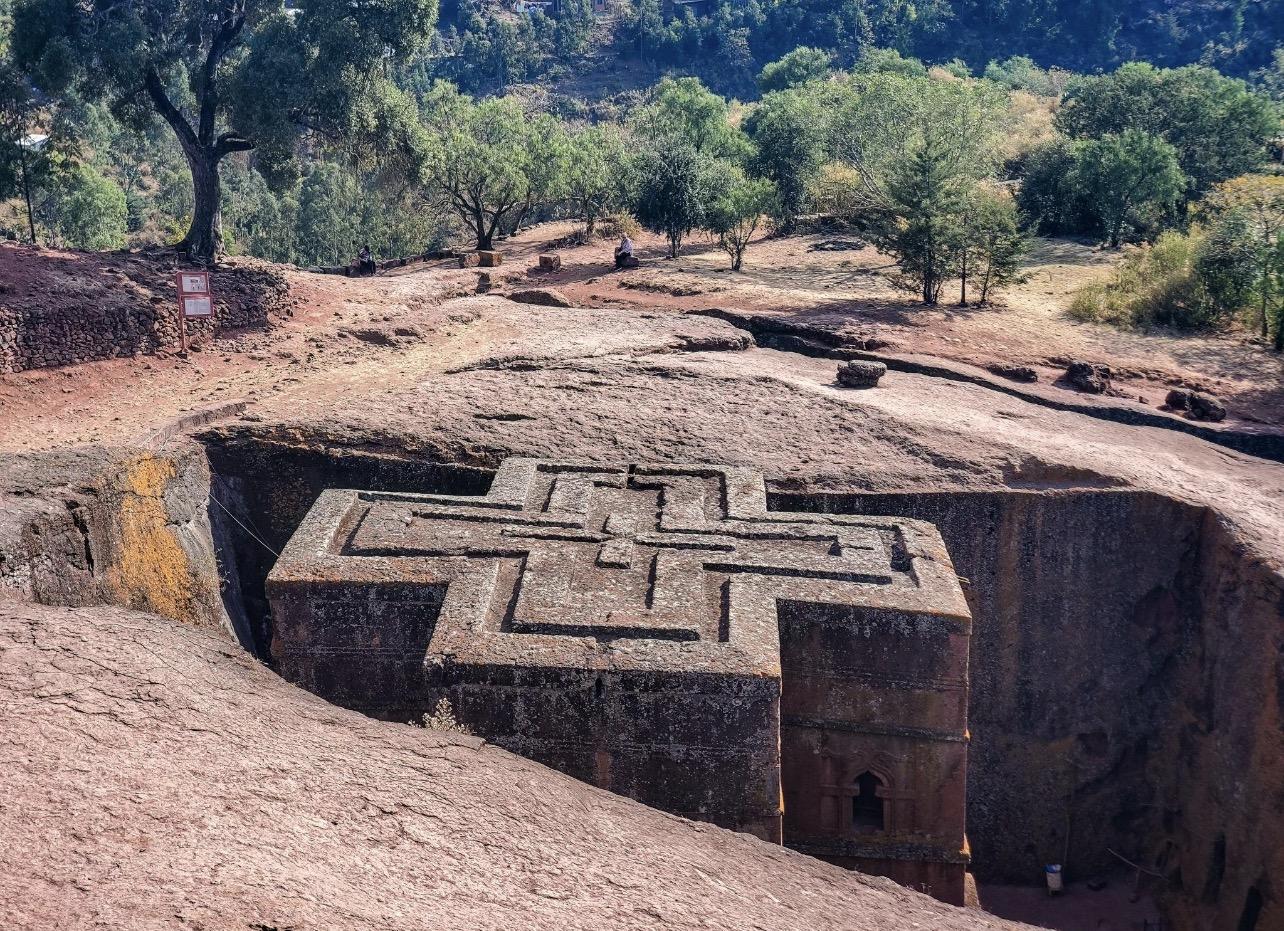
The Church of Saint George.
This church is carved in the shape of a perfect cross.
Viewed from above, it looks like a giant stone cross carved deep into the earth.
Pilgrims descend through a narrow trench to reach its entrance.
Standing there, surrounded by towering rock walls, many visitors feel a sense of awe and mystery.
The Church of Saint George has become one of the most iconic religious structures in the world.
The Mystery of How It Was Built
Even today, historians and architects are amazed by Lalibela.
How could medieval builders carve such precise structures without modern technology?
The scale alone is astonishing.
Some of the churches are more than twelve meters deep.
Passageways twist through the rock like underground labyrinths.
Drainage systems were carved to prevent flooding.
Windows were sculpted with decorative patterns.
Pillars and arches were shaped with artistic precision.
For centuries, people believed supernatural forces helped build the churches.
Ethiopian tradition says angels worked at night to assist the laborers.
While historians see this as legend, the story reflects how extraordinary the achievement truly was.
Even modern engineers admit the construction would still be extremely challenging today.
Lalibela Becomes a Holy City
After the churches were completed, Lalibela became one of the most important pilgrimage destinations in Africa.
Christians from across Ethiopia began traveling long distances to visit the sacred site.
Many came barefoot, walking for weeks through mountains and valleys.
They came to pray.
They came to celebrate religious festivals.
They came to feel closer to God.
Priests held ancient ceremonies inside the stone churches.
Sacred chants echoed through the narrow corridors.
Candles illuminated the carved walls.
The atmosphere inside the churches felt timeless.
And it still does today.
A Living Religious Site
Unlike many historical monuments that have become silent ruins, Lalibela remains a living place of worship.
Priests still conduct services there every day.
Monks live nearby in quiet devotion.
Pilgrims continue to arrive throughout the year.
One of the most important celebrations is Ethiopian Christmas, known as Genna.
During this festival, tens of thousands of believers gather at Lalibela.
Dressed in white robes, they pray, sing, and participate in night long ceremonies.
The sight is breathtaking.
Thousands of candles glow in the darkness while prayers echo through the rock hewn chambers.
It is a powerful reminder that Lalibela is not only history.
It is still alive.
Recognition by the World
The significance of Lalibela eventually gained global attention.
In 1978, the Rock Hewn Churches of Lalibela were recognized as a UNESCO World Heritage Site.
This designation confirmed that Lalibela is not only important to Ethiopia but to all humanity.
Experts consider the churches one of the greatest architectural achievements in the world.
They represent a combination of engineering brilliance, artistic beauty, and deep spiritual devotion.
Tourists from across the globe now travel to the Ethiopian highlands to witness the sacred city carved from stone.
Many arrive with curiosity.
Many leave with deep respect.
Challenges Through Time
Despite its greatness, Lalibela has faced challenges over the centuries.
Weathering and erosion slowly affect the rock structures.
Earthquakes and environmental changes have caused damage in some areas.
Conservation efforts have been introduced to preserve the churches for future generations.
Protective shelters were built over some churches to prevent rain damage.
Experts continue studying the site to ensure its survival.
The goal is simple.
To protect a piece of human history that cannot be replaced.
Why Lalibela Became History
The Rock Hewn Churches of Lalibela became history because they represent something truly rare.
They are not just ancient buildings.
They are symbols of faith carved into the earth.
They represent the determination of a king who believed he was fulfilling a divine mission.
They show what humans can achieve when vision meets devotion.
Few places on earth combine religion, architecture, legend, and mystery in such a powerful way.
Lalibela tells the story of a civilization that believed faith could move mountains.
And in this case, it literally carved them.
The Legacy of King Lalibela
Today, King Lalibela is remembered as one of Ethiopia’s greatest historical figures.
His vision transformed a remote mountain region into a spiritual capital.
The town that bears his name continues to attract pilgrims and visitors from all over the world.
More than eight hundred years later, the churches still stand.
Silent.
Sacred.
Unforgettable.
They remind humanity that history is not always written in books.
Sometimes it is carved into stone.
Sometimes it is built with faith strong enough to last for centuries.
And in the highlands of Ethiopia, the legacy of Lalibela continues to inspire the world.
A Timeless Wonder of Africa
Africa holds countless historical treasures, but few are as breathtaking as the Rock Hewn Churches of Lalibela.
They prove that Africa’s history is rich with innovation, culture, and spiritual depth.
They show that centuries ago, African civilizations were creating architectural masterpieces that still astonish the modern world.
Visitors who descend into the rock corridors of Lalibela often feel as though they have stepped into another era.
A time where kings believed they were guided by heaven.
A time when faith shaped mountains.
A time when history was carved one stone at a time.
And that is why Lalibela remains one of the greatest historical wonders ever created.
A sacred city hidden in stone.
A story of vision and belief.
A masterpiece that continues to stand against time.
Categorias
Leia Mais
Has the Federal Government truly settled the salary arrears of Nigerian doctors—or is the health sector heading for another shutdown? The National Association of Resident Doctors (NARD) has challenged the Tinubu administration’s claim that outstanding 25–35 per cent CONMESS (Consolidated Medical Salary Structure) arrears have been fully paid, revealing that over 2,000 resident...

Osinachi Josephine Nwachukwu Long before her voice echoed across churches, long before millions lifted their hands to the song “Ekwueme,” and long before her name became a symbol of both worship and painful national reflection, there was a young girl in Abia State whose heart beat for God and whose voice carried unusual depth. The world knew her as Osinachi Nwachukwu. But...

Mark Angel Mark Angel is a Nigerian comedian, scriptwriter, video producer, and digital content creator widely known as the founder of the popular YouTube comedy channel Mark Angel Comedy. Born Mark Angel on May 27, 1991, in Port Harcourt, Rivers State, Nigeria, he became one of Africa’s most successful online comedians. Early Life and Background Mark Angel was born and...

Samuel Onyeka Okposo Before the bright lights of international gospel stages, before choirs echoed his songs across continents, and before the phrase “Wellu Wellu” became a signature chant in Nigerian praise culture, there was a young boy in Delta State whose destiny was quietly forming. The world came to know him as Sammie Okposo — energetic, charismatic, joyful. But his...

Living life as a decent lady is not as easy as people make it sound. I minded my business, worked hard, and depended on no man. I had seen too many girls give their hearts to boys who only wanted their bodies, then disappear like nothing ever happened. I promised myself I would not be one of them. I worked. I struggled. I stood alone. Then I met Tunde. Tunde was different at least that was...