


 About
About
The Inspiring Story of Catherine Wanjoya and the Genesis Care System
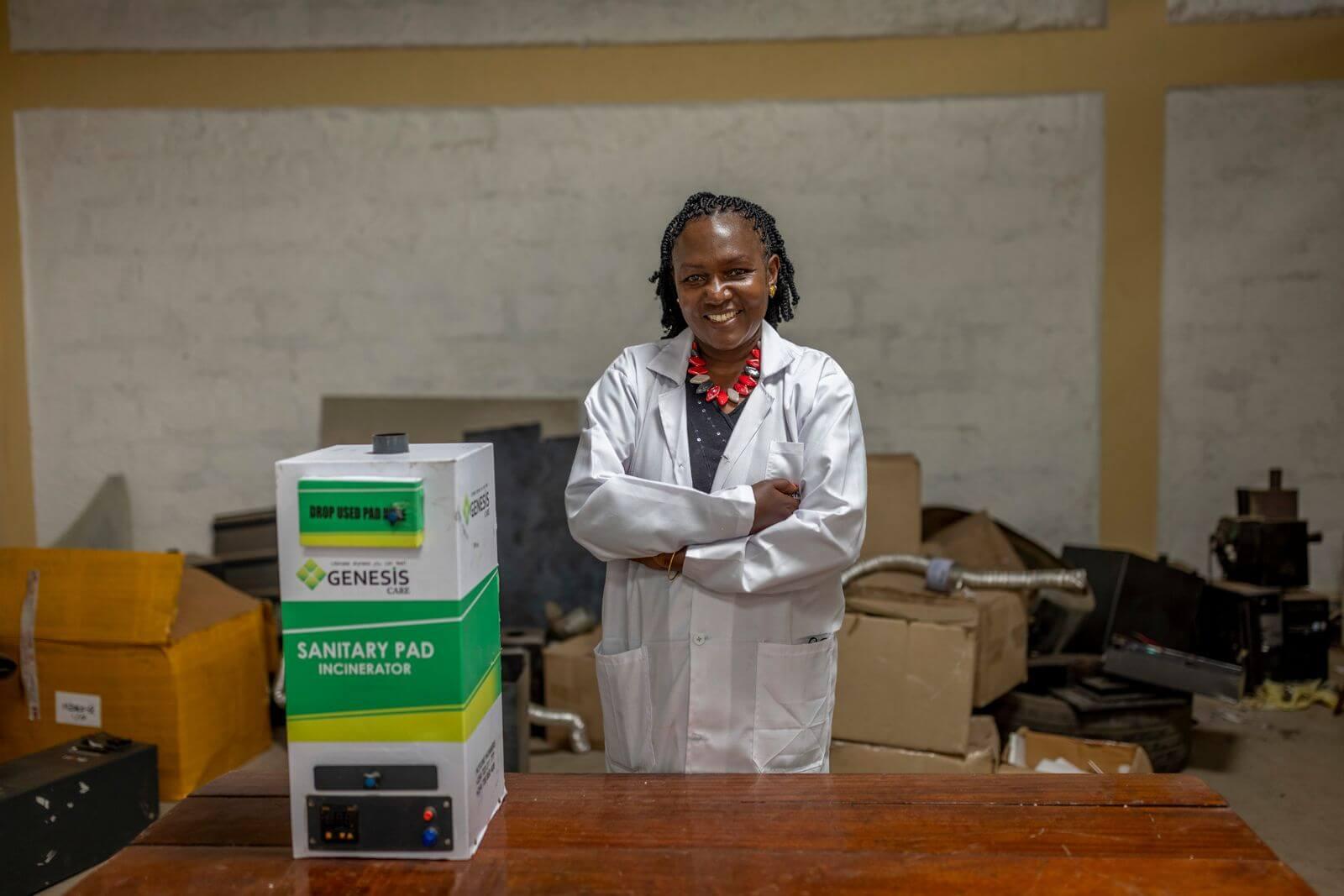
Catherine Wanjoya
Across Africa, millions of girls and women face a silent but serious challenge that affects their education, health, and dignity. The challenge is access to affordable menstrual hygiene products. For many families in low income communities, sanitary pads are simply too expensive. As a result, girls miss school, women miss work, and many resort to unsafe alternatives that threaten their health.
In Kenya, this problem has affected generations of girls, especially those living in rural communities and informal settlements. But one Kenyan entrepreneur decided that the problem needed a practical and innovative solution. That woman is Catherine Wanjoya.
Through determination, creativity, and compassion, she created the Genesis Care system, a groundbreaking innovation designed to make sanitary products affordable and accessible while also solving the environmental problem of disposal. Her invention has helped thousands of girls stay in school and has transformed how menstrual health is managed in many communities.
This is the full story of Catherine Wanjoya, the woman behind the Genesis Care system, and how her invention is changing lives across Kenya and beyond.
Early Life and Background
Catherine Wanjoya, whose full name is Catherine Mumbua Wanjoya, grew up in Kenya where she witnessed firsthand the struggles faced by girls and women during menstruation. Like many African communities, discussions about menstrual health were often surrounded by stigma and silence.
For young girls growing up in rural areas, sanitary pads were considered a luxury rather than a necessity. Many families could not afford them, forcing girls to use pieces of cloth, old newspapers, or even leaves. These alternatives were uncomfortable and often unsafe.
The consequences were serious. Many girls skipped school for several days every month. Some eventually dropped out completely because they felt embarrassed or lacked proper protection.
As Catherine grew older, she began to understand that this was not just a personal issue but a widespread social problem affecting millions of women across Africa.
Her early experiences planted the seed of a mission that would later define her life’s work.
Education and Entrepreneurial Journey
Catherine Wanjoya pursued higher education in Kenya and developed strong interests in business and entrepreneurship. She later obtained a degree in entrepreneurship and an MBA in strategic management from Kenya Methodist University.
Her education helped her understand how businesses could be used not only to make profits but also to solve real social problems.
Together with her husband Chege Wanjoya, she started a family business known as Silmak Agencies. Over time, the company grew and worked with various organizations and institutions.
However, Catherine wanted to do something more meaningful than simply running a business. She wanted to build something that would improve lives, particularly for women and girls.
Her opportunity came when she returned to her rural home community and saw how serious the menstrual hygiene problem truly was.
Discovering the Problem
While visiting her rural community, Catherine noticed that many girls were struggling with menstrual hygiene management. Some could not attend school during their periods because they lacked sanitary products.
She was shocked by how widespread the problem was.
Research and community conversations revealed that in some developing regions, only a small percentage of women could afford sanitary pads. In Kenya, up to 65 percent of women could not afford menstrual hygiene products.
At the same time, she also realized another problem. Even when women managed to get sanitary products, there was often no proper system for disposing of them safely.
Used pads were frequently thrown into open spaces, latrines, or drainage systems, creating serious environmental and health concerns.
Catherine understood that solving the problem required a complete system not just providing sanitary products but also ensuring safe disposal.
The Birth of Genesis Care
Determined to find a solution, Catherine began developing a new idea.
Instead of selling sanitary pads only in large packages that many girls could not afford, she envisioned a system where women could buy a single pad at a time whenever they needed it.
This idea eventually became the Genesis Care sanitary pad dispenser.
The machine works in a simple but powerful way. Users insert a coin or complete a mobile money transaction through M Pesa. Once the payment is made, the machine automatically releases a single sanitary pad.
This innovation allows girls and women to buy only what they can afford at the moment rather than paying for a full pack.
Because the price per pad is extremely low, it becomes accessible even for girls from low income families. The cost can be less than one tenth of the normal retail price.
The dispensers are installed in places where women and girls need them most.
These locations include
schools
hospitals
community centers
churches
public washrooms
workplaces
With these machines, girls no longer need to miss school simply because they cannot afford sanitary pads.
Solving the Disposal Problem
As the sanitary pad dispensers became more popular, Catherine noticed another challenge emerging.
More sanitary products meant more waste.
Without proper disposal systems, used pads could become an environmental hazard.
To address this issue, Catherine and her team created another innovation a mobile menstrual incinerator.
This machine is designed to burn used sanitary pads safely and hygienically.
The incinerator is small, portable, and capable of reaching temperatures of up to 800 degrees Celsius, which allows it to destroy waste completely and safely.
These incinerators can be installed directly in schools, offices, and public washrooms so that waste can be disposed of immediately after use.
By combining sanitary pad dispensers with incinerators, Genesis Care created a complete menstrual hygiene management system.
How the Genesis Care System Works
The Genesis Care system includes several integrated innovations designed to improve menstrual health management.
The sanitary pad dispenser
This device allows girls and women to purchase single sanitary pads using coins or mobile money. The pads are affordable and available whenever needed.
The menstrual waste incinerator
A small portable machine that safely burns used sanitary pads and prevents environmental pollution.
Smart monitoring systems
The dispensers can be digitally monitored to track usage, refill needs, and inventory.
Biodegradable sanitary pads
The company has also developed environmentally friendly sanitary pads made from agricultural waste materials that decompose faster than traditional pads.
SMS education chatbot
Genesis Care also created an SMS based chatbot that provides information about menstrual health, reproductive health, and mental wellness.
Together, these innovations form a comprehensive system that addresses menstrual hygiene from access to disposal and education.
Impact of Genesis Care
Since its launch, Genesis Care has had a remarkable impact across Kenya.
The system has been installed in dozens of locations including schools, hospitals, churches, and community centers.
More than 53 sites were already operating with Genesis Care dispensers within a few years of its launch.
These sites serve over 15,000 regular users.
Millions of sanitary pads have been distributed through the machines.
By providing affordable access to menstrual products, the system has helped keep thousands of girls in school.
Many teachers have reported that school attendance among girls improves significantly when menstrual hygiene products are easily available.
The system has also improved workplace dignity for women and reduced environmental pollution from improperly disposed sanitary waste.
Adapting During the COVID 19 Pandemic
When the COVID 19 pandemic struck the world, schools and many public spaces closed.
This created a serious challenge for Catherine’s business because many of her installations were located in schools.
However, instead of giving up, she adapted the technology.
Her team modified the menstrual waste incinerators so they could also burn used personal protective equipment such as masks and gloves.
These adapted incinerators helped prevent the spread of infection in healthcare facilities and communities.
This flexibility demonstrated how her innovation could solve multiple public health challenges.
Recognition and Awards
Catherine Wanjoya’s work has received recognition from organizations across Africa and internationally.
Her Genesis Care system was selected as one of the innovative technologies in the Africa Prize for Engineering Innovation organized by the Royal Academy of Engineering.
The award highlights engineering innovations that address important problems in Africa.
Being recognized among Africa’s most promising innovators helped bring international attention to the menstrual health challenges facing African women.
It also demonstrated that local solutions can effectively address local problems.
Challenges Along the Way
Like many entrepreneurs, Catherine faced several obstacles while building her innovation.
Funding was a major challenge during the early stages.
Developing machines, testing prototypes, and installing them across communities required significant financial investment.
Another challenge was changing social attitudes.
In many communities, menstruation was considered a taboo subject. Talking openly about menstrual health was difficult.
Catherine had to work with schools, community leaders, and organizations to raise awareness and promote menstrual health education.
Infrastructure was also a challenge in some rural areas where electricity and facilities were limited.
Despite these obstacles, Catherine remained committed to her mission.
Vision for the Future
Catherine Wanjoya believes that menstrual health is a fundamental human rights issue.
Her long term vision is to expand Genesis Care systems across Africa and other developing regions.
She hopes to install dispensers and incinerators in thousands of schools and public spaces so that every girl can manage her menstruation safely and with dignity.
The company also aims to continue improving the technology behind its systems.
Future plans include
expanding digital monitoring systems
increasing production of biodegradable pads
improving menstrual health education
partnering with governments and NGOs
expanding to other African countries
By combining technology, social entrepreneurship, and education, Catherine hopes to create a world where no girl has to miss school because of her period.
Why Catherine Wanjoya’s Innovation Matters
The work of Catherine Wanjoya demonstrates how one person’s idea can transform a major social challenge.
Her innovation addresses several critical issues at once
access to menstrual products
school attendance for girls
environmental protection
public health
women’s dignity and empowerment
In many ways, Genesis Care is more than a business.
It is a social movement that challenges the stigma surrounding menstruation and promotes gender equality.
Legacy and Inspiration
Today, Catherine Wanjoya stands as an example of African innovation solving African problems.
Her story reminds us that the most powerful inventions often begin with simple observations about everyday problems.
By paying attention to the struggles of girls in her community, she created a system that now benefits thousands of women.
Her work continues to inspire young innovators across Africa to develop solutions that improve lives.
And as Genesis Care expands, the impact of her vision will continue to grow.
Girls who once missed school because they lacked sanitary pads can now continue their education with confidence.
Women who once faced embarrassment and inconvenience now have dignified access to menstrual hygiene solutions.
All of this began with one woman who refused to ignore a problem that many people overlooked.

Categorie
Leggi tutto
In a remarkable display of integrity, Governor Alex Otti of Abia State has publicly commended Nigeria Immigration Service (NIS) officer Ugochukwu Orji for rejecting a ₦10 million bribe offered by a native doctor implicated in ritual killings. The incident unfolded when Orji apprehended the suspect, identified as Mr. Levi Okoro, who was attempting to flee the country. Upon his detention, Okoro...

Yinka Quadri: A Pillar of Yoruba Cinema Yinka Quadri, born Olayinka Quadri, is one of Nigeria’s most celebrated actors, filmmakers, and cultural icons, renowned for his immense contribution to the Yoruba film industry. Born on October 7, 1959, in Lagos State, Lagos State, Quadri grew up in a modest family that instilled in him strong values of discipline, hard work, and...

Reekado Banks In the lively city of Lagos, where ambition breathes through traffic fumes and dreams are born in crowded classrooms and church choirs, a young boy once discovered that his voice carried more than just sound. It carried emotion. It carried promise. It carried destiny. That boy was Ayoleyi Hanniel Solomon. The world would later know him as Reekado Banks. His journey is not just...

Sheikh Abdul Qadir Jilani Early Life Abdul Qadir Jilani was born in the year 1077 in a small town called Jilan, in present-day Iran. From a young age, he was known for his honesty, discipline, and deep love for knowledge. His mother was a righteous woman who raised him with strong values. She taught him to always speak the truth, no matter the situation. This lesson would later...

As Nigeria marks June 12 Democracy Day, former Secretary to the Government of the Federation, Chief Olu Falae, has stirred political waters by claiming he was the rightful winner of the 1999 presidential election. In a bold assertion, Falae insisted the results did not reflect the will of the people. Falae, who ran against former President Olusegun Obasanjo in Nigeria’s return to civilian...

