


 About
About
The History of Egypt From Ancient Civilization to Modern Nation
Introduction
The history of Egypt is one of the longest and most fascinating in human civilization. Known as the gift of the Nile, Egypt developed one of the earliest and most powerful ancient societies in the world. From the construction of massive pyramids to modern political revolutions, Egypt has shaped religion, culture, science, and politics for over five thousand years.
Strategically located between Africa and Asia, Egypt became a bridge between continents and civilizations. Its fertile land along the Nile River allowed agriculture to flourish, creating the foundation for a strong and organized state.
Prehistoric Egypt and the Rise of Civilization
Long before the pharaohs, people lived along the Nile Valley, farming and raising animals. Around 5000 BCE, small settlements began to form. The Nile flooded annually, leaving rich soil that made farming productive and reliable.
By around 3100 BCE, a ruler known as Narmer unified Upper and Lower Egypt. This event marked the beginning of dynastic Egypt and the First Dynasty. The unification created one of the world’s first centralized governments.
The Old Kingdom and the Age of Pyramids
The Old Kingdom lasted from around 2686 to 2181 BCE. It is often called the Age of Pyramids because of the monumental tombs built during this period.
Pharaohs were considered divine rulers who acted as intermediaries between the gods and the people. They commanded massive labor forces to build grand structures as eternal resting places.
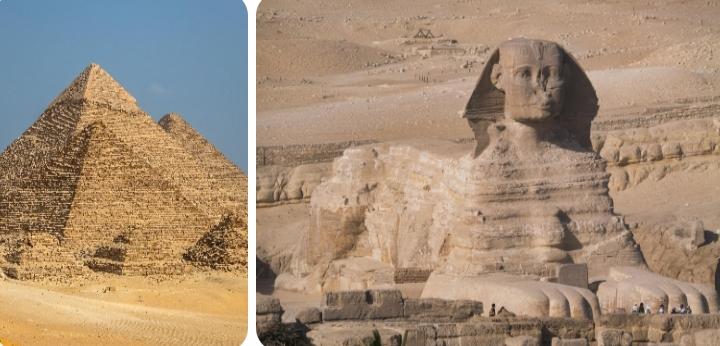
The most famous monuments of this era are the pyramids at Giza, built for Pharaohs Khufu, Khafre, and Menkaure. These structures remain among the greatest engineering achievements in history.
The Great Sphinx, carved near the pyramids, symbolized royal power and protection.
Despite its achievements, the Old Kingdom declined due to economic problems, drought, and weakened central authority.
The Middle Kingdom
After a period of instability known as the First Intermediate Period, Egypt reunified around 2050 BCE under Mentuhotep II. This began the Middle Kingdom, a time of cultural growth and military expansion.
The Middle Kingdom strengthened trade routes and built irrigation projects. Literature and art flourished. Pharaohs focused more on the welfare of the people rather than just monumental building.
However, foreign groups known as the Hyksos invaded Egypt around 1650 BCE, introducing new technologies such as horse drawn chariots.
The New Kingdom and Imperial Power
The New Kingdom began around 1550 BCE when Egyptian rulers expelled the Hyksos. This era became Egypt’s golden age of empire and international influence.
Powerful pharaohs expanded Egypt’s territory into Nubia and the Near East. Trade, wealth, and art reached new heights.
One notable ruler was Hatshepsut, one of the few female pharaohs. She promoted trade and built impressive temples.
Ramses II, often called Ramses the Great, ruled for over sixty years and constructed grand monuments. He fought the Hittites in the Battle of Kadesh, one of the earliest recorded peace treaties in history.
The Valley of the Kings became the burial site of pharaohs, including the famous boy king Tutankhamun. His tomb, discovered in 1922, provided priceless artifacts that revealed details about royal life.
The New Kingdom eventually weakened due to economic strain, internal conflicts, and invasions by Sea Peoples.
Late Period and Foreign Rule
After the New Kingdom, Egypt entered another period of instability. It was conquered by several foreign powers including the Assyrians and Persians.
In 332 BCE, Alexander the Great conquered Egypt. After his death, one of his generals, Ptolemy, established the Ptolemaic Dynasty.
The Ptolemaic Era and Cleopatra
The Ptolemaic rulers were of Greek origin but adopted many Egyptian customs. Alexandria became a center of learning and culture. The famous Library of Alexandria was one of the largest collections of knowledge in the ancient world.
The last ruler of this dynasty was Cleopatra VII. She formed political alliances with Julius Caesar and later Mark Antony of Rome. After their defeat by Octavian, Cleopatra died in 30 BCE, and Egypt became a Roman province.
Roman and Byzantine Egypt
Under Roman rule, Egypt became an important source of grain for the Roman Empire. Christianity spread throughout Egypt during this time.
By the fourth century CE, Christianity became dominant. Monastic traditions began in Egypt and influenced Christian practices worldwide.
When the Roman Empire divided, Egypt became part of the Byzantine Empire. However, internal divisions weakened Byzantine control.
Islamic Conquest and Medieval Egypt
In 641 CE, Arab Muslim forces conquered Egypt. Islam gradually became the dominant religion, and Arabic replaced earlier languages as the main language.
Egypt became part of various Islamic caliphates. The city of Cairo was founded in 969 CE by the Fatimid dynasty and became a major political and cultural center.
The Mamluks later ruled Egypt and defended it against Crusaders and Mongols. Cairo flourished as a center of Islamic scholarship and trade.
Ottoman Rule
In 1517, the Ottoman Empire conquered Egypt. While it remained under Ottoman control for centuries, local rulers known as Mamluks retained influence.
Egypt’s strategic location made it important for trade between Europe and Asia.
Muhammad Ali and Modernization
In the early nineteenth century, Muhammad Ali rose to power. He modernized Egypt’s military, agriculture, and industry. He is often considered the founder of modern Egypt.
Under his leadership, Egypt expanded its territory and developed a stronger economy.
British Occupation
Although technically part of the Ottoman Empire, Egypt fell under British control in 1882. The British sought to protect their interests, especially the Suez Canal, which connected Europe to Asia.
Nationalist movements grew in response to foreign control.
Egypt gained partial independence in 1922 but remained heavily influenced by Britain.
Revolution and the Republic
In 1952, a group of military officers overthrew King Farouk. Egypt became a republic.
Gamal Abdel Nasser emerged as a powerful leader. He nationalized the Suez Canal in 1956, leading to the Suez Crisis involving Britain, France, and Israel. Nasser became a symbol of Arab nationalism.
After Nasser, Anwar Sadat became president. He signed a peace treaty with Israel in 1979, becoming the first Arab leader to do so. This move was controversial but reshaped Middle Eastern politics.
Modern Egypt
Hosni Mubarak ruled Egypt from 1981 to 2011. His long presidency brought stability but also criticism over political repression and corruption.
In 2011, mass protests known as the Arab Spring led to Mubarak’s resignation. Political changes followed, including the election of Mohamed Morsi and later the rise of Abdel Fattah el Sisi.
Today, Egypt faces challenges including economic reform, population growth, and regional security issues.
Culture and Legacy
Egypt’s contributions to civilization are immense. Ancient Egyptians developed hieroglyphic writing, complex mathematics, medicine, and architectural techniques.
The Nile River remains central to Egyptian life. The country’s monuments attract millions of tourists each year.
Egyptian identity blends ancient heritage with Islamic and modern influences. Its culture has influenced Africa, the Middle East, and beyond.
Conclusion
The history of Egypt spans from prehistoric settlements along the Nile to a modern republic shaping regional politics. It has experienced periods of greatness, foreign rule, revolution, and reform.
Egypt’s pyramids and temples remind the world of its ancient glory, while its modern cities show its continuing evolution. Through thousands of years, Egypt has remained a land of resilience, innovation, and global significance.
Few nations can claim such a long and continuous story. Egypt stands as one of the foundational civilizations of humanity, a nation whose past continues to shape its present and future.


Categorie
Leggi tutto
Tunde Folawiyo Tunde Folawiyo is not known for loud interviews or flashy publicity. He belongs to a class of businessmen who operate quietly while controlling massive assets behind the scenes. His journey is rooted in legacy, discipline, and strategic expansion within Nigeria’s oil and gas sector. Born into one of Nigeria’s most established business families, Tunde...

I was born the kind of girl people whispered about, though never to my face. Jealousy was in my blood, like a pulse I could never control. My sister, Nneka, had everything I wanted: beauty that turned heads, intelligence that earned praise, and a life that seemed effortless. And me? I was always in her shadow, no matter how hard I tried. The envy started small resentful glances, bitter...

Kashali came to Lagos with two bags, big dreams, and a heart full of trust. He was a hardworking young man from Ikorodu, determined to make something better for himself. Every morning before sunrise, he joined the rush of buses, conductors shouting, engines roaring, and the endless movement that made Lagos feel alive. He believed if he worked hard enough, the city would eventually smile at...

Jason Njoku Jason Njoku did not grow up with a silver spoon or a ready made empire waiting for him. His journey is a story of rejection, resilience, digital vision, and the courage to bet on an industry many overlooked. Today he is known as the founder of iROKOtv, a platform that helped push Nollywood films beyond DVDs and street markets into the global streaming era. But his...

One of the most significant and rapidly expanding of all MPLS Market Opportunities lies in providing secure, high-performance private connectivity to public cloud services. The era of the enterprise data center as the sole center of gravity for IT is over. The modern enterprise operates in a hybrid, multi-cloud world, and requires a network that can seamlessly and securely connect its...

