


 About
About
THE CLAY POT THAT CRIED MY NAME
THE CLAY POT THAT CRIED MY NAME
Before the pot entered my life, hunger had already made a home in our room.
It sat with us at dawn when the mosque nearby began to call people to prayer and the night’s cold still held the walls. It sat with us in the afternoon heat when the air in Mushin became heavy like wet cloth. It sat with us at night when the generator sounds outside turned into a choir of frustration and the smell of frying akara from a neighbor’s window mocked our empty stomachs.
Hunger made you count everything.
You counted cups of rice like they were coins. You counted sachets of pure water like they were blessings. You counted days, hoping tomorrow would be softer than today.
I am Bisi.
Not a thief. Not wicked. Not the kind of woman who enjoys disobeying her husband. I am a mother who once promised her children that life would get better and then watched my promise rot slowly in the corners of our one room apartment.
My husband is Femi.
He is the kind of man whose goodness shows even when his pockets are empty. The kind who will give his last fifty naira to a blind man and come home smiling like he owns the world. The kind who still says Thank you Jesus when all we have for dinner is hot water and dry bread.
But goodness does not pay rent.
It does not stop landlords from banging on doors.
It does not stop children from crying at midnight because their stomachs feel like they are eating themselves.
We met when things were not this hard. Femi had jobs then. Bricklaying. Painting. Small contracts. His laughter was louder. His shoulders were stronger. I used to watch him come home with cement dust on his face and still find him handsome like a movie actor.
Then Nigeria did what Nigeria does.
Jobs became scarce. Prices climbed like stubborn goats. Food that used to be cheap suddenly became luxury. A bag of rice became something you whispered about like it was a miracle.
Still, we survived.
We had two children. A boy and a girl.
My son, Kunle, is seven and too wise for his age. He watches people the way old men watch the road. My daughter, Morenike, is five and full of stubborn joy, always singing even when nothing is working.
But joy cannot fill an empty pot.
Some days we ate once.
Some days we ate nothing.
There were times I went to borrow pepper from neighbors just to create the illusion of cooking. There were times I boiled water and added salt so the children could feel something warm enter their bodies.
And there were times, like last week, when they drank garri without sugar for three days straight and still asked me with bright eyes, Mummy, will there be meat tomorrow.
Tomorrow.
That word became a lie I repeated until my mouth grew tired.
In the corner of our room, under an old red cloth, sat the ugly clay pot.
It had been there for six years.
Cracked. Dusty. Unloved.
Sometimes it looked like something a village woman would use to store palm oil. Sometimes it looked like an abandoned shrine item that should have been buried long ago.
Whenever I swept, I swept around it.
Whenever I mopped, I mopped around it.
It took space like a stubborn guest who never paid rent.
And yet, my husband treated it like it was a newborn child.
He would come home tired and still glance at the corner before greeting me properly.
He would adjust the cloth covering it, ensuring it did not slide.
He would warn the children with a seriousness that frightened them.
Do not go near that thing.
If I asked why, he would change his face.
Bisi, do not touch it.
Sometimes he added something else.
If the whole house burns, leave it.
It is a family heirloom.
I used to roll my eyes when he was not looking.
Heirloom.
We were suffering like this and he was guarding mud.
There was a day, two years ago, when our landlord threatened to throw us out. I suggested selling the pot then. I was angry. My pride was bleeding. I said it loudly so my husband would feel my pain.
Sell that nonsense and let us pay rent.
Femi’s reaction shocked me.
He grabbed my wrist so tight I cried out.
Do not joke with that pot again, Bisi. Do not.
He released me immediately and apologized, but the fear in his eyes stayed with me. He looked like a man who had seen something in the dark and could not unsee it.
That night, I asked him again gently.
Femi, what is inside it.
He stared at the ceiling for a long time like he was fighting an invisible battle.
Nothing inside, he said finally. But it is holding something.
He did not explain more.
And because our life was full of problems, I pushed it to the back of my mind.
Until yesterday morning.
Yesterday morning began like every other morning in Mushin.
Noise outside. Heat rising early. A woman shouting at her child. A generator coughing. The smell of frying oil from someone who could afford it.
Femi left before six to look for a job. He wore his faded shirt and carried his small bag like hope. He kissed the children and told them to behave.
I watched him leave and prayed silently.
God, let today be different.
Before noon, the children were already crying.
Mummy hunger.
Mummy my stomach is paining me.
My daughter’s voice cracked like she was older than five. She sat on the floor, clutching her belly, tears rolling down her cheeks.
I checked the cupboard.
Nothing.
Not even beans.
Not even one cube of sugar.
I checked my purse.
Two hundred naira.
What is two hundred naira in today’s Lagos.
I sat on the bed and felt something in me snap.
It was not anger.
It was desperation.
A mother’s desperation is a dangerous thing. It makes you bold. It makes you reckless. It makes you break rules you once respected.
My eyes drifted to the corner.
The pot.
My husband’s precious mud.
I stood up slowly.
Space occupier, I hissed under my breath.
I pulled the red cloth away.
The pot looked uglier than ever. Its crack ran like a scar across its side. Dust had settled into its lines like old secrets.
I told myself a story to make the guilt easier.
It is just superstition.
It is just tradition.
Tradition cannot feed children.
I called the Aboki scrap buyer who roams our street with his cart and loud voice.
He came quickly, excited as always when he heard the word sell.
He entered our room, glanced around like he was counting our poverty, then his eyes fell on the pot.
He laughed.
Madam, this one na mud. Wetin I go do with am. I fit pay two thousand.
Two thousand.
It sounded like fortune in my ears.
I did not bargain.
I did not pause.
I handed him the pot.
As he lifted it, I heard something faint.
A sound like a small sigh.
I froze.
Did you hear that, I asked.
The Aboki laughed again.
Madam, hunger don make you dey hear voice.
He carried it away.
Just like that.
Two thousand naira entered my hands like fire.
I ran to the market.
Rice. Fish. Oil. Tomatoes. Even a small sachet of seasoning that smelled like comfort.
I returned home and cooked like I was cooking for a wedding. The aroma filled the room. The children danced around me. My son smiled for the first time in days.
We ate until our stomachs were full.
I watched my children sleep with round bellies and I felt victorious.
Let him complain, I told myself. At least my children ate.
Evening came.
Femi returned around seven.
He stepped inside, and the smell of fish greeted him. His eyes softened.
Ah, Bisi. You cooked.
He smiled, then his gaze shifted.
Straight to the corner.
Empty.
The smile died instantly.
He dropped his bag like it was heavy with bad news.
Bisi, where is the container.
His voice was shaking.
My heart began to beat too fast.
It broke, I lied quickly. I threw it away.
Femi stared at me.
His eyes became wet.
He did not shout.
He did not raise his hand.
He knelt on the floor like a man whose legs had lost strength.
Then he began to cry.
The kind of cry that comes from the stomach.
Bisi, he whispered, tears soaking his shirt. You don’t know what you have done. You have just sold your own life.
I laughed nervously because fear makes you laugh when you should run.
Femi, stop it. It was just a pot.
He looked up at me, and I saw terror.
It is not a pot, he said. It is the Cage.
Cage for what.
He wiped his face with trembling hands.
My grandfather was a hunter, he said. A powerful one. He trapped a demon inside that pot fifty years ago. A demon of poverty and sickness. It was roaming, destroying families, feeding on bloodlines. My grandfather caught it. He sealed it.
I stared at him.
This is Mushin. Not a movie.
The rule was simple, Femi continued. As long as the pot sits in our house, it cannot touch our bloodline. It can only make us poor, but it cannot kill us. That was why we suffer but we survive. That was why sickness does not finish us. That was why death has not collected any of us.
My throat went dry.
I wanted to insult him.
I wanted to say nonsense.
But his fear was too real.
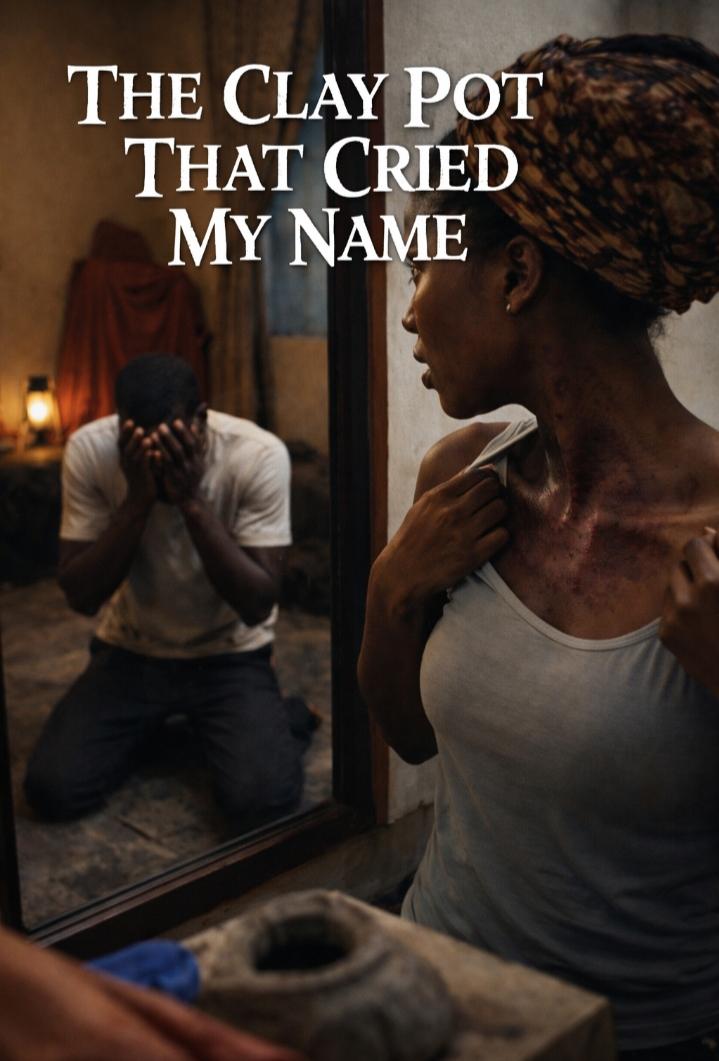
Then he dragged me toward our small mirror.
Look at your neck, he said.
I looked.
My scream caught in my throat.
There were black fingerprints on my neck.
Clear marks as if a giant hand had squeezed me while I slept.
I stepped back, shaking.
How.
The pot is gone, Femi whispered. The jail is broken. The tenant has been evicted. And now it needs a new house.
At that moment, the room went cold.
Not normal cold.
The kind of cold that enters bone.
My daughter screamed in her sleep.
Mummy there is a man in the ceiling.
I looked up.
The ceiling was wet.
Red liquid dripped slowly, drop by drop, onto the floor like a warning.
Femi rushed to the door.
It would not open.
We did not lock it.
The padlock outside began to rattle like someone was shaking it from the other side.
Femi backed away from me.
It has seen who sold the house, he said. It wants the seller.
The light bulb flickered.
The walls seemed to breathe.
My son woke and started crying.
Mummy, who is calling my name.
Because someone was calling.
Softly.
Bisi.
Bisi.
Not from outside.
From inside the room.
From the corner where the pot used to sit.
A shadow formed there, thick and dark, like smoke learning how to stand.
Femi held the children close, whispering prayers with a voice that was breaking.
I could not breathe.
In that moment, motherhood left my body and fear took over.
I did not think.
I acted.
I jumped through the window.
I ran barefoot into the street, screaming for help, not caring who saw me.
Behind me, our window glowed with a strange red light.
I looked back once.
A figure stood in the window.
It wore my husband’s shape.
But its eyes were fire.
It raised its hand and waved at me slowly, like someone greeting an old friend.
I ran until my lungs burned.
I ran to the church down the street because churches in Nigeria are the closest thing to safety when your mind is falling apart.
The pastor’s wife opened the door and dragged me inside when she saw my face.
They prayed.
They poured anointing oil.
They covered me with cloth.
I sat shaking on the floor, unable to explain properly.
They thought it was ordinary spiritual attack.
They did not know it was something I sold for two thousand naira.
Around midnight, my phone buzzed.
A message from an unknown number.
Bisi, you have moved house. But your debt remains.
I threw the phone away like it was hot.
Then another message entered.
A picture.
It was our room.
My husband was sitting on the floor holding the children, but his head was bowed like he was listening to someone standing over him.
In the corner, where the pot used to sit, was a red cloth spread on the floor like an altar.
Under it, something bulged as if a body was hiding there.
Another message followed.
Bring the seller. Take your children.
My stomach twisted.
So it could speak.
And it knew what mattered to me.
I cried until my eyes were swollen.
I begged God for forgiveness.
I begged God for a miracle.
At exactly three in the morning, the church door began to knock.
Slow. Patient.
Three knocks.
Then silence.
Then three knocks again.
The pastor’s wife held my hand tightly.
Who is there, the pastor asked, his voice strong.
No answer.
Then a voice came, soft like my husband’s voice, but wrong.
Pastor, open. It is me, Femi. I came to take my wife.
My blood froze.
The pastor’s wife looked at me.
Is that your husband.
I shook my head violently.
No.
No.
The pastor stepped back.
He began to pray louder.
The knocking grew harder.
The church door trembled.
The candles flickered even though there was no wind.
Then I remembered something.
The Aboki.
The scrap buyer.
He took the pot.
If the demon was free, the first place it would go was where the pot went.
I grabbed my phone from the floor with shaking hands and dialed the Aboki’s number. I had it because he once helped me carry something.
It rang.
It rang again.
Then someone picked.
Madam, the voice whispered.
It was the Aboki.
But it sounded like he was underwater.
Where is the pot, I shouted.
Madam, he cried. I no do again. I no know. As I carry am reach my yard, the pot begin shake. The red cloth fall. Something enter my chest. Something dey inside me. Madam, e dey tell me make I bring you.
My heart slammed.
Do not come near me, I screamed.
He began to sob.
Madam, e too late. E don use me.
The line cut.
Outside the church, the knocking stopped.
Silence.
A silence that felt like a predator crouching.
Then the pastor’s wife screamed and pointed at the window.
I turned.
At the far end of the church, near the altar, a shadow stood.
It was not there before.
It did not enter through the door.
It was simply there, like darkness growing legs.
It leaned forward.
And in a voice that sounded like clay grinding on stone, it spoke.
Bisi.
The pastor began to chant prayers with force, calling on the name of Jesus, splashing oil, commanding it to leave.
The shadow laughed.
Not loud.
Just a dry laugh like dead leaves.
Then it did something that made my chest collapse.
It shifted into my own shape.
It became me.
A second Bisi stood there, smiling with empty eyes.
And it said calmly.
You sold me. Now you will carry me.
My body refused to move.
My legs were water.
That was when my son’s voice rang in my head like a bell.
Mummy will there be meat tomorrow.
Something in me rose.
Not bravery.
Not strength.
Love.
I stood up, shaking, but standing.
I faced the thing.
You cannot have my children, I said.
The second Bisi smiled wider.
Then give me yourself.
The pastor shouted for the church members to hold me back, but I stepped forward.
I did not know what I was doing. I only knew I could not run again.
I lifted my hands and spoke, not to the demon, but to God.
If I must pay for my mistake, let it end with me. But spare my children. Spare my husband.
The room went colder.
The shadow stretched toward me.
And just as it was about to touch my face, the church bell began to ring.
Not the small bell the pastor sometimes rings.
This was loud. Violent. Continuous.
The pastor’s wife gasped.
Nobody was holding the rope.
But the bell rang on its own, shaking the air.
The shadow flinched.
It stepped back as if the sound burned it.
The pastor shouted again, louder than before, his voice cracking with authority.
You spirit of affliction, return to your place. By fire, return.
The bell rang harder.
The shadow screamed.
Not with a human mouth, but with the sound of clay breaking.
Then it collapsed into the floor like smoke crushed by wind.
The air warmed suddenly.
The lights stopped flickering.
People fell on their knees, crying, praying, thanking God.
I collapsed too, trembling so hard my teeth clicked.
At sunrise, the pastor and two church elders accompanied me back to our street.
We found our room open.
The door was wide.
Inside, my husband sat on the floor holding the children. They were alive. They were shaking, but alive.
Femi looked up at me, eyes red.
I am sorry, I whispered.
He nodded, too tired for anger.
In the corner where the pot used to sit, there was only dust.
No red cloth.
No sign.
But on the floor, there were black footprints leading out of the room and toward the back of the compound, as if something had walked away unwillingly.
Later that day, we heard the Aboki had been found in his yard, unconscious, surrounded by broken clay pieces and ash. He survived, but he could not speak again. His eyes remained wide, like a man who had seen the inside of darkness.
We moved out of that room within a week.
We did not carry much.
We left behind pride, stubbornness, and the belief that warnings are always superstition.
Today, we are still poor.
But we are alive.
And sometimes, when hunger comes, I remember the demon’s voice calling my name.
I remember my husband kneeling and crying.
And I remind myself of a truth I learned too late.
Some poverty is a fence.
Some suffering is protection.
And if your elders warn you about an old thing in your house, do not laugh.
Do not test it.
Because not every cage is meant to be opened.
Some cages are holding back the kind of darkness that will gladly trade your life for a plate of rice.
The End.

Categories
Read More
Patience Ozokwor Patience Ozokwor, popularly known as Mama G, is one of Nigeria’s most respected and recognizable actresses. Born on September 14, 1958, in Ngwo, Enugu State, she grew up in a modest Igbo family where discipline, culture, and strong moral values shaped her early life. From a young age, Patience displayed a lively personality. She was dramatic, expressive, and naturally...

Gaël Matina Egbidi Gaël Matina Egbidi is part of a new generation of African builders who looked at a daily problem, understood how deeply it shaped ordinary life, and decided that technology should solve it in a practical way. Public profiles describe her as a software engineer from Togo, the co founder and chief executive of Solimi, and a specialist in digital payments and...

Beverly Osu Beverly Osu is a Nigerian actress, model, and reality television personality known for her bold personality, versatility, and strong screen presence. Born Beverly Ada Osu on September 27, 1992, in Delta State, Nigeria, she rose to prominence after participating in Big Brother Africa and later established herself in Nollywood. Early Life and Background Beverly Osu...

The Nigerian Navy has launched a new round of training exercises aimed at strengthening its capacity for land-based operations as part of national efforts to combat insurgency and growing insecurity across the country. The initiative was revealed by Rear Admiral Victor Choji, Commandant of the Nigerian Navy Basic Training School, Onne, Rivers State, during a simulation exercise tagged...

Gani Fawehinmi There are lawyers who defend clients. And there are lawyers who defend a nation’s conscience. The life of Gani Fawehinmi was not merely about courtrooms and legal briefs. It was about courage in the face of dictatorship, about standing alone when others chose silence, and about using the law as a weapon against injustice. He was arrested dozens of times. His offices were...

