Environ
Chinyere Kalu: The Woman Who Rose Above the Clouds and Rewrote Nigeria’s Sky
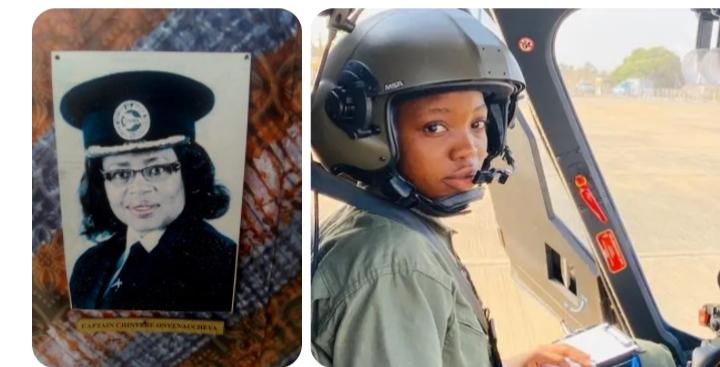
Chinyere Kalu: The Woman Who Rose Above the Clouds and Rewrote Nigeria’s Sky
Chinyere Kalu
There are moments in a nation’s history that pass quietly at the time but grow louder as generations look back. A door opens. A boundary shifts. A woman steps forward where no woman has stepped before.
That was the story of Chinyere Kalu.
She did not shout when she made history. She did not demand applause. She simply entered the cockpit, placed her hands on the controls, and lifted into the Nigerian sky.
Long before aviation became common, long before young girls could point to female captains as proof that it was possible, Chinyere Kalu stood alone. She became the first Nigerian woman to fly an aircraft and the first woman commercial pilot in Nigeria.
But her story did not begin in the cockpit. It began in a small girl’s imagination.
A Child Who Looked Beyond the Horizon
Chinyere Kalu was born in Nigeria during a time when the country was still shaping its post colonial identity. The Nigeria of her childhood was filled with promise and struggle. Roads were expanding. Institutions were forming. Expectations for women, however, were still narrow.
From an early age, Chinyere was curious. She did not accept that certain dreams belonged only to boys. While many young girls were encouraged toward teaching or nursing, she found herself fascinated by machines and movement.
She would look up whenever she heard the sound of an aircraft. In those days, planes were rare sights. When one crossed the sky, children ran outside to watch.
While others waved, she wondered.
Who is inside that machine.
How does it stay up there.
What does it feel like to control it.
Those questions stayed with her.
Growing Up in a Changing Nigeria
Chinyere grew up in a household that valued education. Her parents believed strongly in learning, and that belief would become her foundation.
Nigeria in the 1960s was undergoing social transformation. Independence had come in 1960, but the country would soon face political instability and civil war.
During this period, aviation was not seen as a female profession. In fact, it was barely accessible even to men without strong connections or financial means.
But Chinyere did not limit herself to what society expected.
She excelled academically. She was disciplined, focused, and determined. She understood that if she was going to challenge tradition, she needed excellence on her side.
The Spark That Refused to Die
Many children dream of flying. Most grow out of it.
Chinyere did not.
As she matured, her interest became sharper. She began researching how to become a pilot. She learned that it required rigorous training, technical understanding, and physical endurance.
She also learned that almost no Nigerian woman had attempted it.
That did not discourage her. It energized her.
When she shared her ambition, some people laughed. Others warned her that aviation was dangerous. A few suggested she pursue something more suitable.
But she had already made her decision.
Leaving Nigeria to Learn the Sky
Opportunities for aviation training in Nigeria were limited at the time. To achieve her dream, she had to travel abroad.
In the late 1960s, Chinyere left Nigeria to pursue flight training in the United Kingdom. It was not an easy transition. She was young, far from home, and entering a field dominated almost entirely by men.
The classrooms were filled with skeptical glances.
The flight instructors were not accustomed to female trainees from Africa.
But she absorbed everything.
Aerodynamics. Navigation. Meteorology. Aircraft systems. Emergency procedures.
Flight training is unforgiving. Mistakes are not theoretical. They are immediate.
Chinyere trained in small aircraft, learning takeoff, landing, and mid air control. She learned how to read the wind. How to trust instruments when visibility disappears. How to remain calm when turbulence shakes the aircraft.
Each successful flight strengthened her resolve.
The Moment of Certification
After intense training and examination, Chinyere Kalu earned her pilot’s license.
It was not just a certificate.
It was a statement.
A Nigerian woman had mastered the sky.
When she returned home, she did not return quietly. She returned ready.
Becoming Nigeria’s First Female Commercial Pilot
Upon returning to Nigeria, Chinyere joined the Nigerian Airways training program. She went through additional certification to operate larger aircraft.
The aviation industry in Nigeria was still developing. Infrastructure was expanding. National pride was attached to the growth of aviation.
And there she was.
The first Nigerian woman in the cockpit.
Passengers boarding those early flights may not have realized they were witnessing history. But inside that aircraft, every adjustment of throttle and rudder carried symbolic weight.
She became the first Nigerian female commercial pilot.
In many accounts, she is described as the first Nigerian woman to fly a plane professionally.
Challenges in the Cockpit
History often celebrates the milestone but forgets the daily battles.
Chinyere faced skepticism.
Some male colleagues doubted her strength.
Some passengers reportedly expressed surprise when they learned a woman was piloting.
Aviation demands precision. There is no room for insecurity at thirty thousand feet.
She responded not with arguments but with performance.
She flew safely. Consistently. Professionally.
Over time, doubt turned into respect.
Nigeria’s Aviation Landscape
While Sir Alan Cobham had demonstrated early aviation flights in colonial Nigeria decades earlier, it was pioneers like Chinyere Kalu who localized the dream.
She was not a foreign visitor showcasing possibility.
She was Nigerian.
She represented ownership.
Her flights symbolized that Nigeria’s sky belonged to Nigerians.
And that women had equal claim to it.
The Civil War Era and Aftermath
The Nigerian Civil War in the late 1960s disrupted many sectors, including aviation. Infrastructure suffered. Political tensions were high.
Yet aviation remained critical for transport and connection.
Chinyere’s persistence through this turbulent era further cemented her resilience.
She did not choose the easy decade to rise.
She chose the difficult one.
Recognition and Influence
Over time, her achievement gained recognition. She was celebrated in aviation circles and eventually honored nationally.
In 2011, she received a national honor from the Nigerian government, acknowledging her pioneering role.
But beyond medals, her real impact was visible in classrooms and training academies.
Young girls began to imagine themselves in the cockpit.
A barrier had been broken.
Personal Life and Balance
Balancing aviation and personal life is complex. Long hours. Travel schedules. Constant re certification.
Chinyere navigated both professional and family responsibilities with discipline.
She became not just a pilot, but a mentor and advocate for women in aviation.
Retirement and Legacy
After decades of service, she eventually retired from active commercial flying.
But retirement did not silence her influence.
She continued speaking at aviation events, encouraging women to pursue careers once considered unreachable.
Her story became part of Nigerian history.
Was She the First Person to Fly in Nigeria
It is important to understand the distinction.
She was not the first human being to fly an aircraft over Nigerian soil. Early colonial demonstration flights occurred before her time.
However, she was the first Nigerian woman to become a licensed commercial pilot and fly professionally within Nigeria.
That distinction matters.
Because representation changes destiny.
Final Reflection
Chinyere Kalu did not conquer the sky with noise.
She did it with preparation.
With courage.
With technical mastery.
She proved that ambition does not ask permission from tradition.
She was a young girl who looked up.
And then she rose.
Her story is not only about flight.
It is about possibility.
And the sound of an engine lifting into the Nigerian sky will always carry a piece of her legacy.

Catégories
Lire la suite
Tove Lo Tove Lo, whose full name is Ebba Tove Elsa Nilsson, is a Swedish singer and songwriter known for her raw, honest lyrics and unique blend of pop and electronic music. She is widely recognized for her bold artistic style and emotionally expressive songs. Tove Lo was born on October 29, 1987, in Stockholm, Sweden. Early Life and Background Tove Lo grew up in Stockholm in a...

The Sterilization Flat Roll from Hopeway AMD offers a flexible, reliable packaging solution tailored for professionals who require adaptable materials to maintain sterile conditions throughout handling and storage. This product is designed to support various operational needs while maintaining integrity during sterilization cycles. One of the key strengths of this flat roll packaging is its...

In modern kitchens where functionality meets space-saving designs, the Double Hot Plate Burner stands out as a versatile solution for everyday cooking tasks. Positioned between single-burner minimalism and full-sized stoves, this compact appliance offers the convenience of dual heating zones without requiring a permanent gas connection. For households, small apartments, RVs, and temporary...

Daniel Day-Lewis Daniel Day-Lewis is a British Irish actor widely regarded as one of the greatest actors in film history. He is known for his intense method acting approach and his ability to completely transform into his characters. Daniel Michael Blake Day-Lewis was born on April 29, 1957, in London, England. Early Life and Background Daniel Day-Lewis was born into a highly creative...

Stan Nze Stan Nze is a Nigerian actor, model, and television personality known for his roles in Nollywood films and television series. Early Life and Background Stan Nze whose full name is Stanley Ebuka Nzediegwu was born on May 15, 1989, in Lagos State, Nigeria. He originally comes from Imo State in southeastern Nigeria. Growing up in Lagos exposed him to Nigeria’s vibrant...