Martin Luther King Jr: The Dream That Shook America
Martin Luther King Jr: The Dream That Shook America
Introduction
Martin Luther King Jr. stands as one of the most influential figures of the twentieth century. A Baptist minister, social reformer, and moral visionary, he became the face of the American Civil Rights Movement and a global symbol of nonviolent resistance. His life was marked by courage, intellectual depth, spiritual conviction, controversy, relentless struggle, and ultimately assassination.
He did not simply deliver speeches. He reorganized the moral conscience of a nation. He did not merely protest injustice. He challenged the legal, political, and spiritual foundations of racial inequality in the United States. He did not die as a passive dreamer. He died in the midst of organizing a campaign that would expand civil rights into economic justice.
This is the full and detailed account of his life, his formation, his leadership, his private struggles, the opposition he faced, and the events that led to his death.
Early Life and Family Background
Martin Luther King Jr was born on January 15 1929 in Atlanta Georgia. He was originally named Michael King Jr. His father, Michael King Sr, later changed both their names to Martin Luther in honor of the German Protestant reformer Martin Luther after a trip to Germany.
His father was a powerful and respected pastor of Ebenezer Baptist Church in Atlanta. His mother, Alberta Williams King, was a schoolteacher and the daughter of a prominent minister. King grew up in a middle class Black household that valued education, discipline, and religious devotion.
Despite this relative stability, he experienced racial discrimination from a young age. He later described the moment when a white childhood friend suddenly refused to play with him because of segregation. That moment marked his early awareness of racial injustice.
He attended segregated public schools in Atlanta and was academically gifted. At the age of fifteen, he entered Morehouse College without formally graduating from high school, a common practice during World War Two due to accelerated programs.
Education and Intellectual Formation
At Morehouse College, King studied sociology. The president of the college, Benjamin Mays, became a major intellectual influence. Mays encouraged students to see ministry not merely as preaching but as social leadership.
King initially resisted the idea of becoming a minister. He questioned religious doctrines and wrestled with faith intellectually. Over time, he embraced Christianity as both spiritual and socially transformative.
After graduating from Morehouse in 1948, he attended Crozer Theological Seminary in Pennsylvania. There he encountered the ideas of theologians and philosophers such as Reinhold Niebuhr and Walter Rauschenbusch. He studied deeply the concept of the social gospel, which emphasized applying Christian ethics to social problems.
It was also during this period that he encountered the philosophy of Mahatma Gandhi. Gandhi’s strategy of nonviolent resistance profoundly shaped King’s future activism. King concluded that nonviolence was not weakness but disciplined moral strength.
In 1951 he entered Boston University for doctoral studies in systematic theology. While there, he met Coretta Scott, a talented musician studying at the New England Conservatory. They married in 1953 and eventually had four children.
King earned his doctorate in 1955. Years later, controversy arose regarding portions of his dissertation that were found to contain unattributed material. Boston University conducted an investigation in the 1990s and concluded that while there were instances of improper citation, the degree would not be revoked because the work still made a valid scholarly contribution.
Montgomery and the Bus Boycott
In 1954 King became pastor of Dexter Avenue Baptist Church in Montgomery Alabama. At just twenty five years old, he entered a city that would soon become the center of a national movement.
On December 1 1955, Rosa Parks refused to give up her seat to a white passenger on a segregated bus. Her arrest sparked outrage among Black citizens.
Local leaders formed the Montgomery Improvement Association and chose King as its president. His youth, education, and relatively recent arrival in the city made him a unifying figure.
The Montgomery Bus Boycott lasted 381 days. Black citizens refused to ride the buses, organizing carpools and walking long distances. King’s home was bombed during the boycott, though his family survived.
Throughout the campaign, King emphasized nonviolence despite harassment, arrests, and threats. In 1956 the Supreme Court ruled that bus segregation was unconstitutional.
The boycott made King a national figure.
Formation of the Southern Christian Leadership Conference
In 1957 King helped found the Southern Christian Leadership Conference. The organization aimed to coordinate nonviolent protests across the South.
King traveled extensively, speaking at churches, universities, and rallies. His oratory combined biblical imagery, constitutional ideals, and moral urgency.
The late 1950s and early 1960s were marked by sit ins, freedom rides, and desegregation battles. King did not organize all of these actions but became their most visible spokesperson.
He was arrested multiple times. In 1960 he was jailed in Georgia during a protest. His imprisonment drew national attention, and political intervention helped secure his release.
Birmingham and the Letter from Jail
In 1963 King and the SCLC targeted Birmingham Alabama, one of the most segregated cities in America.
Peaceful protests were met with violent responses from local authorities under Police Commissioner Bull Connor. Images of children attacked by police dogs and fire hoses shocked the nation.
King was arrested and wrote his famous Letter from Birmingham Jail. In it he responded to white clergy who criticized his actions as too extreme. He argued that waiting for justice often meant never receiving it. He declared that injustice anywhere is a threat to justice everywhere.
The Birmingham campaign helped build momentum for federal civil rights legislation.
The March on Washington
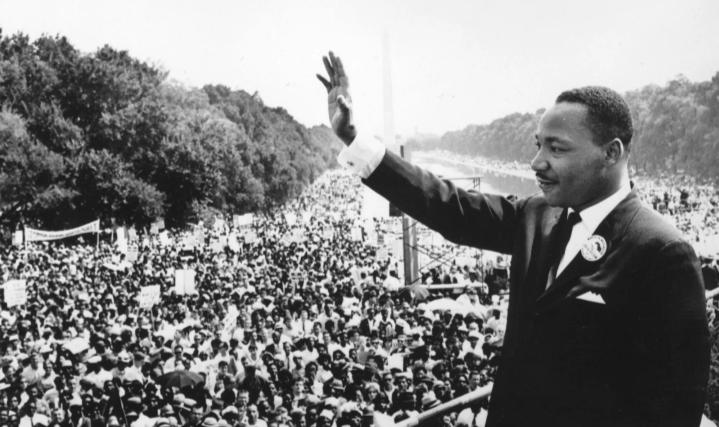
On August 28 1963 King spoke at the March on Washington for Jobs and Freedom.
Standing before the Lincoln Memorial, he delivered his most famous speech. Though prepared remarks were written, he departed from his script when urged to speak about the dream.
The I Have a Dream speech became one of the most iconic addresses in American history. He spoke of a future where people would not be judged by the color of their skin but by the content of their character.
The march drew over 200000 people and placed immense pressure on lawmakers.
Civil Rights Act and Nobel Prize
In 1964 President Lyndon B Johnson signed the Civil Rights Act into law. It outlawed segregation in public places and employment discrimination.
That same year King received the Nobel Peace Prize at the age of thirty five. He donated the prize money to the movement.
Yet even as national recognition grew, opposition intensified.
Selma and Voting Rights
In 1965 King focused on voting rights in Selma Alabama. Peaceful marchers were brutally attacked on the Edmund Pettus Bridge in what became known as Bloody Sunday.
Televised images sparked national outrage.
Eventually, federal protection allowed marchers to complete the journey from Selma to Montgomery.
Later that year, the Voting Rights Act was signed into law.
Expanding the Struggle
After major legal victories, King turned toward economic inequality and opposition to the Vietnam War.
In 1967 he publicly condemned the war, arguing that America could not preach nonviolence abroad while practicing violence at home. This stance alienated many political allies and media supporters.
He also launched the Poor People’s Campaign, seeking economic justice for poor Americans of all races.
King faced criticism from younger activists who believed nonviolence was too slow. The rise of Black Power movements reflected growing frustration.
Surveillance and Controversy
King was monitored by the Federal Bureau of Investigation under Director J Edgar Hoover. The bureau conducted surveillance, wiretapping his phones and attempting to discredit him.
Documents later revealed attempts to expose alleged personal misconduct and pressure him to withdraw from public life.
King struggled privately with stress, exhaustion, and allegations regarding extramarital relationships. These issues became part of historical discussions decades later.
Final Days in Memphis
In early 1968 King traveled to Memphis Tennessee to support striking sanitation workers seeking fair wages and safe conditions.
On April 3 1968 he delivered his final speech at Mason Temple. In what became known as the Mountaintop speech, he declared that he had been to the mountaintop and had seen the promised land. He acknowledged threats against his life but expressed no fear.
The next evening, April 4 1968, King stood on the balcony of the Lorraine Motel. At approximately 6 01 pm he was shot.
He was rushed to the hospital but pronounced dead shortly afterward. He was thirty nine years old.
James Earl Ray was arrested and convicted of the assassination, though debates and investigations into the broader circumstances continued for decades.
Legacy
King’s death sparked riots in cities across the United States.
In the years that followed, he became a symbol not only of civil rights but of moral courage worldwide.
A federal holiday now honors his birthday. His speeches continue to be studied. His philosophy of nonviolence influences movements globally.
Martin Luther King Jr did not live to see all the changes he envisioned. But his leadership reshaped American law and consciousness.
He moved a nation toward justice through disciplined nonviolence, intellectual clarity, and spiritual conviction.
His life was not simple. It was complex, controversial, courageous, and transformative.
He dreamed aloud.
And that dream still echoes.


الأقسام
إقرأ المزيد
Deepika Padukone Deepika Padukone is an Indian actress, model, and film producer. She is one of the most successful and highest paid actresses in Bollywood and is widely known for her powerful performances in Indian cinema. Early Life and Background Deepika Padukone was born on January 5, 1986, in Copenhagen, Denmark. She was raised in Bangalore, India. She comes from a sports...

Tunde Kelani Tunde Kelani is a renowned Nigerian filmmaker, director, cinematographer, and storyteller celebrated for promoting Yoruba culture through film. He is widely regarded as one of the most influential figures in Nollywood, especially in culturally rich and indigenous storytelling. Tunde Kelani was born on February 26, 1948, in Abeokuta, Ogun State, Nigeria. Early Life...
Iran’s parliament has voted in favour of closing the Strait of Hormuz, a critical global oil route, following a series of U.S. airstrikes on key Iranian nuclear facilities. The decision, reported by The Telegraph, marks a sharp escalation in tensions between Tehran and Washington. The Strait of Hormuz handles roughly 20% of global oil and gas shipments and serves as a vital passageway for...

Central African Republic In the very center of the African continent lies a land of rivers, forests, and vast open plains. The Central African Republic is often described as the geographic heart of Africa. Yet beyond its location, its history is filled with powerful kingdoms, colonial hardship, struggle for independence, and an ongoing search for stability. It is a story of...

Resident doctors in the Federal Capital Territory (FCT) have declared an indefinite strike beginning Monday, citing the government’s failure to address their demands despite earlier warnings. In a statement issued late Sunday, the Association of Resident Doctors, FCTA (ARD-FCTA), announced the decision following an Emergency General Meeting on September 14. “The Association of...