


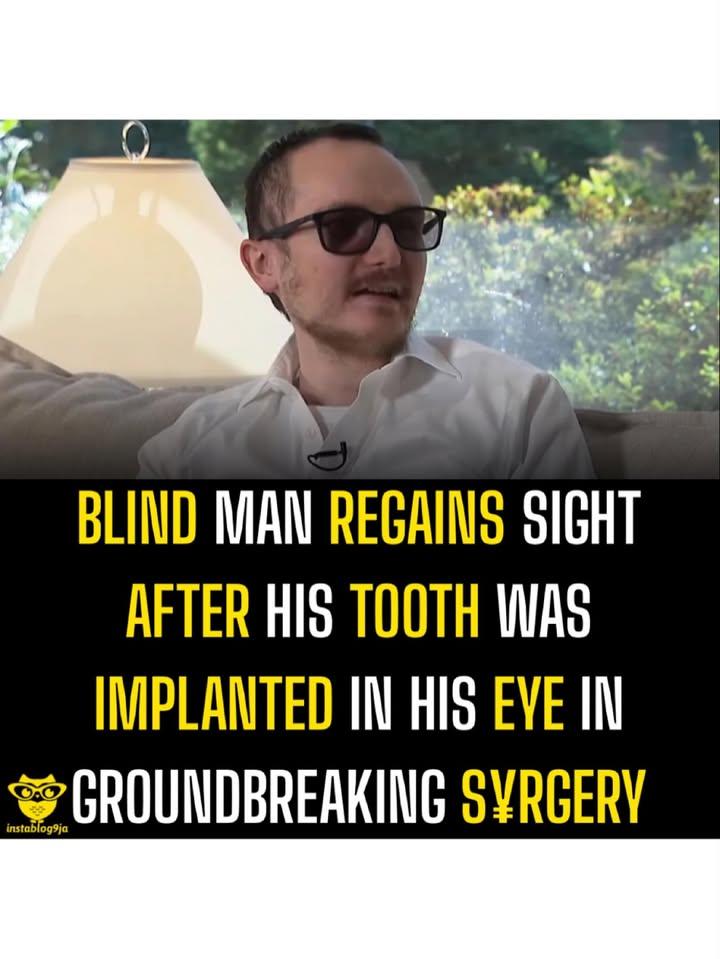
Blind Man Regains Sight After His Tooth Was Implanted in His Eye in Groundbreaking Surgery.
A 34-year-old Canadian man has regained his vision after more than two decades of blindness, thanks to a rare and unusual procedure known as “tooth-in-eye” surgery.
Brent Chapman from North Vancouver lost his sight at age 13 following a rare allergic reaction to ibuprofen, called Stevens-Johnson syndrome, which left him blind in both eyes. For over 20 years, he tried different treatments without lasting success until he met Dr. Greg Moloney, an ophthalmologist at Mount Saint Joseph Hospital in Vancouver.
Dr. Moloney recommended the unconventional “tooth-in-eye” procedure, first developed in the 1960s and performed on only a few hundred people worldwide.
The surgery involves removing a patient’s tooth, flattening it, drilling a small hole, and fitting a prosthetic lens inside. The tooth, carrying the lens, is then implanted in front of the eye, allowing the patient to see. Because it uses the patient’s own tooth, the risk of rejection is significantly reduced.
Chapman admitted he was skeptical at first, saying the idea sounded “like something out of a science fiction movie.” But the results were immediate—he could see his hands moving right after surgery, and once fully healed, his vision improved to 20/30 in the treated eye.
“I feel fantastic. Vision comes back, and it’s a whole new world,” Chapman told WABC after the life-changing procedure.
A 34-year-old Canadian man has regained his vision after more than two decades of blindness, thanks to a rare and unusual procedure known as “tooth-in-eye” surgery.
Brent Chapman from North Vancouver lost his sight at age 13 following a rare allergic reaction to ibuprofen, called Stevens-Johnson syndrome, which left him blind in both eyes. For over 20 years, he tried different treatments without lasting success until he met Dr. Greg Moloney, an ophthalmologist at Mount Saint Joseph Hospital in Vancouver.
Dr. Moloney recommended the unconventional “tooth-in-eye” procedure, first developed in the 1960s and performed on only a few hundred people worldwide.
The surgery involves removing a patient’s tooth, flattening it, drilling a small hole, and fitting a prosthetic lens inside. The tooth, carrying the lens, is then implanted in front of the eye, allowing the patient to see. Because it uses the patient’s own tooth, the risk of rejection is significantly reduced.
Chapman admitted he was skeptical at first, saying the idea sounded “like something out of a science fiction movie.” But the results were immediate—he could see his hands moving right after surgery, and once fully healed, his vision improved to 20/30 in the treated eye.
“I feel fantastic. Vision comes back, and it’s a whole new world,” Chapman told WABC after the life-changing procedure.
Blind Man Regains Sight After His Tooth Was Implanted in His Eye in Groundbreaking Surgery.
A 34-year-old Canadian man has regained his vision after more than two decades of blindness, thanks to a rare and unusual procedure known as “tooth-in-eye” surgery.
Brent Chapman from North Vancouver lost his sight at age 13 following a rare allergic reaction to ibuprofen, called Stevens-Johnson syndrome, which left him blind in both eyes. For over 20 years, he tried different treatments without lasting success until he met Dr. Greg Moloney, an ophthalmologist at Mount Saint Joseph Hospital in Vancouver.
Dr. Moloney recommended the unconventional “tooth-in-eye” procedure, first developed in the 1960s and performed on only a few hundred people worldwide.
The surgery involves removing a patient’s tooth, flattening it, drilling a small hole, and fitting a prosthetic lens inside. The tooth, carrying the lens, is then implanted in front of the eye, allowing the patient to see. Because it uses the patient’s own tooth, the risk of rejection is significantly reduced.
Chapman admitted he was skeptical at first, saying the idea sounded “like something out of a science fiction movie.” But the results were immediate—he could see his hands moving right after surgery, and once fully healed, his vision improved to 20/30 in the treated eye.
“I feel fantastic. Vision comes back, and it’s a whole new world,” Chapman told WABC after the life-changing procedure.
0 Comments
·0 Shares
·356 Views